Critical Events in Anaesthetised Kids Undergoing Tracheal Intubation (CRICKET)—study protocol for an international multicentre prospective observational study
Tom Bennett, Nicola Disma, Thomas Engelhardt, John Fiadjoe, Alexander Fuchs, Annery Garcia-Marcinkiewicz, Dario Gregori, Robert Greif, Walid Habre, Giulia Lorenzoni, Maren Kleine-Brueggeney, Clyde Matava, Cinzia Anna Maria Papappicco, Vinicius Caldeira Quintão, Thomas Riva

TL;DR
The CRICKET study is tracking critical events during tracheal intubation in children across multiple international centers to better understand their incidence and management.
Contribution
This is the first large-scale international multicenter study to systematically observe critical events during pediatric tracheal intubation.
Findings
CRICKET aims to include 105,000 patients to assess the incidence of critical events during tracheal intubation in children.
As of May 2025, around 25,000 patients had been enrolled, with plans to reach 50,000 by the end of 2025.
The study collects detailed data on patient characteristics and airway management techniques.
Abstract
Critical Events in Anaesthetised Kids undergoing Tracheal Intubation (CRICKET) is a prospective, international multicentre observational study with the objective of capturing, assessing, and analysing critical events associated with tracheal intubation in children. CRICKET involves paediatric patients aged 0–16 yr, requiring tracheal intubation, performed by the anaesthesia team for procedures or interventions requiring general anaesthesia, either planned or unplanned. Patient characteristics and airway management techniques are recorded using a dedicated electronic case report form. If one or more critical events associated with airway management occur, a second, more detailed questionnaire will be completed for the follow-up until the patient is discharged or up to a maximum of 30 days. We aim to include 105 000 patients from participating centres disseminated worldwide. Every…
Genes, proteins, chemicals, diseases, species, mutations and cell lines named across the full text — each resolved to its canonical identifier and authoritative record.
Click any figure to enlarge with its caption.
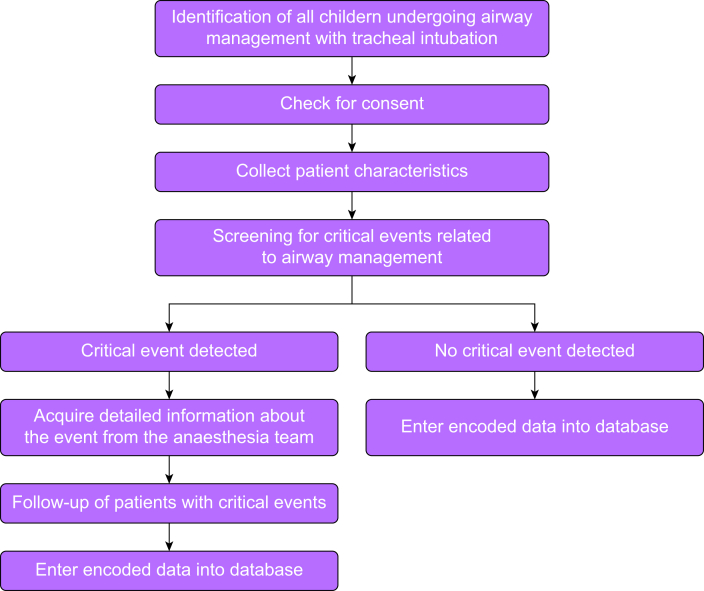 Figure 1
Peer Reviews
No public reviews on file for this paper yet. If you reviewed it on a platform where reviews are public (OpenReview, ICLR, NeurIPS, ICML), you can paste yours below so the community can read it here.
Videos
No videos yet. Explain this paper in a talk, walkthrough, or lecture? Add one.
Taxonomy
TopicsAirway Management and Intubation Techniques · Tracheal and airway disorders · Anesthesia and Sedative Agents