Physics-informed TVAE workflow for data augmentation, mechanical validation, optimization of CFRP-strengthened CFST beams
Muluken Bogale Admasu, Addisu Mengistu Admassu, Tariku Habtamu Biresaw, Abrham Gebre Tarekegn

TL;DR
This paper introduces a physics-informed data augmentation workflow for designing CFRP-strengthened concrete-filled steel tube beams.
Contribution
A novel physics-informed workflow that integrates data augmentation, mechanical validation, and machine learning for structural engineering.
Findings
The workflow generates synthetic datasets that preserve statistical fidelity while enforcing physical constraints.
An open-source software tool is provided to support reproducibility and practical engineering decision-making.
The method enables multi-objective optimization of CFRP configurations using ensemble machine learning.
Abstract
This article presents a reproducible, physics-informed workflow designed to address data scarcity in the analysis and design of carbon fiber-reinforced polymer (CFRP)-strengthened concrete-filled steel tube (CFST) members. Conventional tabular generative models can reproduce statistical trends but cannot ensure that generated samples satisfy the physical, geometric, and material constraints required for structural engineering applications. To overcome this limitation, the proposed method embeds physics-based constraints directly into the data augmentation process and incorporates mechanics-based validation using nonlinear moment-curvature analysis to verify the physical admissibility of synthetic samples. The resulting datasets are suitable for downstream predictive modeling, design optimization, and decision support in data-scarce structural applications. The workflow further…
Genes, proteins, chemicals, diseases, species, mutations and cell lines named across the full text — each resolved to its canonical identifier and authoritative record.
Click any figure to enlarge with its caption.
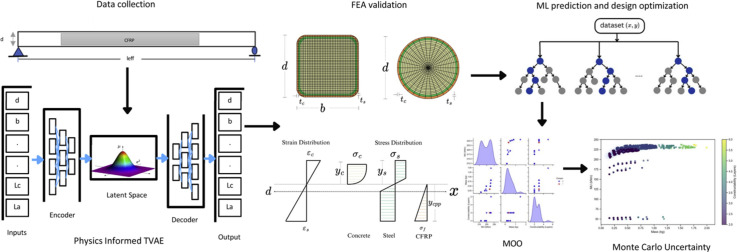 Figure 1
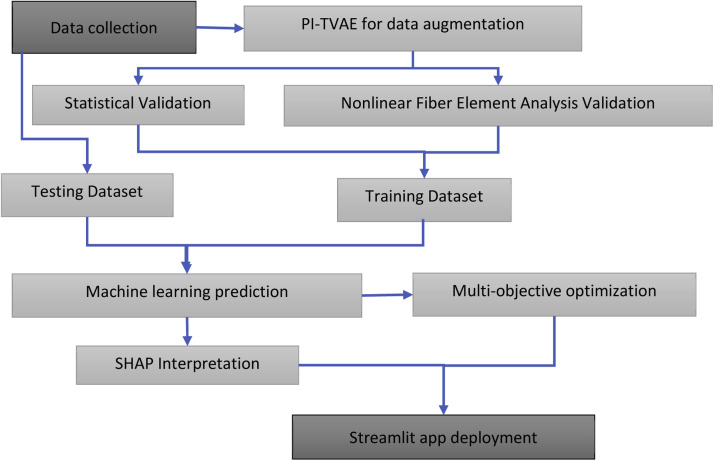 Figure 2
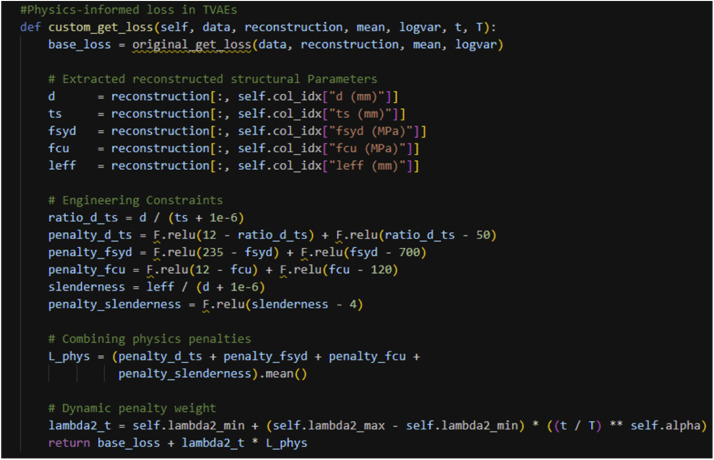 Figure 3
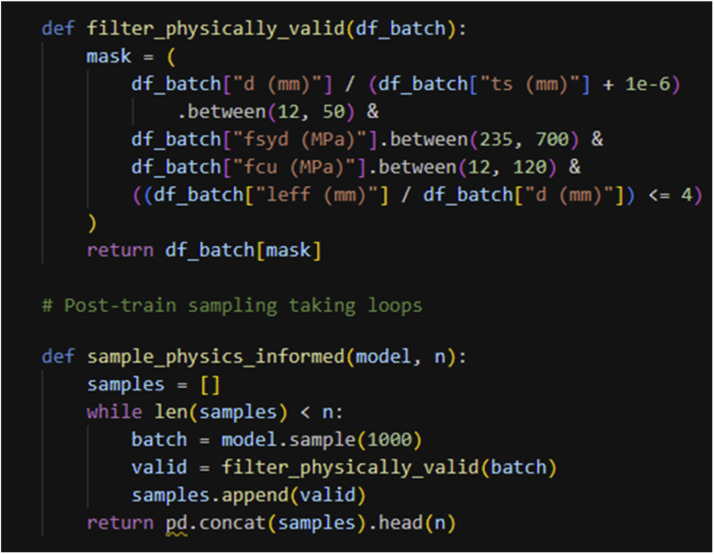 Figure 4
Peer Reviews
No public reviews on file for this paper yet. If you reviewed it on a platform where reviews are public (OpenReview, ICLR, NeurIPS, ICML), you can paste yours below so the community can read it here.
Videos
No videos yet. Explain this paper in a talk, walkthrough, or lecture? Add one.
Taxonomy
TopicsTopology Optimization in Engineering · Model Reduction and Neural Networks · Probabilistic and Robust Engineering Design