A computational approach for intramural length estimation in anomalous aortic origin of a coronary artery
Vikram Shah, Lauren Ferrino, Dana Reaves-O’Neal, Tam T. Doan, Shagun Sachdeva, Craig G. Rusin, Dan Lior, Charles Puelz, Prakash M. Masand, Silvana Molossi

TL;DR
This paper introduces a new computational method to estimate intramural length in a heart condition called anomalous aortic origin of a coronary artery, which could help improve risk assessment and surgical planning.
Contribution
A semi-automatic computational method for estimating intramural length in AAOCA patients, validated against surgical measurements.
Findings
The computational method showed an overall RMSE of 3.4 mm, comparable to radiologic estimates.
For L-AAOCA subjects, the method had lower RMSE than radiologic estimates.
The method is accurate relative to surgical measurements and could aid in risk stratification and surgical planning.
Abstract
Anomalous aortic origin of a coronary artery (AAOCA) is associated with sudden cardiac death. The intramural (IM) length is considered high-risk, yet radiologic measurements by computed tomography angiography (CTA) show variable agreement with measurements at surgery. We aimed to develop a semi-automatic computational method to estimate IM length in a retrospective cohort of surgical AAOCA patients. In 58 patients [49 right(R), 9 left(L)], CTA images were used to generate 3D segmentations of the aorta and a centerline of the anomalous coronary. The distance from the centerline to the aortic segmentation was calculated. The IM length was estimated from a transition point in the derivative of the distance curve and compared to radiologic and surgical measurements. Our method demonstrated an overall root-mean-square error (RMSE) of 3.4 mm, comparable to radiologic estimates (3.2 mm). For…
Genes, proteins, chemicals, diseases, species, mutations and cell lines named across the full text — each resolved to its canonical identifier and authoritative record.
Click any figure to enlarge with its caption.
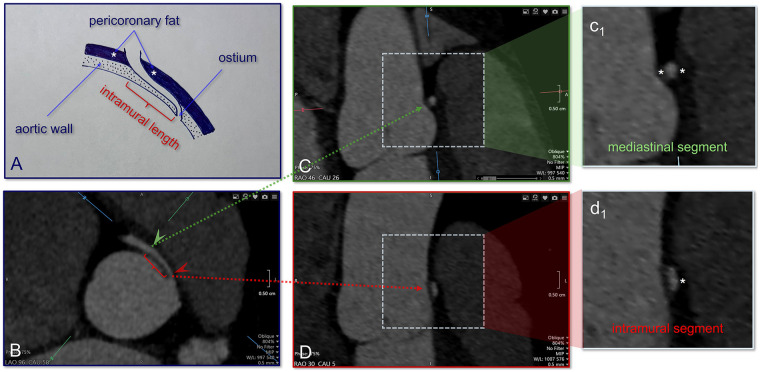 Figure 1
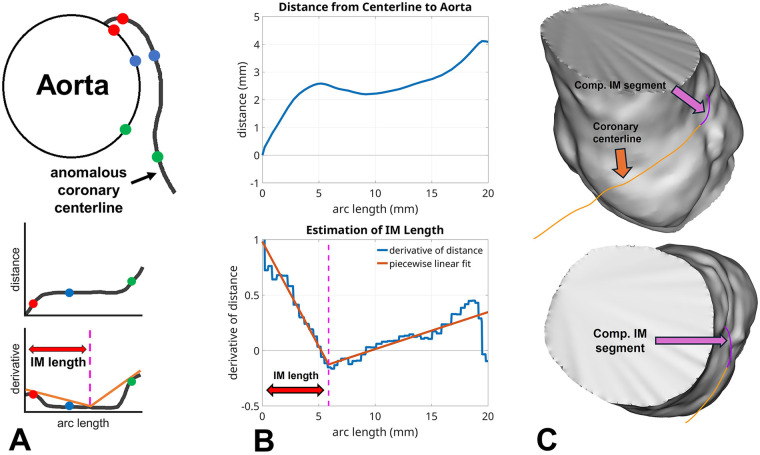 Figure 2
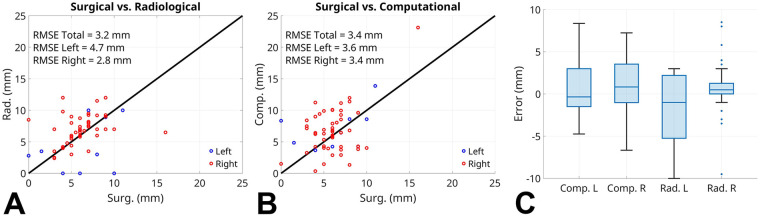 Figure 3
Peer Reviews
No public reviews on file for this paper yet. If you reviewed it on a platform where reviews are public (OpenReview, ICLR, NeurIPS, ICML), you can paste yours below so the community can read it here.
Videos
No videos yet. Explain this paper in a talk, walkthrough, or lecture? Add one.
Taxonomy
TopicsCoronary Artery Anomalies · Congenital Heart Disease Studies · Aortic Disease and Treatment Approaches