Decoding the brain’s ATG8 paralog code: LC3–GABARAP specialization at synapses and the astrocyte–neuron interface
Haneul Choi, Seung-Min Lee, Jin-A. Lee

TL;DR
This paper reviews how different ATG8 proteins specialize in autophagy processes in neurons and astrocytes, impacting brain health and disease.
Contribution
It introduces the concept of an 'ATG8 code' that assigns specific roles to ATG8 paralogs in autophagy within the CNS.
Findings
LC3 and GABARAP have distinct roles in autophagy, with LC3 managing cargo recruitment and GABARAP handling maturation and fusion.
Neurons and astrocytes use autophagy differently, with neurons focusing on synaptic health and astrocytes on metabolic support and debris clearance.
Dysregulation of autophagy in these cells contributes to neurodegenerative diseases and synaptic disorders.
Abstract
Macroautophagy is essential for the long-term health of neurons and astrocytes in the central nervous system (CNS). The six mammalian ATG8 paralogs (LC3A/B/C and GABARAP/GABARAPL1/L2) exhibit an emerging “ATG8 code”—a division of labor among these proteins that assigns specialized roles in the autophagy pathway to each paralog, enabling fine-tuned proteostasis at synapses and the astrocyte–neuron interface. This review synthesizes how LC3 versus GABARAP mediate distinct steps of autophagy (LC3 primarily governs cargo recruitment and phagophore expansion, whereas GABARAP drives autophagosome maturation, transport, and lysosomal fusion) and how these molecular distinctions translate into functional differences in neurons versus astrocytes. Neurons coordinate autophagy across long axons and synapses: presynaptic autophagy clears aging synaptic vesicles and organelles, while postsynaptic…
Genes, proteins, chemicals, diseases, species, mutations and cell lines named across the full text — each resolved to its canonical identifier and authoritative record.
Click any figure to enlarge with its caption.
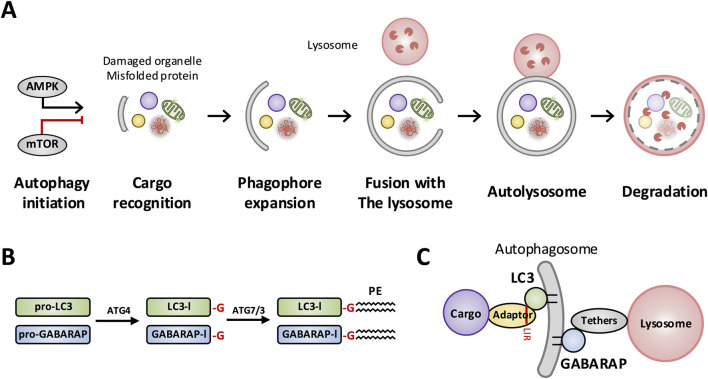 Figure 1
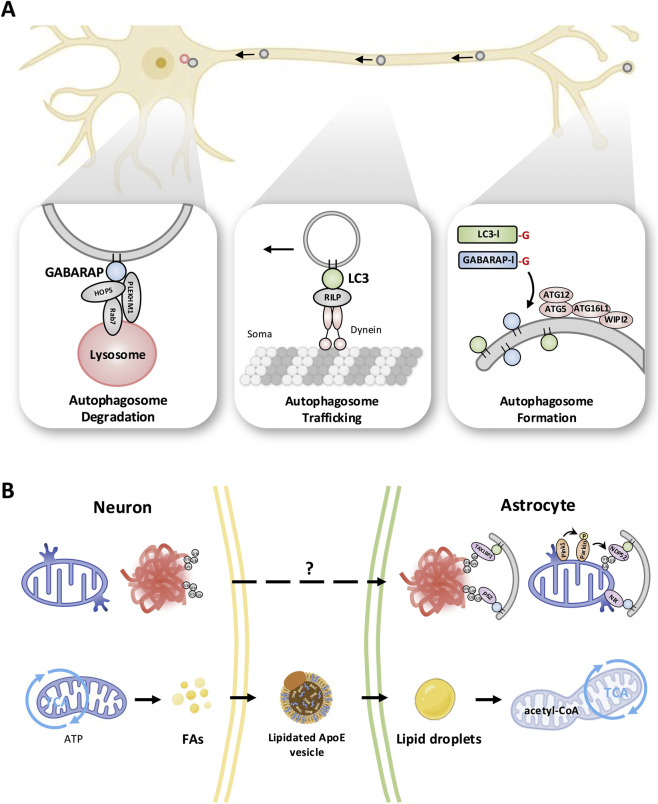 Figure 2
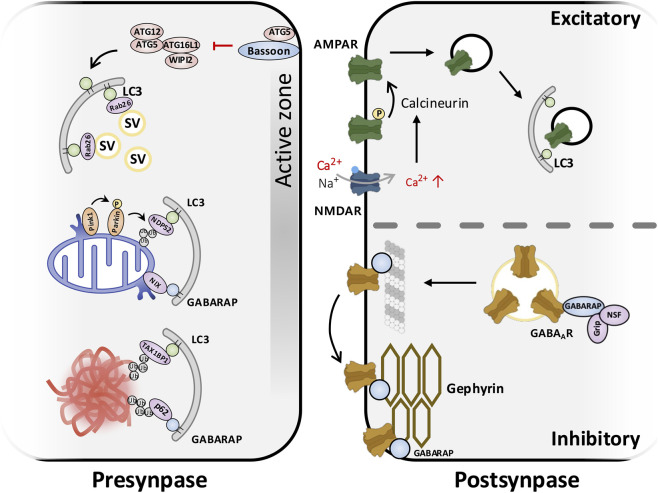 Figure 3
 Figure 4
Peer Reviews
No public reviews on file for this paper yet. If you reviewed it on a platform where reviews are public (OpenReview, ICLR, NeurIPS, ICML), you can paste yours below so the community can read it here.
Videos
No videos yet. Explain this paper in a talk, walkthrough, or lecture? Add one.
Taxonomy
TopicsAutophagy in Disease and Therapy · Alzheimer's disease research and treatments · Neuroscience and Neuropharmacology Research