Heterozygous TREM2 (p.W44X) and PSEN1 (p.A431T) mutations in two Peruvian families with familial Alzheimer’s disease: expanding the genetic landscape in underrepresented populations
Claudio Villegas-Llerena, Solange R. Paredes-Moscosso, María Luisa Guevara-Fujita, Daisy Obispo, Nilton Custodio, Rosa Montesinos, José F. Parodi, Oscar Flores-Flores, John Hardy, Ricardo Fujita

TL;DR
This study identifies two new genetic mutations linked to Alzheimer’s disease in Peruvian families, expanding understanding in underrepresented populations.
Contribution
The study reports the first TREM2 and PSEN1 mutations associated with Alzheimer’s disease in the Peruvian population.
Findings
A heterozygous TREM2 (p.W44X) mutation was found in a Peruvian family with Alzheimer’s disease.
A novel PSEN1 (p.A431T) mutation was identified in another Peruvian family with Alzheimer’s disease.
TREM2 p.W44X is likely pathogenic, while PSEN1 p.A431T is a variant of uncertain significance.
Abstract
Alzheimer’s disease (AD) accounts for up to 70% of all dementia cases, affecting an estimated 23–35 million people worldwide. According to the World Health Organization (WHO), the number of AD cases in Latin America, including Peru, is expected to quadruple by 2050. However, these populations remain underrepresented in research, diagnostics, and care. Early-onset Alzheimer’s disease (EOAD), characterized by symptom onset before the age of 65, has been shown to have a strong genetic component, making it valuable for genetic studies. Identifying EOAD-associated mutations in underrepresented populations is crucial for uncovering pathogenic variants that may provide new insights into the disease’s mechanisms. In this article, we present two Peruvian families with early and late onset AD in whom whole-exome sequencing (WES) revealed heterozygous variants associated with AD. In family AD002,…
Genes, proteins, chemicals, diseases, species, mutations and cell lines named across the full text — each resolved to its canonical identifier and authoritative record.
Click any figure to enlarge with its caption.
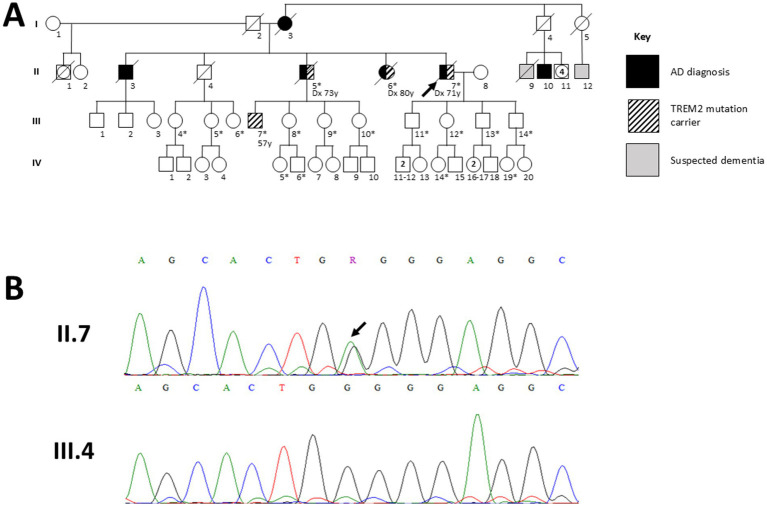 Figure 1
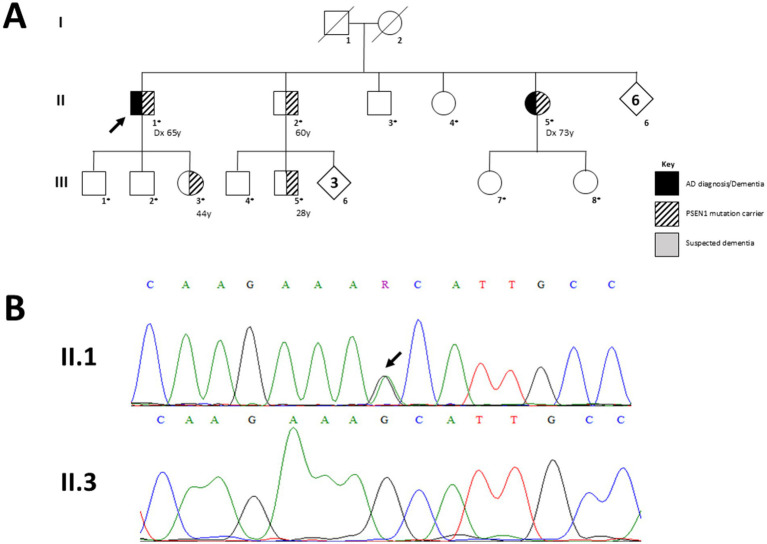 Figure 2
Peer Reviews
No public reviews on file for this paper yet. If you reviewed it on a platform where reviews are public (OpenReview, ICLR, NeurIPS, ICML), you can paste yours below so the community can read it here.
Videos
No videos yet. Explain this paper in a talk, walkthrough, or lecture? Add one.
Taxonomy
TopicsNeuroinflammation and Neurodegeneration Mechanisms · Alzheimer's disease research and treatments · Dementia and Cognitive Impairment Research