Soluble immune checkpoint proteins as predictive biomarkers for lymph node metastases in penile cancer
Dominik Glombik, Jessica Carlsson, Peter Kirrander, Sabina Davidsson

TL;DR
This study investigates whether soluble immune checkpoint proteins can predict lymph node metastases in penile cancer, finding limited predictive value but evidence of immune suppression in cancer patients.
Contribution
The study is the first to explore soluble immune checkpoint proteins as potential biomarkers for lymph node metastases in penile cancer.
Findings
A prediction model using 14 soluble immune checkpoint proteins achieved 77.5% accuracy in the training set but only 62.2% in the test set.
Four inhibitory soluble immune checkpoint proteins were significantly elevated in penile cancer patients compared to cancer-free controls.
The study found no strong evidence that these proteins can predict lymph node metastases in penile cancer.
Abstract
Penile cancer (PeCa) is a rare but aggressive disease where lymph node metastases (LNM) represent the most significant prognostic factor. Accurate identification of LNM remains a clinical priority, but traditional imaging and clinical parameters often fail to detect occult LNM. Soluble immune checkpoint proteins (sICs) have recently emerged as potential non-invasive biomarkers in various malignancies, although unexplored in PeCa. The primary aim of this study was to explore the value of a panel of 14 sICs for predicting LNM in PeCa. The secondary aim was to compare plasma sIC levels between PeCa patients and cancer-free controls. Using ProcartaPlex immunoassays, BTLA, IDO, LAG-3, HVEM, PD-1, PD-L1, PD-L2, TIM-3, CD80, CTLA-4, GITR, CD27, CD28, and CD137 were measured in plasma from 284 PeCa patients and 45 cancer-free controls. PeCa patients were divided into a training set (n=202) and…
Genes, proteins, chemicals, diseases, species, mutations and cell lines named across the full text — each resolved to its canonical identifier and authoritative record.
Click any figure to enlarge with its caption.
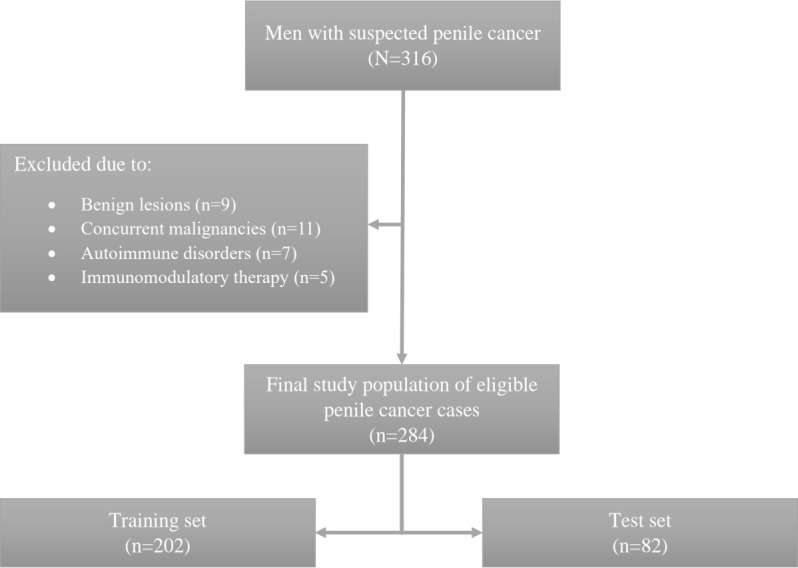 Figure 1
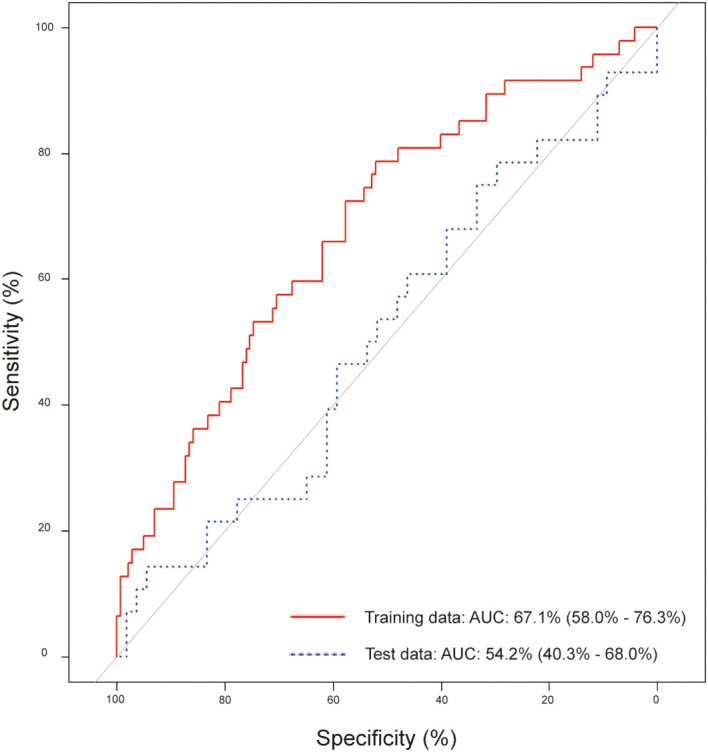 Figure 2
Peer Reviews
No public reviews on file for this paper yet. If you reviewed it on a platform where reviews are public (OpenReview, ICLR, NeurIPS, ICML), you can paste yours below so the community can read it here.
Videos
No videos yet. Explain this paper in a talk, walkthrough, or lecture? Add one.
Taxonomy
TopicsGenital Health and Disease · Cancer Immunotherapy and Biomarkers · Dupuytren's Contracture and Treatments