Gestational Age‐Dependent Effects of Antenatal Magnesium Sulfate on Fetal S100B Levels: An Observational Study Using Cord Serum
Takuma Shimaya, Kazuya Fuma, Sho Tano, Seiko Matsuo, Takafumi Ushida, Kenji Imai, Hiroaki Kajiyama, Tomomi Kotani

TL;DR
This study finds that magnesium sulfate given to mothers before 30 weeks of pregnancy does not raise fetal S100B levels, but it does so after 30 weeks, suggesting a gestational age-dependent effect.
Contribution
The study reveals a gestational age-dependent effect of antenatal magnesium sulfate on fetal S100B levels, a potential biomarker of neural distress.
Findings
MgSO4 was associated with higher S100B levels in fetuses delivered at ≥30 weeks, but not in those delivered before 30 weeks.
S100B levels showed a gestational age-dependent increase in response to MgSO4, peaking around 32 weeks.
The association remained consistent across multiple sensitivity analyses.
Abstract
Magnesium sulfate (MgSO4) is widely used for fetal neuroprotection in preterm births before 32 weeks of gestation, yet it remains unclear whether its effect depends on gestational age. S100 calcium‐binding protein B (S100B), a protein secreted by astrocytes, is recognized as a biomarker of neural distress. This study aimed to investigate the relationship between antenatal MgSO4 administration and umbilical cord serum S100B levels, with a focus on gestational age. This retrospective study included women who delivered between 22+0 and 33+6 weeks of gestation at a tertiary center. Patients with hypertensive disorders of pregnancy, category 1 cesarean sections, multiple pregnancies, major congenital anomalies, or insufficient MgSO4 administration were excluded. Cord blood samples were analyzed for S100B levels using ELISA. Multiple linear regression and restricted cubic spline modeling…
Genes, proteins, chemicals, diseases, species, mutations and cell lines named across the full text — each resolved to its canonical identifier and authoritative record.
Click any figure to enlarge with its caption.
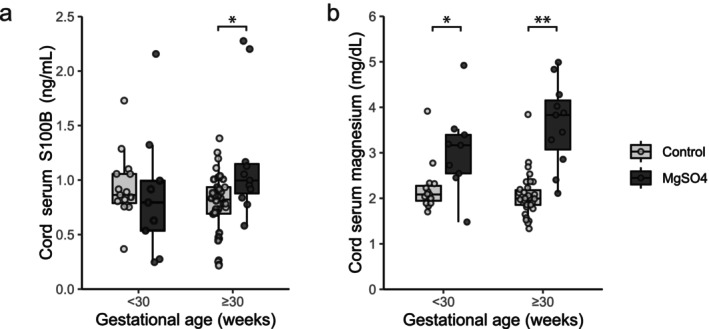 Figure 1
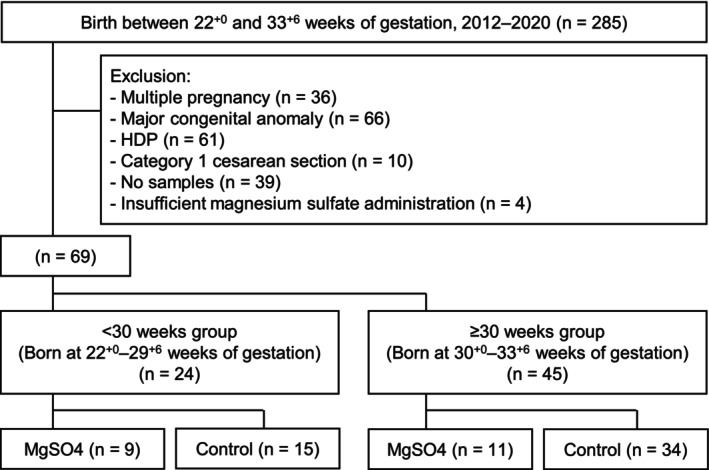 Figure 2
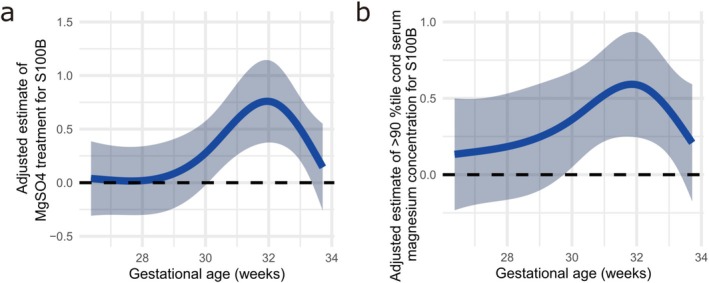 Figure 3
Peer Reviews
No public reviews on file for this paper yet. If you reviewed it on a platform where reviews are public (OpenReview, ICLR, NeurIPS, ICML), you can paste yours below so the community can read it here.
Videos
No videos yet. Explain this paper in a talk, walkthrough, or lecture? Add one.
Taxonomy
TopicsPreterm Birth and Chorioamnionitis · S100 Proteins and Annexins · Pregnancy-related medical research