Developing a concise multivariable predictive model for cesarean delivery following neuraxial analgesia during labor: a prospective observational cohort study
Paula Daniele Lopes da Costa, Murilo Henrique da Veiga Ferreira, Joelcio Francisco Abbade, Claudia Garcia Magalhães, Norma Sueli Pinheiro Módolo, Guilherme Antonio Moreira de Barros, Gabriel Ricardo Correa Turco, Pedro Henrique Esteves Trindade, Paulo do Nascimento Junior

TL;DR
This study identifies factors that predict cesarean delivery after neuraxial analgesia during labor, finding age, analgesia duration, and oxytocin use as key predictors.
Contribution
The study develops a concise predictive model for cesarean delivery following neuraxial analgesia using a prospective observational cohort.
Findings
28.4% of parturients receiving neuraxial analgesia underwent cesarean delivery.
Older age, longer analgesia duration, and no oxytocin use after analgesia initiation were significant predictors of cesarean.
Arrest of descent and fetal distress were the most common reasons for cesarean delivery.
Abstract
Sometimes, planned vaginal deliveries with neuraxial analgesia may result in unplanned cesareans. We aimed to determine the incidence of cesarean among parturients receiving neuraxial analgesia for vaginal delivery, identify associated factors, and develop a predictive model. In this prospective observational cohort study, we evaluated parturients receiving neuraxial analgesia for vaginal delivery and analyzed factors associated with progression to cesarean. Multiple logistic regression with a step-up procedure was performed. The dataset was split into training (70%) and testing (30%) databases, with the latter used to assess performance metrics. Bootstrap validation with 5,000 repetitions was performed. We evaluated 331 parturients and 94 (28.4%) underwent cesarean. Variables differing between cesarean and vaginal delivery groups (p < 0.05) included patient age, body mass index,…
Genes, proteins, chemicals, diseases, species, mutations and cell lines named across the full text — each resolved to its canonical identifier and authoritative record.
Click any figure to enlarge with its caption.
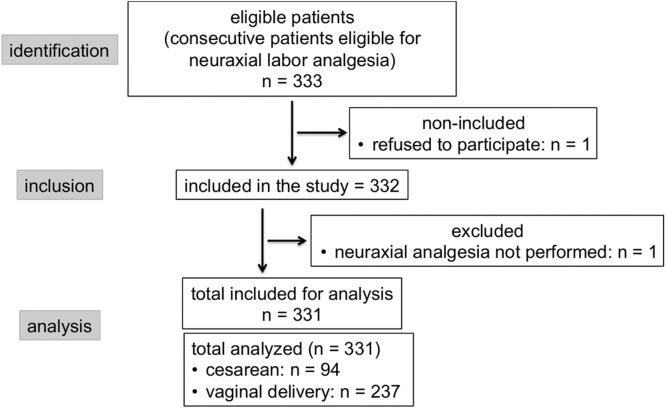 Figure 1
Peer Reviews
No public reviews on file for this paper yet. If you reviewed it on a platform where reviews are public (OpenReview, ICLR, NeurIPS, ICML), you can paste yours below so the community can read it here.
Videos
No videos yet. Explain this paper in a talk, walkthrough, or lecture? Add one.
Taxonomy
TopicsAnesthesia and Pain Management · Maternal and Perinatal Health Interventions · Enhanced Recovery After Surgery