Conscious experience and emotion: an attention-based account
Giorgio Marchetti

TL;DR
The paper explains how emotions arise from attention-based consciousness, linking emotional experiences to shifts in self-awareness and internal balance.
Contribution
It introduces a novel attention-based theory of consciousness (AME theory) that connects emotional experiences to modulation of attentional energy.
Findings
Emotions emerge from interactions between core affect, appraisal processes, and physiological responses.
Emotional experiences result from shifts in attention that activate self-related areas of attention.
Emotions help monitor and reconstruct the sense of self through conscious and unconscious processing cycles.
Abstract
This article aims to explain how emotions arise and operate within the framework of my attention-based theory of consciousness, referred to here as the AME theory of consciousness (Attentional Modulation of Energy). According to the AME theory of consciousness, the phenomenal aspect of consciousness is produced by the modulation of the energy level of the area of the organ of attention (aOA) that underpins our attentional activity. The phenomenal aspect of consciousness, in turn, provides us with a sense of self and informs us about how our activities affect it. It manifests through five main dimensions—qualitative, quantitative, hedonic, temporal, and spatial—each of which can be explained by a specific aspect of the modulation of the energy level of the aOA. Emotions, which represent some of the most informative forms of conscious experience, emerge from the interaction of three main…
Click any figure to enlarge with its caption.
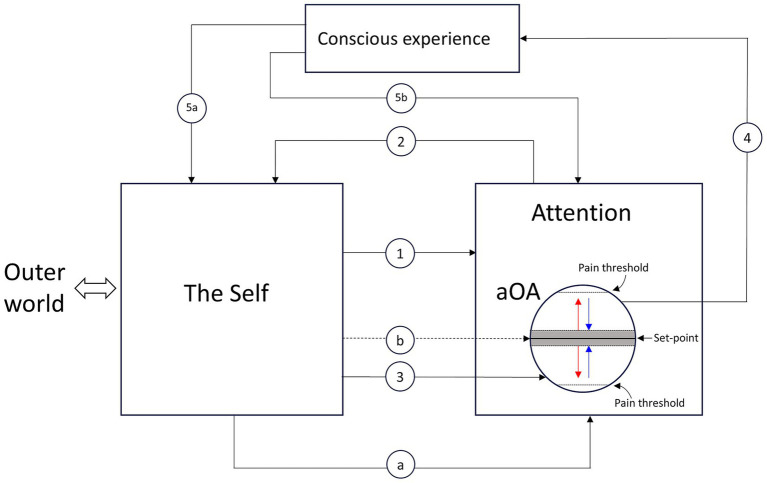 Figure 1
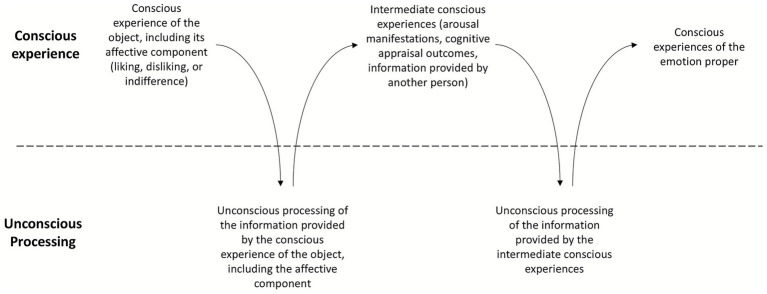 Figure 2
Peer Reviews
No public reviews on file for this paper yet. If you reviewed it on a platform where reviews are public (OpenReview, ICLR, NeurIPS, ICML), you can paste yours below so the community can read it here.
Videos
No videos yet. Explain this paper in a talk, walkthrough, or lecture? Add one.
Taxonomy
TopicsEmotions and Moral Behavior · Embodied and Extended Cognition · Action Observation and Synchronization