Episodic future thinking modulates delay discounting in individuals with problematic substance use: a narrative review
Xiwen Chen, Huanxin Wang, Cong Fan

TL;DR
A review shows that imagining future scenarios can reduce impulsive behavior linked to substance use disorders.
Contribution
The paper highlights how episodic future thinking may reduce impulsivity in individuals with substance use disorders.
Findings
Episodic future thinking (EFT) reduces delay discounting in individuals with substance use disorder.
EFT may work by extending the temporal window and lowering the construal level of future events.
Future research should explore emotional valence and neural mechanisms of EFT in impulsivity.
Abstract
Substance use disorder (SUD) poses significant challenges to public health, the economy, and social safety. Delay discounting (DD) is one form of impulsivity which is a risk factor for SUD and other mental health disorders. Moreover, when faced with immediate rewards, individuals with SUD exhibit increased DD compared to healthy controls. Fortunately, previous studies have shown that EFT, referring to vividly imagining potential future events in specific scenarios based on an individual’s current experiences, can effectively reduce DD and substance use in individuals with SUD. In this process, the potential regulatory mechanism of EFT may involve extending the temporal window and decreasing the construal level of future events. Most promising avenues to pursue in future studies may include manipulating participants’ factors (e.g., sample size, adherence to diagnostic criteria,…
Genes, proteins, chemicals, diseases, species, mutations and cell lines named across the full text — each resolved to its canonical identifier and authoritative record.
Click any figure to enlarge with its caption.
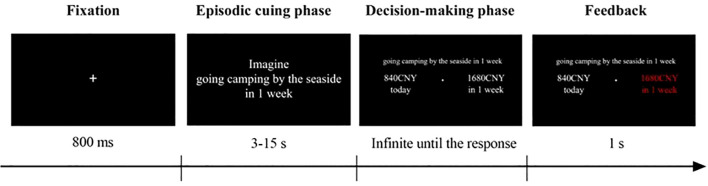 Figure 1
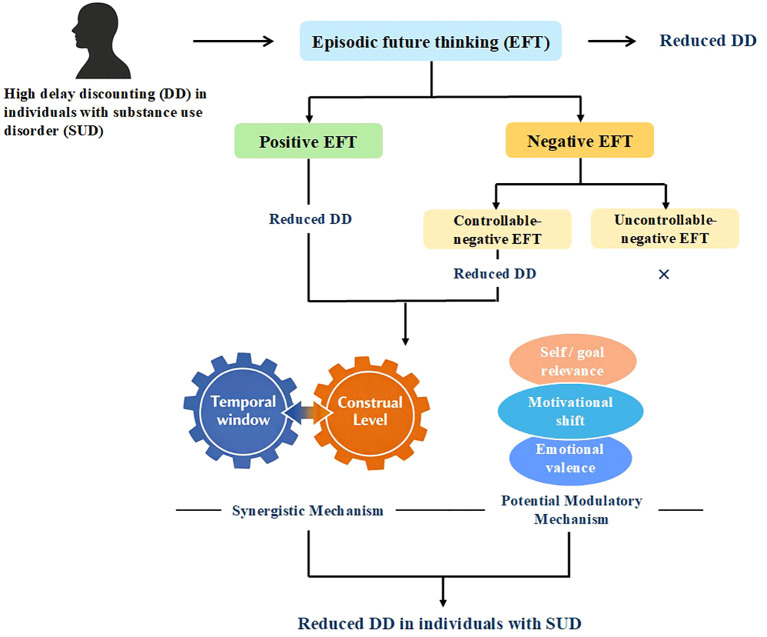 Figure 2
Peer Reviews
No public reviews on file for this paper yet. If you reviewed it on a platform where reviews are public (OpenReview, ICLR, NeurIPS, ICML), you can paste yours below so the community can read it here.
Videos
No videos yet. Explain this paper in a talk, walkthrough, or lecture? Add one.
Taxonomy
TopicsDecision-Making and Behavioral Economics · Behavioral Health and Interventions · Psychological and Temporal Perspectives Research