Spectral discrimination of pediatric SF188 and adult glioblastoma stem cells by deep learning–enhanced Raman profiling
Lennard M. Wurm, Björn Fischer, Volker Neuschmelting, Roland Goldbrunner, Roland S. Croner, Michal W. Jagielski, Dominik Laue, Wolfgang Ertel, Michael C. Hacker, Jakub Dybaś, Ulf D. Kahlert

TL;DR
This study shows that Raman spectroscopy combined with deep learning can distinguish pediatric and adult glioblastoma cells based on their biochemical profiles.
Contribution
The novel use of deep learning-enhanced Raman spectroscopy for non-invasive, label-free discrimination of pediatric and adult glioblastoma stem cells.
Findings
The deep learning model achieved 83.6% accuracy and 0.855 ROC AUC in differentiating pediatric and adult GBM.
Distinct vibrational modes in lipid, protein, and nucleic acid content were identified between age groups.
The model showed high sensitivity for pediatric GBM with a 91.4% identification rate.
Abstract
Pediatric and adult glioblastomas (GBM) represent biologically distinct entities requiring age-tailored therapeutic strategies. However, rapid and non-invasive methods to distinguish these molecular subtypes remain an unmet clinical need. This study evaluates the potential of confocal Raman spectroscopy combined with deep learning as a label-free diagnostic tool to differentiate pediatric from adult GBM based on intrinsic biochemical fingerprints. We acquired n=1,382 Raman spectra from a cohort of six patient-derived GBM neurosphere cell lines, comprising a pediatric model (SF188) and five adult-origin lines. A multilayer perceptron (MLP) neural network was trained to classify spectra by age group. To ensure rigorous validation and generalizability, performance was assessed on a strictly held-out external test set (20% of data), completely excluded from model optimization. The deep…
Genes, proteins, chemicals, diseases, species, mutations and cell lines named across the full text — each resolved to its canonical identifier and authoritative record.
Click any figure to enlarge with its caption.
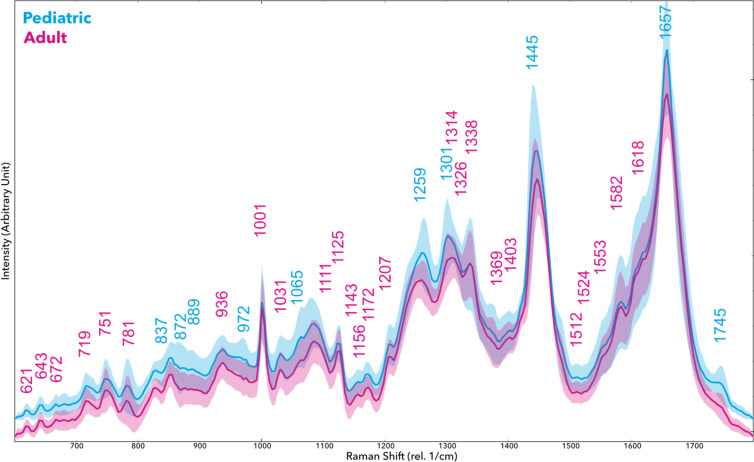 Figure 1
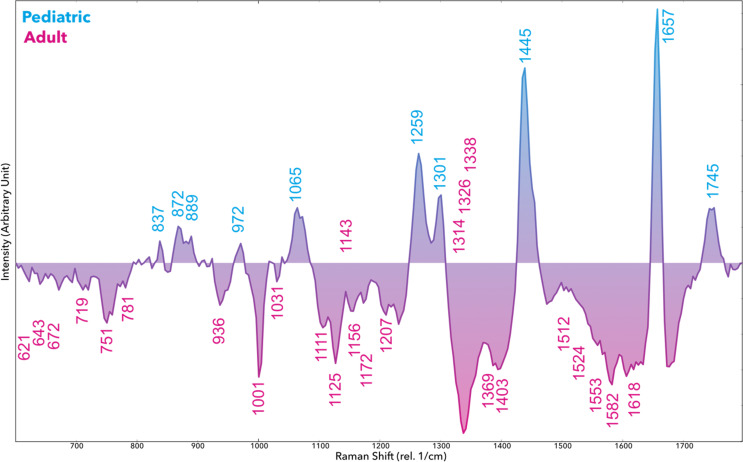 Figure 2
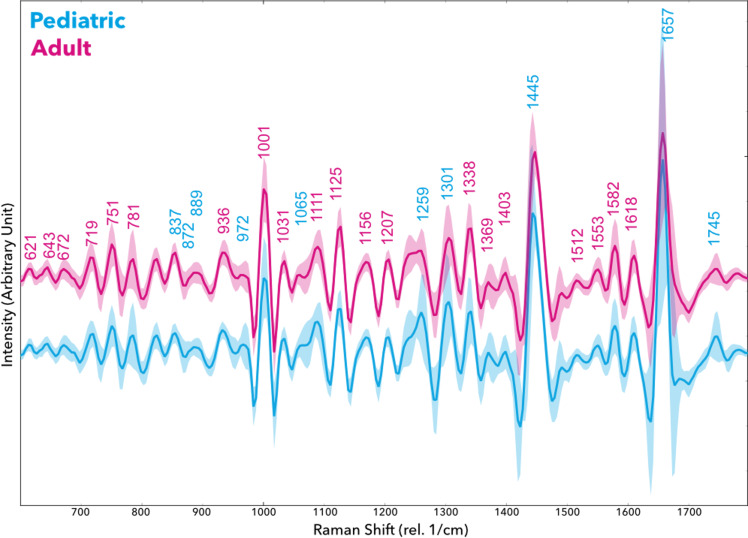 Figure 3
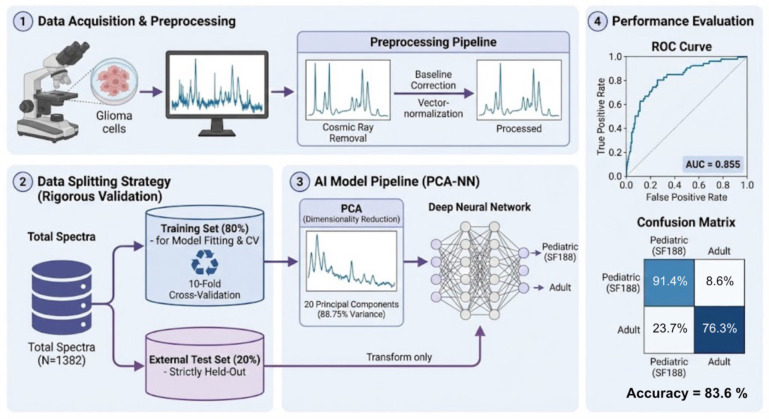 Figure 4
Peer Reviews
No public reviews on file for this paper yet. If you reviewed it on a platform where reviews are public (OpenReview, ICLR, NeurIPS, ICML), you can paste yours below so the community can read it here.
Videos
No videos yet. Explain this paper in a talk, walkthrough, or lecture? Add one.
Taxonomy
TopicsSpectroscopy Techniques in Biomedical and Chemical Research · Optical Imaging and Spectroscopy Techniques · Spectroscopy and Chemometric Analyses