Embodied simulation, body language, and symbolization: understanding somatic symptoms in psychoanalysis
Elena Markova, Gabriel Enache

TL;DR
This paper explores how somatic symptoms in psychoanalysis arise from failures in symbolization and communication, using embodied simulation and clinical examples.
Contribution
The paper introduces a novel integration of embodied simulation theory and clinical vignettes to explain somatic symptoms and intercorporeality in therapy.
Findings
Somatic symptoms emerge from failures in mentalization and symbolization, manifesting as bodily distress.
Therapeutic interactions involving somatic enactments can be understood through intersubjective communication and embodied simulation.
AI lacks bodily resonance, making it unsuitable as a substitute for human-based therapeutic processes.
Abstract
Classical psychoanalysis has traditionally focused on uncovering unconscious conflicts through language—the so-called `talking cure`. However, contemporary research underscores the importance of embodied simulation, body language, and their symbolic representation in understanding and addressing patient’s somatic symptoms. This occurs particularly when individuals seeking psychological help are unable to use spoken words to express their feelings, which is why communication between patient and therapist takes place at a pre-verbal level, within the space of “intercorporeality.” In this paper we explore the interplay between early development, mentalization, language acquisition and somatic disorders as failures of symbolization that manifest in bodily distress. In psychoanalytic psychotherapy these processes can be studied as transference-countertransference interactions. We describe…
Genes, proteins, chemicals, diseases, species, mutations and cell lines named across the full text — each resolved to its canonical identifier and authoritative record.
Click any figure to enlarge with its caption.
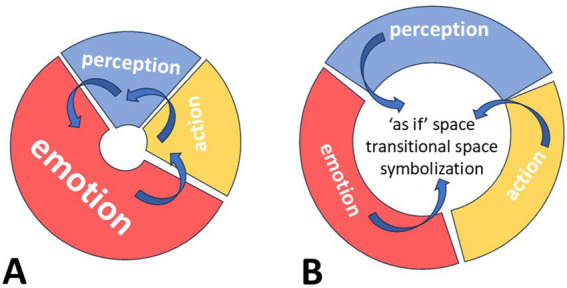 Figure 1
Peer Reviews
No public reviews on file for this paper yet. If you reviewed it on a platform where reviews are public (OpenReview, ICLR, NeurIPS, ICML), you can paste yours below so the community can read it here.
Videos
No videos yet. Explain this paper in a talk, walkthrough, or lecture? Add one.
Taxonomy
TopicsPsychotherapy Techniques and Applications · Action Observation and Synchronization · Mental Health and Psychiatry