Association of intrinsic capacity and neighborhood environment with dementia risk: an interaction and mediation analysis
Shuanglong Hou, Jing Luo, Rui Liu, Xueqiang Wang

TL;DR
This study explores how personal health and neighborhood conditions together influence dementia risk, finding that both factors independently increase risk and that personal health partially explains the impact of poor neighborhoods.
Contribution
The study reveals that intrinsic capacity partially mediates the relationship between neighborhood environments and dementia risk, offering new insights into combined individual and environmental risk factors.
Findings
Each 1-point increase in intrinsic capacity impairment score raises dementia risk by 26%.
Moderate- and high-risk neighborhoods independently increase dementia risk by 26% and 41%, respectively.
Adverse neighborhood effects on dementia risk are partially explained by intrinsic capacity impairments.
Abstract
While intrinsic capacity (IC) impairment and adverse neighborhood environments are established independent risk factors for dementia, their interaction effects and potential mediating pathways remain poorly understood. This study aimed to examine the independent, interactive, and mediating associations of IC, neighborhood environment, and dementia risk among middle-aged and older adults. We analyzed data from 8,107 adults aged 50+ in the China Health and Retirement Longitudinal Study (2011–2020). IC was quantified using a composite impairment score encompassing locomotor, cognitive, sensory, psychological, and vitality domains. Neighborhood environment was classified by resource availability and social provisions (low risk; moderate risk; high risk). Cox proportional hazards models evaluated associations between IC, neighborhood environment, and dementia risk. The four-way…
Genes, proteins, chemicals, diseases, species, mutations and cell lines named across the full text — each resolved to its canonical identifier and authoritative record.
Click any figure to enlarge with its caption.
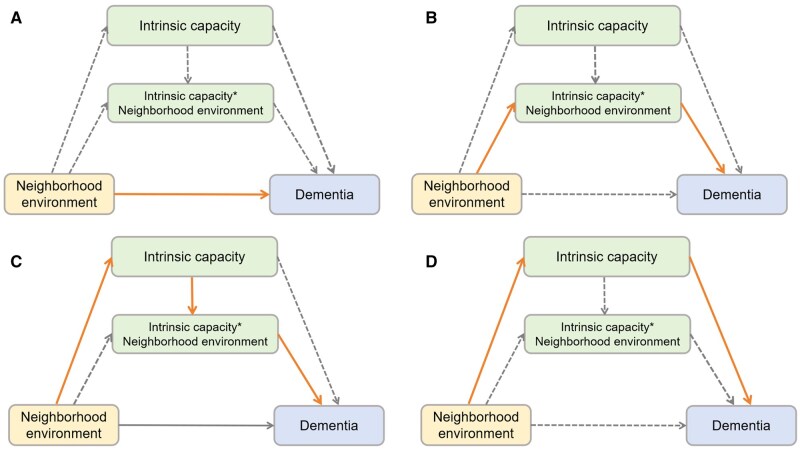 Figure 1
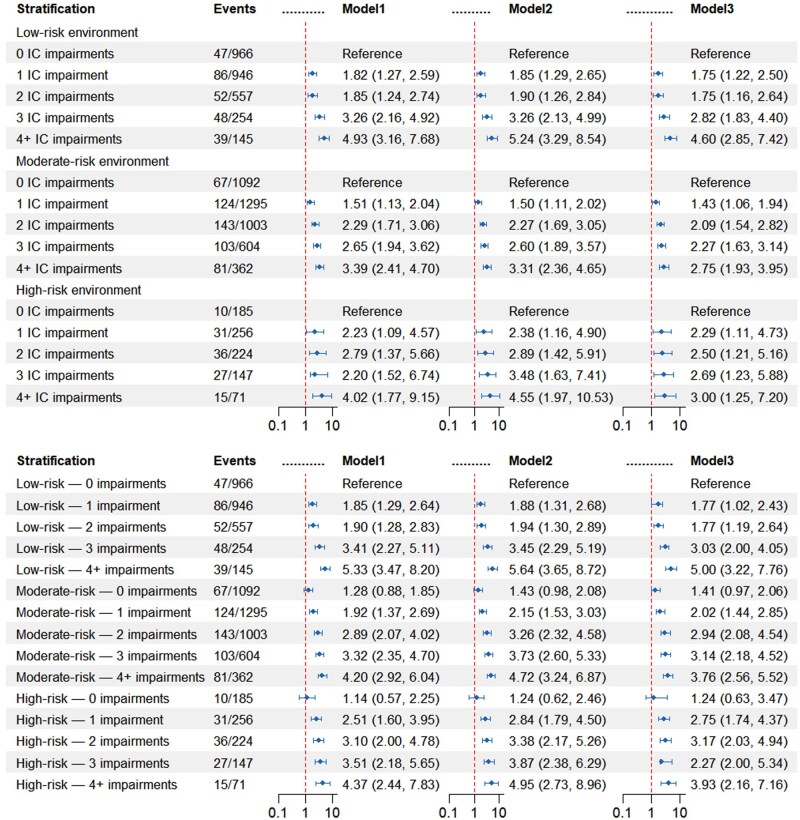 Figure 2
Peer Reviews
No public reviews on file for this paper yet. If you reviewed it on a platform where reviews are public (OpenReview, ICLR, NeurIPS, ICML), you can paste yours below so the community can read it here.
Videos
No videos yet. Explain this paper in a talk, walkthrough, or lecture? Add one.
Taxonomy
TopicsDementia and Cognitive Impairment Research · Older Adults Driving Studies · Health disparities and outcomes