Pathogenic Variants and Olipudase Alfa Treatment of Patients With Acid Sphingomyelinase Deficiency in Taiwan
Hsu‐Heng Lin, Hui‐An Chen, Shyh‐Jer Lin, Rai‐Hseng Hsu, Ni‐Chung Lee, Wuh‐Liang Hwu, Yen‐Hsuan Ni, Yen‐Yin Chou, Pao‐Chin Chiu, Steven Shinn‐Forng Peng, Yin‐Hsiu Chien

TL;DR
This study examines genetic variants and treatment outcomes in Taiwanese patients with acid sphingomyelinase deficiency, highlighting the effectiveness of olipudase alfa, especially when treatment starts early.
Contribution
The study identifies specific SMPD1 variants in Taiwanese ASMD patients and demonstrates clinical benefits of olipudase alfa treatment initiated in early childhood.
Findings
The SMPD1 c.1497_1498inv variant was found in 62.5% of chronic neurovisceral ASMD alleles.
Olipudase alfa treatment improved pulmonary function and other clinical features in patients, especially when started early.
Newborn screening using the NeoLSD MS/MS kit helped detect ASMD cases with partial presentations.
Abstract
Acid sphingomyelinase deficiency (ASMD) is a rare lysosomal disorder with diverse clinical presentations and often delayed diagnosis. This study investigates the clinical features, genetic variants, and treatment outcomes in Taiwanese patients. We retrospectively reviewed nine ASMD cases in Taiwan, including genetic data and responses to olipudase alfa. Newborn screening data using the NeoLSD MS/MS kit for dried blood spot enzyme activity, followed by lyso‐sphingomyelin and molecular testing, were also analysed. The SMPD1 c.1497_1498inv variant was found in 62.5% of alleles among chronic neurovisceral ASMD cases, while c.995C > G appeared in 37.5% of chronic visceral ASMD cases and was also frequent in partial ASMD from newborn screening. Four patients received olipudase alfa; Patient 1, treated for 3 years starting at age 41, showed improved pulmonary function despite persistent…
Genes, proteins, chemicals, diseases, species, mutations and cell lines named across the full text — each resolved to its canonical identifier and authoritative record.
Click any figure to enlarge with its caption.
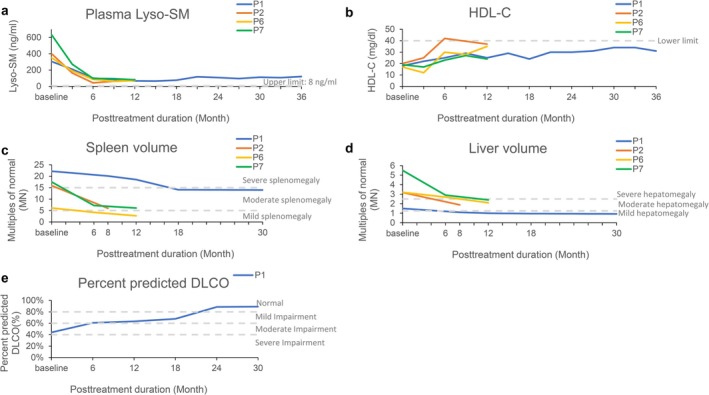 Figure 1
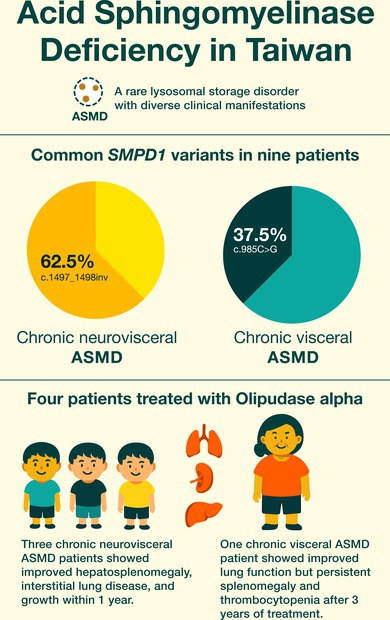 Figure 2
Peer Reviews
No public reviews on file for this paper yet. If you reviewed it on a platform where reviews are public (OpenReview, ICLR, NeurIPS, ICML), you can paste yours below so the community can read it here.
Videos
No videos yet. Explain this paper in a talk, walkthrough, or lecture? Add one.
Taxonomy
TopicsLysosomal Storage Disorders Research · Sphingolipid Metabolism and Signaling · Biomedical Research and Pathophysiology