Refining Alzheimer's disease biological diagnosis with plasma biomarkers: Resolving p‐tau217 “gray zone” with p‐tau181 integration
Giulia Giacomucci, Silvia Maria Rita Tabbì, Assunta Ingannato, Silvia Bagnoli, Sonia Padiglioni, Chiara Crucitti, Chiara Sensi, Serena Sanesi, Valentina Moschini, Carmen Morinelli, Giulia Galdo, Valentina Berti, Benedetta Nacmias, Valentina Bessi

TL;DR
Researchers found that combining two blood biomarkers improves Alzheimer's diagnosis, especially for cases with unclear results.
Contribution
The study introduces a sequential plasma biomarker strategy to resolve diagnostic uncertainty in Alzheimer's disease.
Findings
Plasma p-tau217 showed the highest accuracy for detecting AD pathology.
A two-cutoff strategy for p-tau217 improved diagnostic reliability.
p-tau181 resolved 77.4% of intermediate p-tau217 cases.
Abstract
Blood‐based biomarkers offer a less invasive and more scalable alternative to cerebrospinal fluid (CSF) analysis and amyloid‐positron emission tomography (PET) for the biological diagnosis of Alzheimer's disease (AD). Among blood‐based biomarkers (BBMs), plasma phosphorylated tau217 (p‐tau217) has shown the highest accuracy, although intermediate (“gray zone”) values remain challenging to interpret. In this study, 401 individuals across the Alzheimer's Disease (AD) continuum (Subjective Cognitive Decline, Mild Cognitive Impairment, and AD dementia) underwent clinical and biomarker assessment. Plasma p‐tau217, p‐tau181, neurofilament light chain (NfL), and glial fibrillary acidic protein (GFAP) were measured. Core1 status was defined through CSF or amyloid‐PET. Plasma p‐tau217 demonstrated the strongest discrimination of Core1 positivity (area under the curve [AUC] = 0.95) and showed…
Genes, proteins, chemicals, diseases, species, mutations and cell lines named across the full text — each resolved to its canonical identifier and authoritative record.
Click any figure to enlarge with its caption.
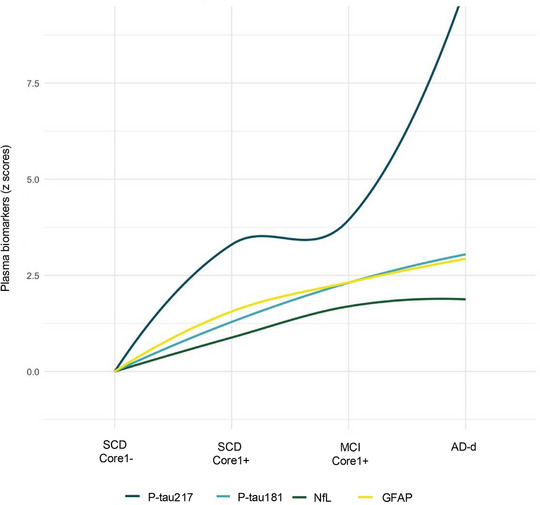 Figure 1
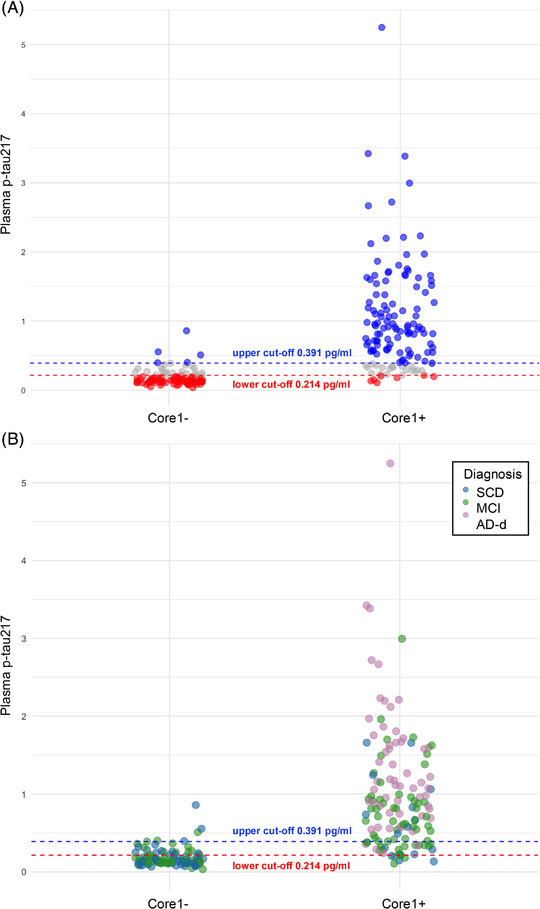 Figure 2
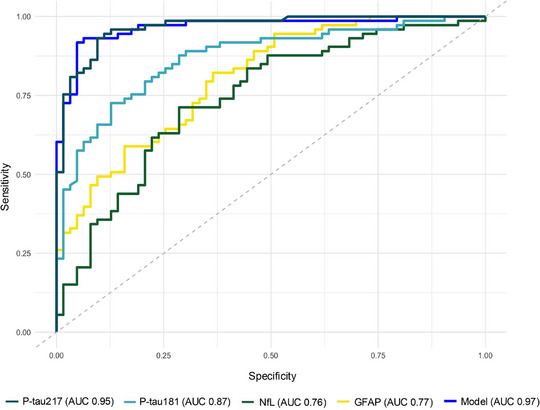 Figure 3
Peer Reviews
No public reviews on file for this paper yet. If you reviewed it on a platform where reviews are public (OpenReview, ICLR, NeurIPS, ICML), you can paste yours below so the community can read it here.
Videos
No videos yet. Explain this paper in a talk, walkthrough, or lecture? Add one.
Taxonomy
TopicsDementia and Cognitive Impairment Research · Alzheimer's disease research and treatments · S100 Proteins and Annexins