Discovering Hereditary Risk Through Surveillance: A Prospective Genetic Analysis of Individuals With Familial Pancreatic Cancer
Salvatore Paiella, Erica Secchettin, Livia Archibugi, Raffaele De Luca, Cristiana Bonifacio, Luigi Laghi, Gabriella Lionetto, Anna Caterina Milanetto, Giuliana Sereni, Chiara Coluccio, Gaetano Lauri, Arianna Dal Buono, Margherita Patruno, Giulia Gabriel, Romano Sassatelli

TL;DR
This study shows that genetic testing in people with a family history of pancreatic cancer reveals hidden risks and that cancer can occur even without known genetic mutations.
Contribution
The study demonstrates that pancreatic cancer can develop in high-risk individuals without pathogenic germline variants, expanding the case for surveillance beyond genetic criteria.
Findings
8.8% of high-risk individuals carried pathogenic variants, some in genes not covered by traditional BRCA testing.
47% of carriers in high-penetrance genes would not have met national testing criteria based on family history alone.
Pancreatic cancer was diagnosed in two mutation-negative individuals, showing cancer can occur without known mutations.
Abstract
Little is known about the genetic background of individuals with familial pancreatic cancer (PC). Integrating germline testing into surveillance may uncover previously unrecognized hereditary susceptibility and expand prevention strategies beyond BRCA testing alone. This study evaluated the genetic landscape of high‐risk individuals due to familiality (HRI‐FHs) enrolled in a national surveillance program. Five hundred HRI‐FHs from seven centers underwent surveillance and germline testing with a 41‐gene NGS panel. Pathogenic/likely pathogenic variants (PGVs) and variants of unknown significance (VUS) were identified and correlated with clinical and imaging findings. Overall, forty‐four (8.8%) out of 500 HRI‐FHs carried at least one PGV, including 3.4% in high‐penetrance genes (ATM, BRCA1/2, PALB2, BRIP1). Notably, 8 out of 17 (47%) of ATM, BRCA1/2, PALB2 carriers would not have met the…
Genes, proteins, chemicals, diseases, species, mutations and cell lines named across the full text — each resolved to its canonical identifier and authoritative record.
Click any figure to enlarge with its caption.
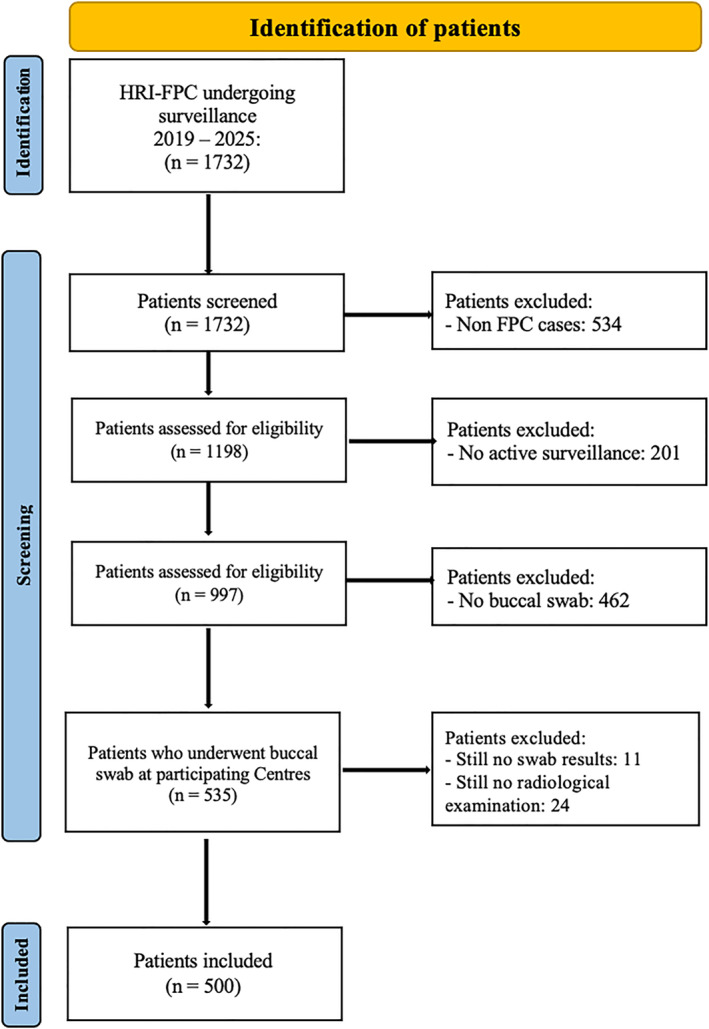 Figure 1
Peer Reviews
No public reviews on file for this paper yet. If you reviewed it on a platform where reviews are public (OpenReview, ICLR, NeurIPS, ICML), you can paste yours below so the community can read it here.
Videos
No videos yet. Explain this paper in a talk, walkthrough, or lecture? Add one.
Taxonomy
TopicsPancreatic and Hepatic Oncology Research · BRCA gene mutations in cancer · Genomics and Rare Diseases