Less Positive Parenting Appears to be a Consequence, Rather Than a Cause, of Youth Antisocial Behavior: Results from a Longitudinal Twin Study
Alaina M. Di Dio, Elizabeth A. Shewark, Luke W. Hyde, S. Alexandra Burt

TL;DR
This study finds that youth antisocial behavior leads to less positive parenting in adolescence, not the other way around.
Contribution
The study uses a twin differences design to show that early antisocial behavior evokes less positive parenting later.
Findings
Childhood antisocial behavior predicts reduced positive parenting in adolescence.
DZ twin differences in childhood antisocial behavior predict differences in adolescent positive parenting.
Genetic influences on antisocial behavior appear to mediate changes in parenting.
Abstract
Although positive parenting in childhood consistently predicts less adolescent antisocial behavior (ASB) over time, the etiology and direction of their association remain unclear. To fill this gap, we sought to illuminate prospective associations and potential changes in the etiology of the relationship between maternal positive parenting and youth ASB from middle childhood to adolescence using a cross-lagged, twin differences design. Participants were drawn from a longitudinal study with planned missingness (1,422 twins ages 6–11 at Wave 1 and 852 twins ages 11–19 at Wave 2) within the Michigan State University Twin Registry. Phenotypic analyses indicated that more childhood ASB significantly predicted less positive parenting in adolescence, but not the reverse. Twin difference-score analyses similarly revealed that, within both monozygotic (MZ) and dizygotic (DZ) twin pairs, co-twin…
Genes, proteins, chemicals, diseases, species, mutations and cell lines named across the full text — each resolved to its canonical identifier and authoritative record.
Click any figure to enlarge with its caption.
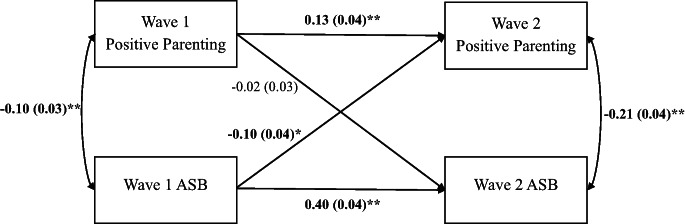 Figure 1
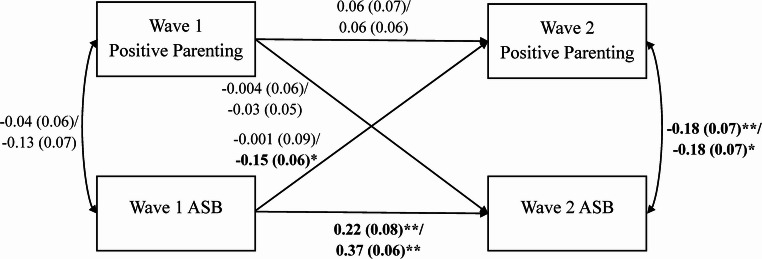 Figure 2
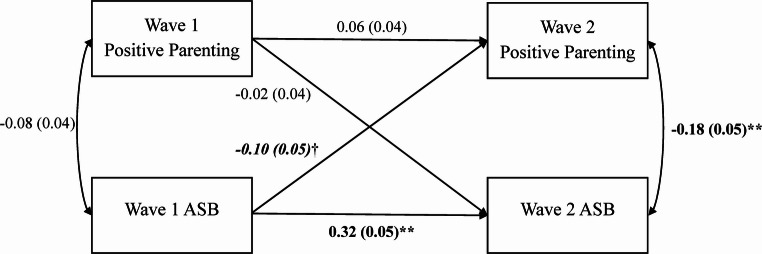 Figure 3
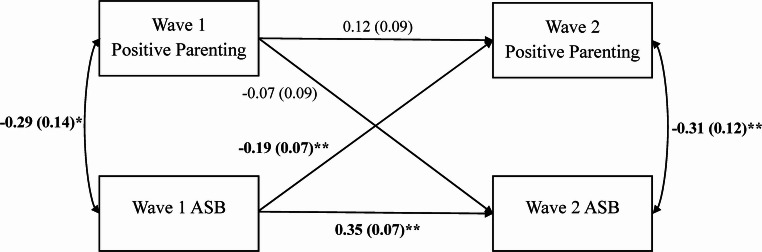 Figure 4
Peer Reviews
No public reviews on file for this paper yet. If you reviewed it on a platform where reviews are public (OpenReview, ICLR, NeurIPS, ICML), you can paste yours below so the community can read it here.
Videos
No videos yet. Explain this paper in a talk, walkthrough, or lecture? Add one.
Taxonomy
TopicsChild and Adolescent Psychosocial and Emotional Development · Cognitive Abilities and Testing · Crime Patterns and Interventions