Estimating recombination fraction via Pearson correlation
Chin-Sheng Teng, Shizhong Xu

TL;DR
This paper introduces a new method using Pearson correlation to estimate recombination fractions in advanced crop generations, offering a faster and accurate alternative to traditional methods.
Contribution
The novel contribution is applying Pearson correlation to estimate recombination fractions in Ft populations (t ≥ 2), which is computationally efficient and reliable.
Findings
The Pearson correlation method provides reliable and accurate recombination fraction estimates across F2, F3, and F4 rice populations.
The method is computationally efficient compared to the expectation–maximization algorithm without sacrificing accuracy.
Genetic maps constructed using this method show increased resolution and detection of recombination events in later generations.
Abstract
Estimating recombination fractions is crucial for constructing genetic linkage maps and understanding the inheritance patterns of crop genome in breeding populations. Traditional methods, such as the maximum likelihood method, rely on iterative algorithms to estimate recombination fractions in \documentclass[12pt]{minimal} \usepackage{amsmath} \usepackage{wasysym} \usepackage{amsfonts} \usepackage{amssymb} \usepackage{amsbsy} \usepackage{mathrsfs} \usepackage{upgreek} \setlength{\oddsidemargin}{-69pt} \begin{document}\end{document}F2 populations, which can be computationally intensive. While most existing methods focus on recombination fractions in \documentclass[12pt]{minimal} \usepackage{amsmath} \usepackage{wasysym} \usepackage{amsfonts} \usepackage{amssymb} \usepackage{amsbsy} \usepackage{mathrsfs}…
Genes, proteins, chemicals, diseases, species, mutations and cell lines named across the full text — each resolved to its canonical identifier and authoritative record.
Click any figure to enlarge with its caption.
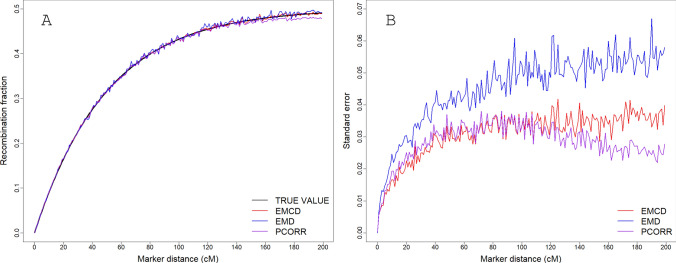 Figure 1
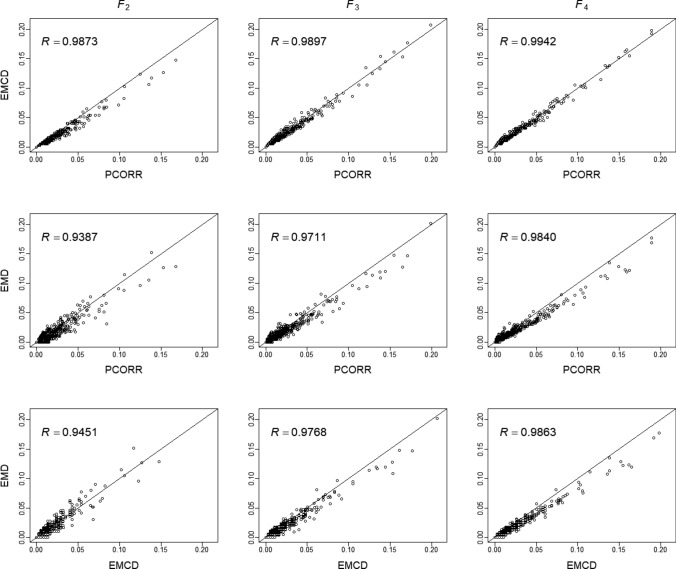 Figure 2
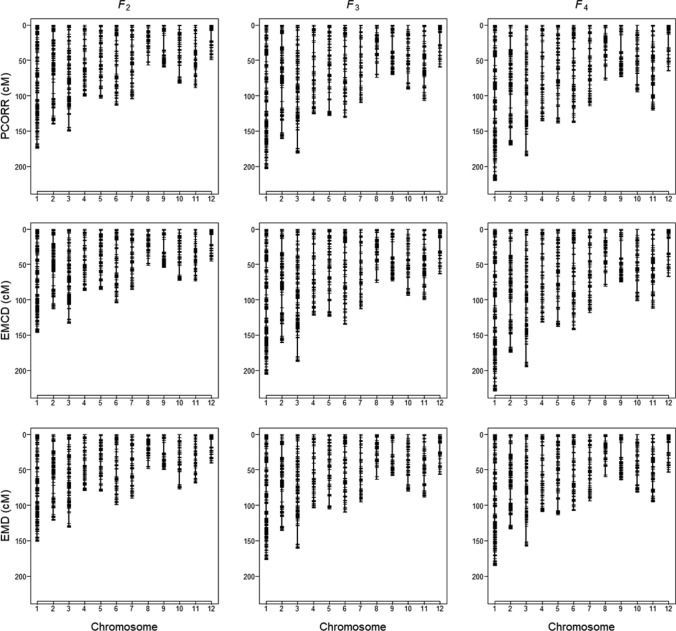 Figure 3
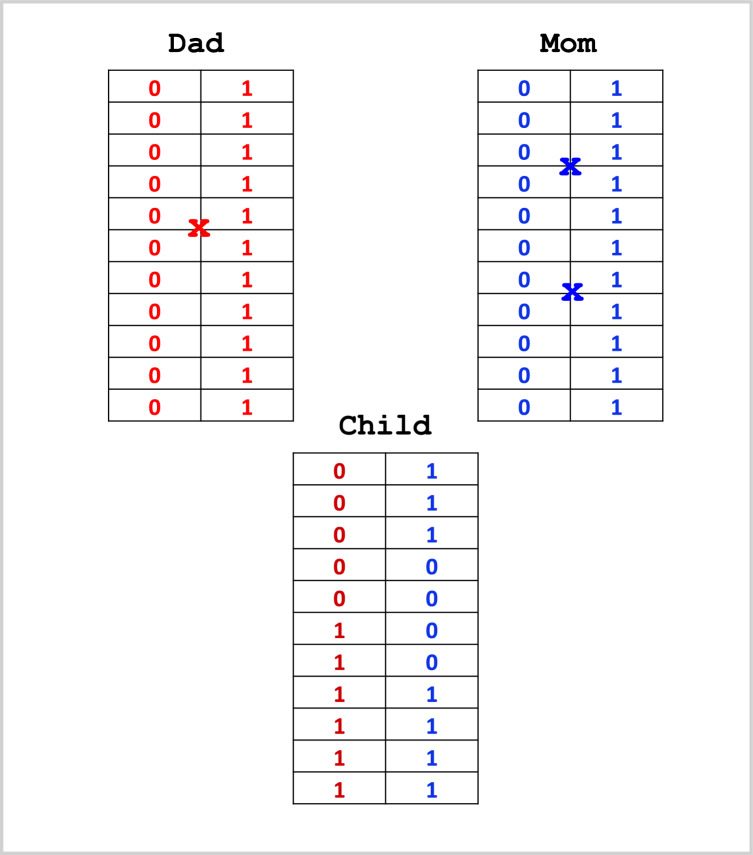 Figure 4
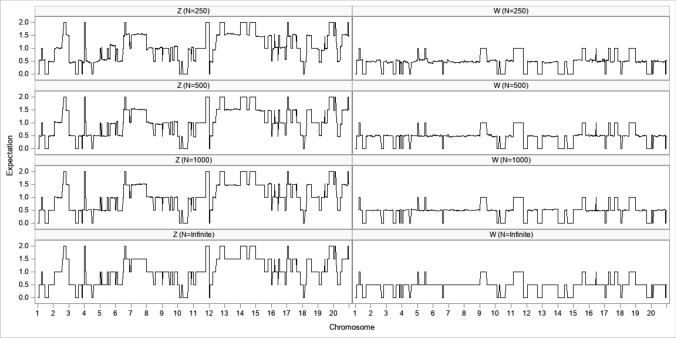 Figure 5
Peer Reviews
No public reviews on file for this paper yet. If you reviewed it on a platform where reviews are public (OpenReview, ICLR, NeurIPS, ICML), you can paste yours below so the community can read it here.
Videos
No videos yet. Explain this paper in a talk, walkthrough, or lecture? Add one.
Taxonomy
TopicsGenetic and phenotypic traits in livestock · Genetic Mapping and Diversity in Plants and Animals · Genetics and Plant Breeding