Differential temporal dynamics in motor imagery shaped by agent type and action duration
Lorenzo Viviani, Alba Liso, Lisa Colotti, Sara Romano, Valentina Fogo, Fabrizio Riguzzi, Giovanni Buccino, Laila Craighero

TL;DR
People imagine human actions more quickly than robotic ones, suggesting motor imagery is influenced by how natural the movement appears.
Contribution
The study reveals that motor imagery temporal bias is modulated by agent type and action duration, challenging simple embodied simulation theories.
Findings
Participants showed a stronger 'After' bias when imagining human actions compared to robotic ones.
Longer robotic actions led to more 'Before' errors, suggesting a perceived slowing in motor imagery.
Action duration had little effect on temporal errors for human actions.
Abstract
This study explored the temporal dynamics of motor imagery (MI) following the observation of robotic versus human actions using a temporal judgment task. Participants observed goal-directed action videos by a human or a NAO robot, performed MI until an auditory stop signal, then completed a two-alternative forced choice task to identify the frame corresponding to their imagery stop point, choosing between the correct frame and either a preceding (‘Before’) or succeeding (‘After’) frame. Results revealed a systematic temporal bias in MI towards ‘After’ incorrect frames. Crucially, this bias was significantly smaller for imagining robotic actions compared to human actions. This difference was primarily driven by an increased number of ‘Before’ errors for longer robotic actions, suggesting a perceived slowing down of MI (leading to an attenuated forward bias) when simulating less…
Genes, proteins, chemicals, diseases, species, mutations and cell lines named across the full text — each resolved to its canonical identifier and authoritative record.
Click any figure to enlarge with its caption.
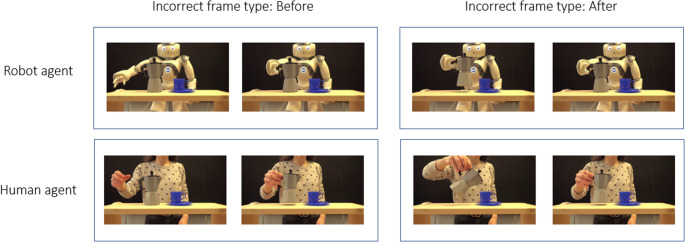 Figure 1
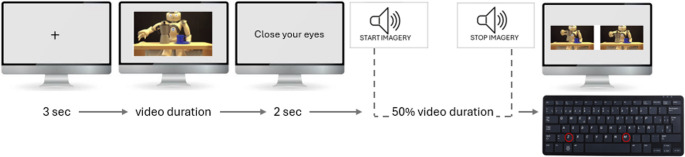 Figure 2
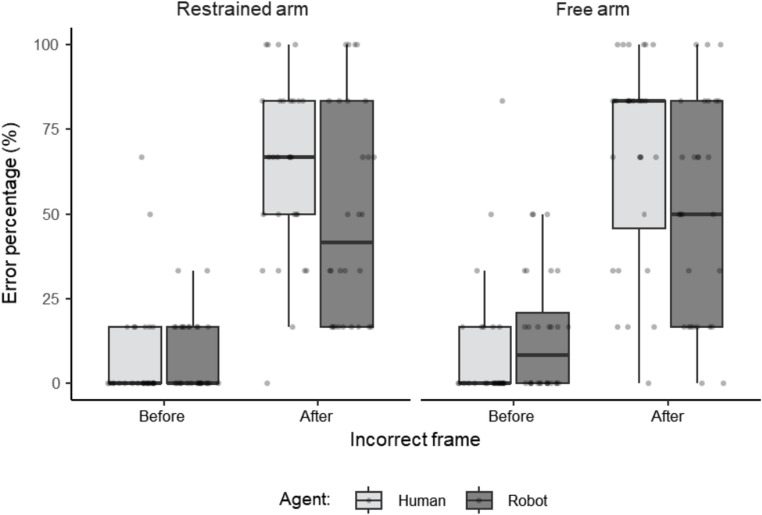 Figure 3
 Figure 4
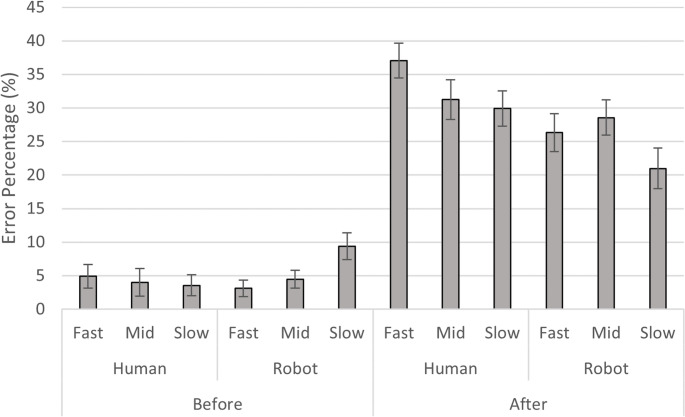 Figure 5
Peer Reviews
No public reviews on file for this paper yet. If you reviewed it on a platform where reviews are public (OpenReview, ICLR, NeurIPS, ICML), you can paste yours below so the community can read it here.
Videos
No videos yet. Explain this paper in a talk, walkthrough, or lecture? Add one.
Taxonomy
TopicsAction Observation and Synchronization · Sport Psychology and Performance · Motor Control and Adaptation