Association of cancer treatment with excess heart age among five-year young breast cancer survivors
Jacqueline B. Vo, Shoshana Rosenberg, Bessie X. Zhang, Craig Snow, Greg Kirkner, Philip D. Poorvu, Rachel Gaither, Kathryn J. Ruddy, Rulla M. Tamimi, Jeffrey M. Peppercorn, Lidia Schapira, Virginia F. Borges, Steven E. Come, Anju Nohria, Ann H. Partridge

TL;DR
This study finds that radiation therapy, especially left-sided radiation, is linked to increased heart age in young breast cancer survivors, suggesting a higher cardiovascular disease risk.
Contribution
The study identifies radiation therapy, particularly left-sided, as a novel factor associated with elevated heart age in young breast cancer survivors.
Findings
Left-sided radiation was associated with higher excess heart age at five-year follow-up.
Radiation therapy, especially left-sided, was linked to increased risk of elevated excess heart age.
Systemic treatments like anthracyclines and trastuzumab showed no significant associations with heart age.
Abstract
Data evaluating cardiovascular disease (CVD) risk by cancer treatment among young women (≤ 40 years) with breast cancer are limited. Among 372 five-year breast cancer survivors aged 30–40 years from the Young Women's Breast Cancer Study, we assessed the association of cancer treatments (anthracyclines, trastuzumab, radiation/laterality, endocrine therapy) and excess heart age (difference between predicted 10-year CVD risk as assessed by adapted Framingham Risk Score and chronological age), prevalent elevated excess heart age (≥ 2 years), and worsening excess heart age (change of ≥ 2 excess heart age years) at breast cancer diagnosis and two- and five-year follow-up using multivariable linear and logistic regressions. Most women had stage I or II (79%), ER + (71%), or PR + (65%) breast cancer. At diagnosis, women had little excess heart age by treatment receipt (range of means =…
Genes, proteins, chemicals, diseases, species, mutations and cell lines named across the full text — each resolved to its canonical identifier and authoritative record.
Click any figure to enlarge with its caption.
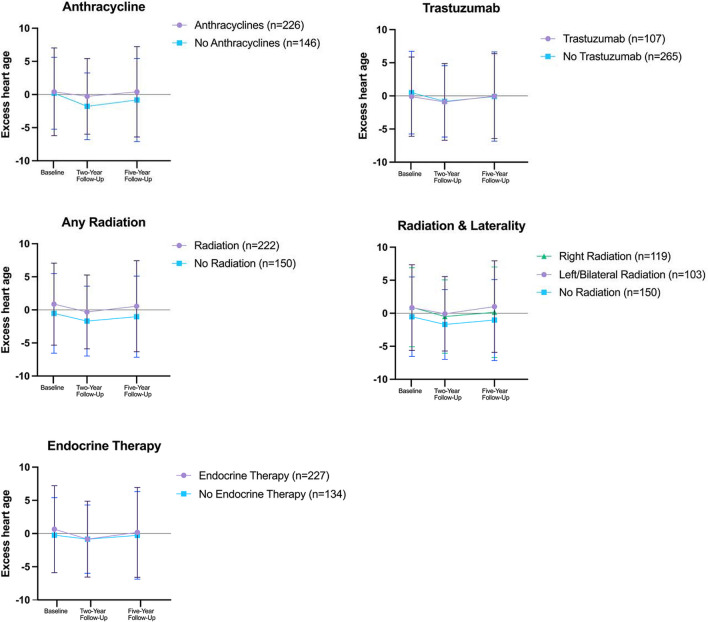 Figure 1
Peer Reviews
No public reviews on file for this paper yet. If you reviewed it on a platform where reviews are public (OpenReview, ICLR, NeurIPS, ICML), you can paste yours below so the community can read it here.
Videos
No videos yet. Explain this paper in a talk, walkthrough, or lecture? Add one.
Taxonomy
TopicsChemotherapy-induced cardiotoxicity and mitigation · Childhood Cancer Survivors' Quality of Life · Cancer-related cognitive impairment studies