Hyperdense middle cerebral artery sign is a prognostic factor of favourable long-term outcomes of mechanical thrombectomy in acute ischaemic stroke
Pawel Wrona, Mateusz Gielczynski, Aleksandra Wojnarska, Katarzyna Sawczynska, Helin Savsin, Katarzyna Chwaleba, Tomasz Homa, Roman Pulyk, Agnieszka Slowik

TL;DR
The hyperdense middle cerebral artery sign on CT scans is linked to better long-term outcomes for stroke patients treated with mechanical thrombectomy.
Contribution
This study shows that the hyperdense middle cerebral artery sign is a reliable predictor of favorable long-term outcomes after mechanical thrombectomy for stroke.
Findings
HMCAS presence was independently associated with good functional outcome at 365 days (OR 1.956).
HMCAS was linked to lower 90-day and 365-day mortality rates.
The study included 359 patients treated with mechanical thrombectomy for acute ischaemic stroke.
Abstract
Hyperdense middle cerebral artery sign (HMCAS) is a phenomenon highly specific for acute ischaemic stroke (AIS) that can be found in brain non-contrast computed tomography (NCCT). Previous studies concerning its association with outcomes of patients undergoing mechanical thrombectomy (MT) are inconclusive. Our aim was to assess the relationship between HMCAS presence and long-term outcomes of AIS patients undergoing MT. The study included anterior circulation AIS patients treated with MT in the University Hospital in [ANONYMIZED] from 2019 to 2021, in whom admission NCCT and one-year follow-up were available. The clinical, laboratory and imaging data, as well as following outcomes: the occurrence of successful recanalization [defined as modified treatment in cerebral infarction (mTICI) score 2b-3], haemorrhagic complications (ICH), 90-day and 365-day rates of mortality and good…
Genes, proteins, chemicals, diseases, species, mutations and cell lines named across the full text — each resolved to its canonical identifier and authoritative record.
Click any figure to enlarge with its caption.
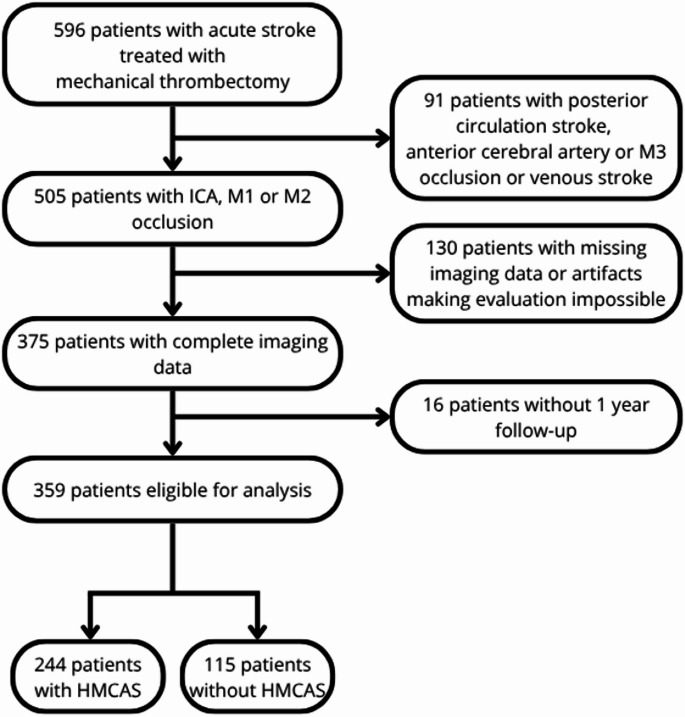 Figure 1
Peer Reviews
No public reviews on file for this paper yet. If you reviewed it on a platform where reviews are public (OpenReview, ICLR, NeurIPS, ICML), you can paste yours below so the community can read it here.
Videos
No videos yet. Explain this paper in a talk, walkthrough, or lecture? Add one.
Taxonomy
TopicsAcute Ischemic Stroke Management · Intracerebral and Subarachnoid Hemorrhage Research · Traumatic Brain Injury and Neurovascular Disturbances