Characterizing TDP‐43 involvement in vascular dementia
Marconi Fung, Yuek Ling Chai, Yi‐Lin Cheng, Nishat Tabassum, Vernise J. T. Lim, Raj N. Kalaria, Dong‐Gyu Jo, Christopher P. Chen, Mitchell K. P. Lai, Thiruma V. Arumugam

TL;DR
The study explores how TDP-43, a protein linked to neurodegeneration, is affected early in vascular dementia models under low blood flow conditions.
Contribution
The paper identifies TDP-43 as a novel, transient target in vascular cognitive impairment under hypoperfusion.
Findings
TDP-43 and phosphorylated TDP-43 show increased expression and mislocalization in vascular dementia models.
Post mortem human vascular dementia brains do not show TDP-43 abnormalities.
TDP-43 pathology is distinct in vascular dementia compared to Alzheimer's and mixed dementia.
Abstract
Vascular dementia (VaD) is a major therapeutic challenge. Tar DNA‐binding protein 43 (TDP‐43), known for its role in neurodegeneration, may contribute to VaD pathogenesis under chronic cerebral hypoperfusion (CCH). This study investigates TDP‐43 dysregulation in VaD. TDP‐43 and phosphorylated TDP‐43 (pTDP‐43) expression and localization were assessed in a VaD animal model, neuronal cells exposed to oxygen–glucose deprivation (OGD), and post mortem human brain tissues. Bilateral Common Carotid Artery Stenosis (BCAS)‐induced CCH led to increased pTDP‐43 and aberrant redistribution of both TDP‐43 and pTDP‐43. In vitro OGD triggered similar mislocalization. Post mortem VaD brains showed no TDP‐43 abnormalities, while Alzheimer's and mixed dementia cases exhibited marked pathology. TDP‐43 dysregulation appears early in VaD under hypoperfusive stress, distinguishing it from other dementia…
Genes, proteins, chemicals, diseases, species, mutations and cell lines named across the full text — each resolved to its canonical identifier and authoritative record.
Click any figure to enlarge with its caption.
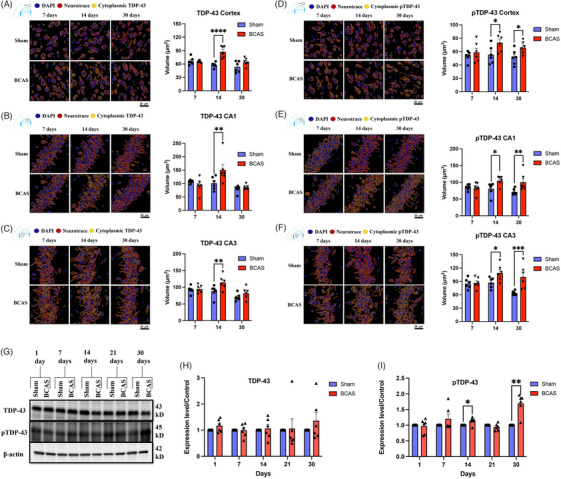 Figure 1
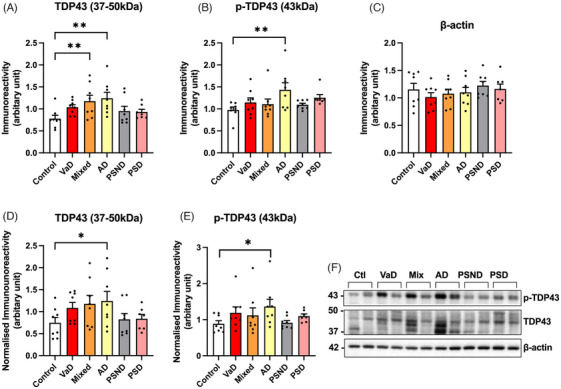 Figure 2
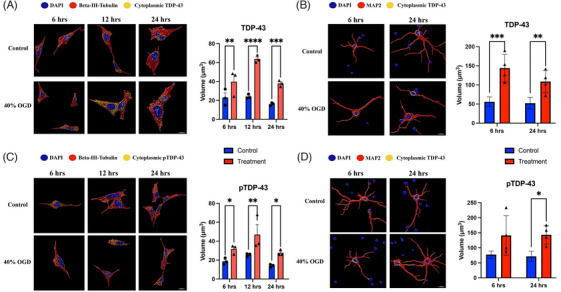 Figure 3
Peer Reviews
No public reviews on file for this paper yet. If you reviewed it on a platform where reviews are public (OpenReview, ICLR, NeurIPS, ICML), you can paste yours below so the community can read it here.
Videos
No videos yet. Explain this paper in a talk, walkthrough, or lecture? Add one.
Taxonomy
TopicsNeurological Disease Mechanisms and Treatments · Ginkgo biloba and Cashew Applications · Barrier Structure and Function Studies