An Active Inference Model of Meter Perception and the Urge to Move to Music
Tomas E. Matthews, Peter Vuust, Jonathan Cannon

TL;DR
This paper explores why certain rhythms make us want to move by using a Bayesian model to show that prediction errors and their reduction through movement drive the urge to move to music.
Contribution
The paper introduces a Bayesian model that operationalizes the predictive processing account of meter perception and movement urge.
Findings
Surprisal increases linearly with rhythmic complexity.
Delta surprisal correlates with urge to move ratings confirmed in an online study.
The urge to move is driven by expected reduction in prediction errors via movement feedback.
Abstract
Why do some rhythms make us want to move and not others? A predictive processing account suggests that prediction errors drive this phenomenon, but this hypothesis remains underspecified. Here, we operationalized this account as a Bayesian model that infers whether a rhythmic sequence is caused by a metered or unmetered template, coupled with an active inference rule in which movement occurs if the sensory feedback from movement would reduce the prediction errors generated by this inference process. Surprisal, as an index of prediction error, was calculated for each rhythm with and without a metronome (a proxy for the feedback from moving along), with delta surprisal as the difference. Surprisal increased linearly as a function of rhythmic complexity, while delta surprisal showed a similar pattern with urge to move ratings shown in previous studies, and this relation was confirmed in an…
Genes, proteins, chemicals, diseases, species, mutations and cell lines named across the full text — each resolved to its canonical identifier and authoritative record.
Click any figure to enlarge with its caption.
 Figure 1
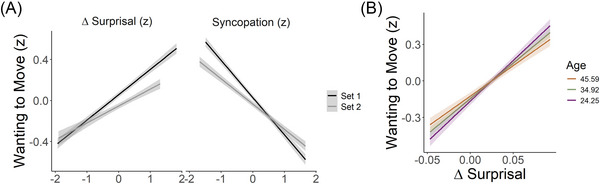 Figure 2
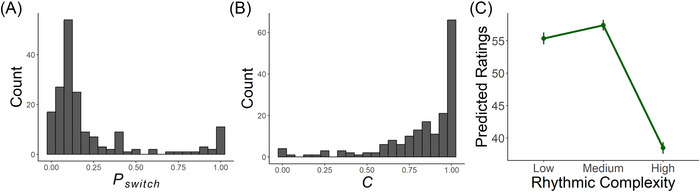 Figure 3
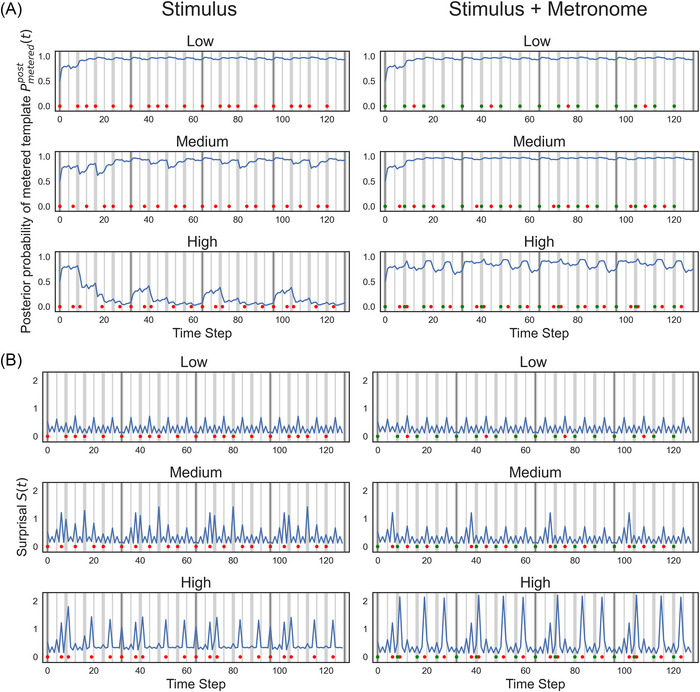 Figure 4
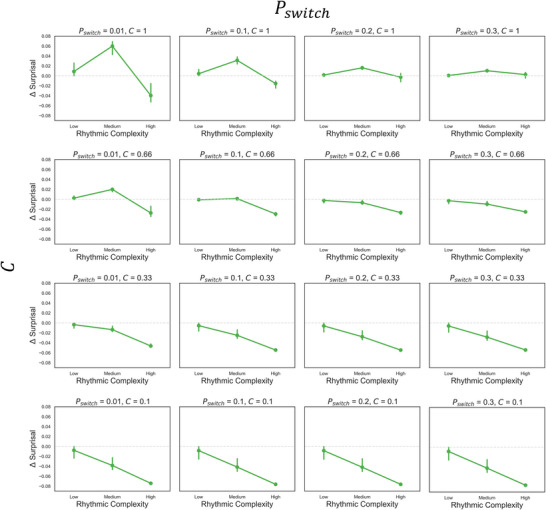 Figure 5
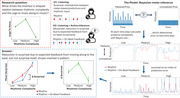 Figure 6
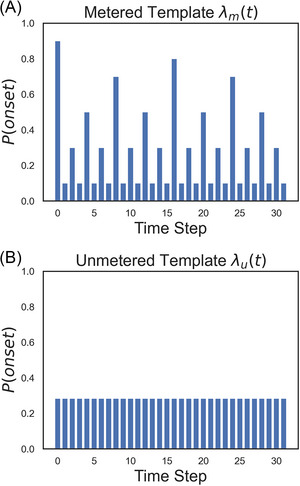 Figure 7
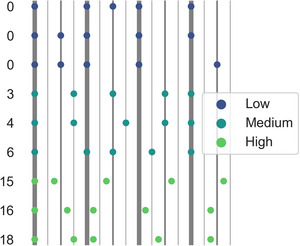 Figure 8
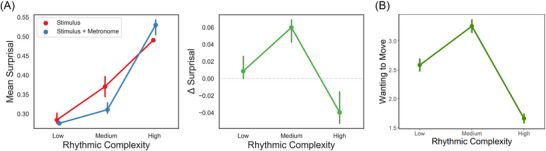 Figure 9
Peer Reviews
No public reviews on file for this paper yet. If you reviewed it on a platform where reviews are public (OpenReview, ICLR, NeurIPS, ICML), you can paste yours below so the community can read it here.
Videos
No videos yet. Explain this paper in a talk, walkthrough, or lecture? Add one.
Taxonomy
TopicsNeuroscience and Music Perception · Embodied and Extended Cognition · Multisensory perception and integration