Delivering Inclusive Cultural Offers for Social Prescribing: A Realist Evaluation Involving Older People From Global Majority Backgrounds and Cultural Sector Providers in the UK
Debra Westlake, Kamal R. Mahtani, Geoffrey Wong, Jordan Gorenberg, Marta Santillo, Kerryn Husk, Sofia Vougioukalou, Ruthanne Baxter, Shoba Dawson, Caroline M. Potter, Harriet Warburton, Beth McDougall, Stephanie Tierney

TL;DR
This study explores how cultural activities can be tailored to better include older people from global majority backgrounds in the UK, to improve their wellbeing through social prescribing.
Contribution
The study introduces a program theory for inclusive cultural engagement based on realist evaluation and participatory methods.
Findings
Three pillars for inclusive cultural engagement were identified: entry support, sustained trust, and transformative outcomes.
Collaborative practices with older global majority participants fostered meaningful cultural participation and wellbeing.
Public involvement groups contributed to shaping data collection and model development for inclusivity.
Abstract
Research shows cultural activities benefit older people's wellbeing, but little is known about why individuals from global majority (minority ethnic) groups engage less with the mainstream cultural sector, or how it could adapt to meet their needs and encourage engagement. The TOUS study (Tailoring cultural Offers with and for diverse older Users of Social prescribing) investigated the question: What tailoring is needed, how, when and for whom, to optimise cultural offers as part of social prescribing for older people (aged 60+) from global majority groups? The TOUS study involved focused ethnographies with six cultural‐sector organisations throughout the United Kingdom and 11 key informant interviews with cultural providers. A realist approach was adopted, resulting in the development of a programme theory. The programme theory has three pillars: (1) broker, hook, and opportunity,…
Genes, proteins, chemicals, diseases, species, mutations and cell lines named across the full text — each resolved to its canonical identifier and authoritative record.
Click any figure to enlarge with its caption.
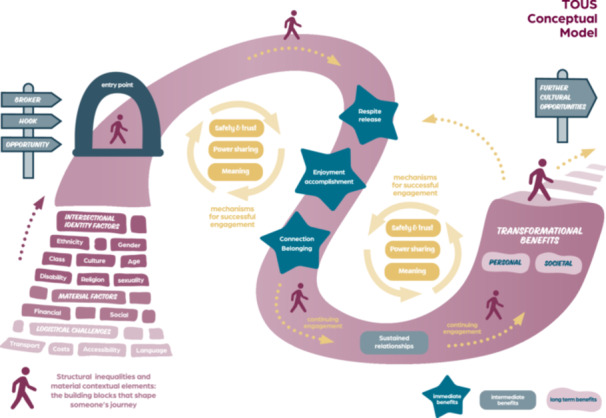 Figure 1
Peer Reviews
No public reviews on file for this paper yet. If you reviewed it on a platform where reviews are public (OpenReview, ICLR, NeurIPS, ICML), you can paste yours below so the community can read it here.
Videos
No videos yet. Explain this paper in a talk, walkthrough, or lecture? Add one.
Taxonomy
TopicsArt Therapy and Mental Health · Music Therapy and Health · Occupational Therapy Practice and Research