Assessing the repurposing potential of disease-modifying antirheumatic drug targets to reduce Alzheimer's disease risk: a Mendelian randomization study
Christina N. Kushnir, Victoria Taylor-Bateman, Neil M. Davies, Emma L. Anderson

TL;DR
This study explores whether drug targets used for rheumatoid arthritis could also be used to treat Alzheimer's disease, finding that only one target, FCGR3B, may increase Alzheimer's risk.
Contribution
The first Mendelian randomization and colocalization study on DMARD targets and Alzheimer's disease risk using cis-pQTLs as instruments.
Findings
Higher levels of FCGR3B are associated with increased Alzheimer's disease risk (OR: 1.10; 95% CI [1.02, 1.19]).
Most other DMARD targets showed little evidence of affecting Alzheimer's disease risk.
Colocalization analysis found no strong evidence of shared genetic signals between DMARD targets and Alzheimer's disease.
Abstract
Systemic inflammation plays a key role in the development and progression of Alzheimer's disease (AD). However, the repurposing potential of select anti-inflammatory drug targets for AD treatment remains unclear. Two-sample Mendelian randomization (MR) and colocalization analyses were conducted to estimate the effects of select disease-modifying antirheumatic (DMARD) targets on AD risk. We investigated 9 DMARD targets, using blood protein quantitative trait loci (pQTLs) from the UK Biobank Pharma Proteomics Project (n = 54,219). Outcome associations were extracted from the International Genomics of Alzheimer's Project (ncases = 21,982, ncontrols = 41,944). Our MR estimates suggest that higher levels of FCGR3B, an etanercept target, increased the risk of AD (OR: 1.10; 95% CI [1.02, 1.19]; p = 0.01). We found little evidence that the remaining DMARD targets affected AD risk.…
Genes, proteins, chemicals, diseases, species, mutations and cell lines named across the full text — each resolved to its canonical identifier and authoritative record.
Click any figure to enlarge with its caption.
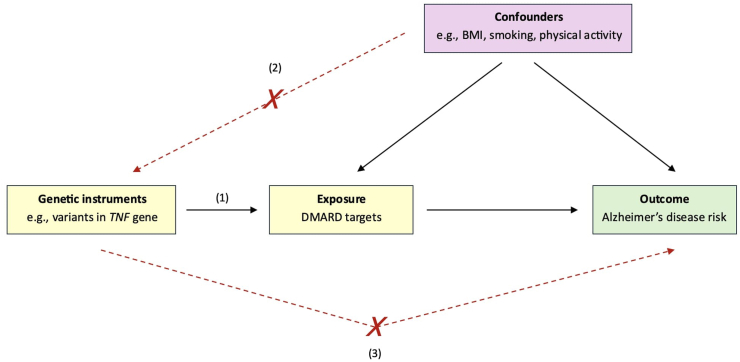 Figure 1
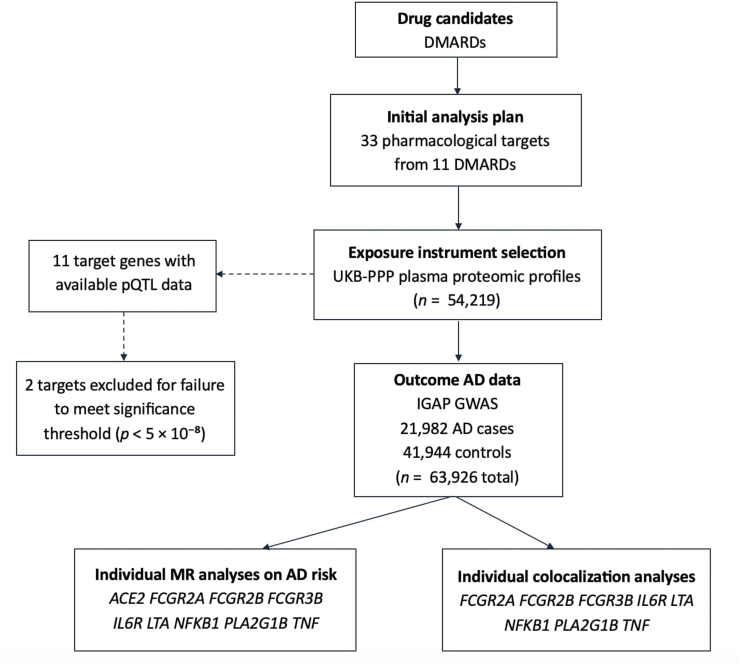 Figure 2
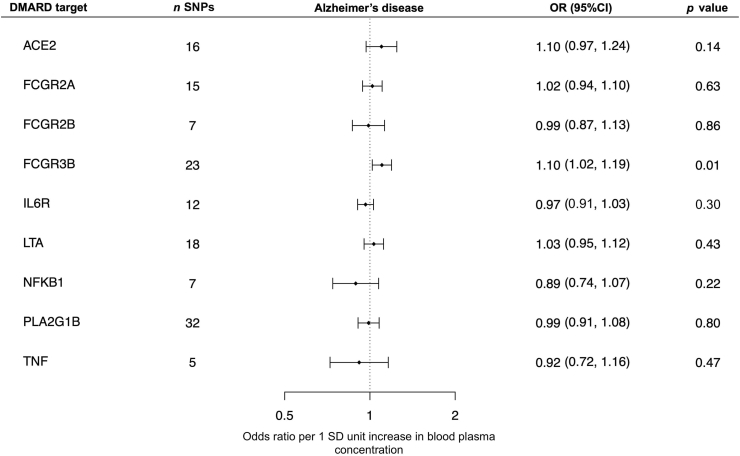 Figure 3
Peer Reviews
No public reviews on file for this paper yet. If you reviewed it on a platform where reviews are public (OpenReview, ICLR, NeurIPS, ICML), you can paste yours below so the community can read it here.
Videos
No videos yet. Explain this paper in a talk, walkthrough, or lecture? Add one.
Taxonomy
TopicsGenetic Associations and Epidemiology · Rheumatoid Arthritis Research and Therapies · Alzheimer's disease research and treatments