Characteristics of parks associated with depression in women only: a cross-sectional study of 329,363 adults
Jonathan R. Olsen, Natalie Nicholls, Fiona M. Caryl, Thomas Astell-Burt, Jill P. Pell, Donald M. Lyall, Frederick K. Ho, Xiaoqi Feng, Richard Mitchell

TL;DR
This study finds that certain park features within walking distance reduce depression risk in women but not in men, suggesting urban planning should consider gender differences.
Contribution
The study identifies specific park characteristics linked to reduced depression in women, challenging current urban planning policies focused on 20-min neighborhoods.
Findings
Recreational amenities and tree canopy coverage in parks within 40-min walking distance are associated with lower depression odds in women.
Each 1% increase in park greenspace within a 20-min catchment reduces depression odds by 11% among women.
No significant protective associations were found for men, with some paradoxical adverse associations observed.
Abstract
To examine associations between public park characteristics within different walking distances from residential locations and depression, to distinguish between features within parks (e.g. amenities, attractions, facilities, tree cover) and park metrics in the home area (e.g. number of parks, size, and total area), and to employ rigorous geospatial analysis linking the best available objectively measured park and urban green space (UGS) exposures to validated depression outcomes across multiple scales. This population-based cross-sectional study utilised baseline data from 329,363 UK Biobank participants resident in urban areas. Prevalent diagnosed depression was defined as an ICD-10 code of F32 (depressive episode) or F33 (recurrent depressive disorder). Park characteristics and urban green space data were derived from Ordnance Survey Great Britain datasets and spatially linked to…
Genes, proteins, chemicals, diseases, species, mutations and cell lines named across the full text — each resolved to its canonical identifier and authoritative record.
Click any figure to enlarge with its caption.
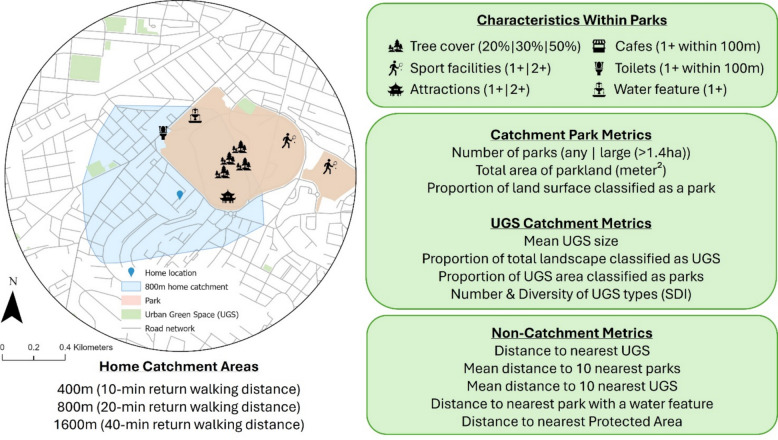 Figure 1
Peer Reviews
No public reviews on file for this paper yet. If you reviewed it on a platform where reviews are public (OpenReview, ICLR, NeurIPS, ICML), you can paste yours below so the community can read it here.
Videos
No videos yet. Explain this paper in a talk, walkthrough, or lecture? Add one.
Taxonomy
TopicsUrban Green Space and Health · Urban Transport and Accessibility · Place Attachment and Urban Studies