The effectiveness and acceptability of face-to-face rehabilitation for patients with Long Covid who were not hospitalised with their acute infection: a mixed-methods study comprising a randomised controlled trial (RCT) with embedded qualitative component
Kate Kontou, Enya Daynes, Sally J. Singh, Rachael A. Evans, Nikki Gardiner, Emma Chaplin, Matthew Richardson, Nicolette Bishop, Jennifer Creese, Nicola Bateman, Adam Wright, Elga Zivtins, Linzy Houchen-Wolloff

TL;DR
This study investigates whether face-to-face rehabilitation improves outcomes for non-hospitalized Long Covid patients and explores how accessible and acceptable the treatment is.
Contribution
The study introduces a mixed-methods approach to evaluate face-to-face rehabilitation for non-hospitalized Long Covid patients, including a focus on healthcare inequalities.
Findings
Face-to-face rehabilitation may improve exercise capacity in non-hospitalized Long Covid patients.
Qualitative insights will reveal how healthcare inequalities affect access to and experience of rehabilitation.
The study will assess the acceptability of symptom-titrated exercise and self-management education.
Abstract
Long Covid is a term used to describe a multisystem condition that presents with a myriad of physical and psychological symptoms that continue or develop after acute COVID-19. Long Covid is a significant public health problem because of the nature of the illness, its negative impfact on everyday functioning, and the healthcare inequalities evident in access and experience, notably in terms of ethnicity and socioeconomic status. Evidence in patients hospitalised with their acute infection suggests exercise-based rehabilitation could be helpful to improve exercise tolerance, respiratory symptoms, fatigue, and cognition; however, research is needed to determine whether exercise-based rehabilitation is effective and acceptable for patients with Long Covid who were not hospitalised. This mixed-methods study comprises a single-centre, randomised controlled trial to determine whether…
Genes, proteins, chemicals, diseases, species, mutations and cell lines named across the full text — each resolved to its canonical identifier and authoritative record.
Click any figure to enlarge with its caption.
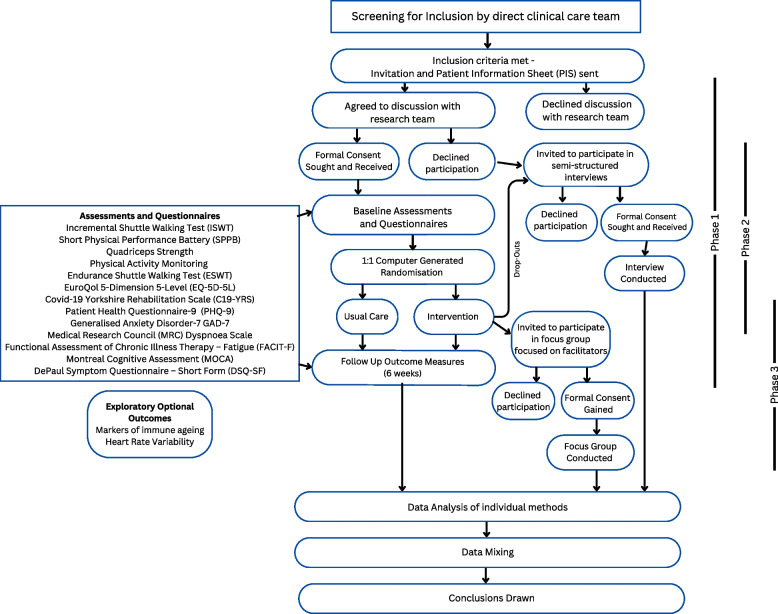 Figure 1
Peer Reviews
No public reviews on file for this paper yet. If you reviewed it on a platform where reviews are public (OpenReview, ICLR, NeurIPS, ICML), you can paste yours below so the community can read it here.
Videos
No videos yet. Explain this paper in a talk, walkthrough, or lecture? Add one.
Taxonomy
TopicsLong-Term Effects of COVID-19 · Intensive Care Unit Cognitive Disorders · Chronic Obstructive Pulmonary Disease (COPD) Research