Spatial Pharmacology: Redefining Organelle Contact Sites as Therapeutic Targets
Minjeong Ko, Jiho You, Eunwoo Cho, Ho Jeong Kwon

Abstract
Click any figure to enlarge with its caption.
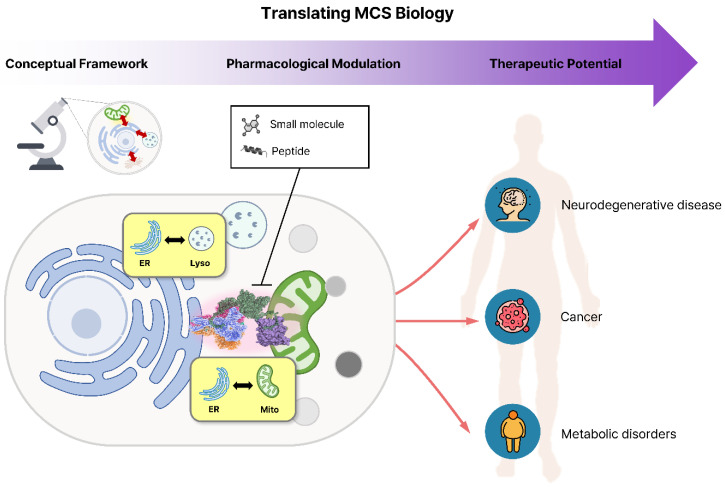 Figure 1
Peer Reviews
No public reviews on file for this paper yet. If you reviewed it on a platform where reviews are public (OpenReview, ICLR, NeurIPS, ICML), you can paste yours below so the community can read it here.
Videos
No videos yet. Explain this paper in a talk, walkthrough, or lecture? Add one.
Taxonomy
TopicsCell Adhesion Molecules Research · Retinoids in leukemia and cellular processes · Animal testing and alternatives
Inter-organelle communication has emerged as a key regulator of cellular homeostasis and disease pathology 1. Although organelles were once viewed as self-contained compartments, emerging evidence has reframed organelle membrane contact sites (MCSs) as molecularly diverse signaling hubs that coordinate ion exchange, lipid metabolism, and stress responses. Notably, recent studies published in the International Journal of Biological Sciences have contributed to shifting this perspective by highlighting mitochondria-associated membranes (MAMs) as pharmacologically responsive interfaces implicated in neurodegenerative and metabolic disorders 2-4. Chen et al. showed that dietary vanadium exposure remodels the hepatic MAM proteome, disrupting glucose homeostasis and promoting ferroptosis 3, while He et al. demonstrated that omega-3 polyunsaturated fatty acids restore MAM abundance and support spermatogenesis 4. Together, these findings point to a broader conceptual shift in which MCSs are viewed not as passive structural contacts but as dynamic, druggable interfaces, bringing their small-molecule therapeutic potential into clearer focus.
Here, we use the term “spatial pharmacology” to describe therapeutic strategies that modulate organelle connectivity rather than individual molecular activities. The implications of this concept extend well beyond the MAM. Recent studies show that diverse organelle contact sites function as key regulatory hubs and can be modulated pharmacologically. In early Alzheimer's disease, Blarcamesine (ANAVEX2-73), an agonist of the Sigma-1 receptor localized at the MAM, demonstrated notable outcomes in clinical trials for Alzheimer's disease (NCT03790709) 5. The flavonoid derivative LW-213 enhanced ER-lysosome interactions through direct binding to lysosomal protein LIMP2, thereby triggering lethal ER stress and suppressing acute myeloid leukemia progression 6. Another natural product, tangeretin, exhibited protective mechanisms against Amyloid beta (Aβ) toxicity by modulating mitochondria-lysosome contacts 7. At the ER-plasma membrane contact sites, the TAT-DP-2 peptide provided neuroprotection in an ischemic stroke model by disrupting the Kv2.1-VAPA interaction 8. Together, these examples illustrate a growing paradigm of “spatial pharmacology,” wherein targeted modulation of organelle connectivity acts as a distinct therapeutic mechanism (Figure 1).
MCS-centered pharmacology is emerging as a new direction in drug discovery, connecting systems-level organelle biology with therapeutics ranging from small molecules to peptides. The main challenge now is achieving precise spatial and temporal control so that these strategies can be applied effectively in clinical settings. Because MCSs are structurally complex and highly dynamic, systemic drugs alone may not provide sufficient specificity, and additional approaches will be synergetic for more accurate manipulation of cellular architecture. To this end, emerging technologies such as organelle-targeting nanoparticles and optogenetic tools represent a promising future direction. Nanoparticles can be engineered with specific physicochemical properties to exploit membrane potential or pH gradients, allowing them to enrich payloads at distinct organelle sites 9. This targeted subcellular delivery allows organelle crosstalk to be modulated precisely, in ways that conventional whole-cell drug exposure cannot achieve. Optogenetic/chemogenetic tools that enable graded control of protein associations, such as small-molecule-activated binary association (SAMBA) systems, can also offer the ability to program the timing and duration of contact formation 10. Furthermore, bridging structural understanding with pharmacological intervention will be essential to translate MCS-targeting strategies into clinically actionable therapies.
Overall, these advances make it increasingly possible to control organelle contacts in a precise and predictable way. By adjusting how organelles connect and communicate, we can begin to treat these contact sites not just as structural features of the cell, but as real therapeutic targets. This idea, that cell function can be modulated by adjusting how organelles connect, captures the core of spatial pharmacology and suggests a new direction for future drug development.
The reference list from the paper itself. Each links out to its DOI / PubMed record.
- 1Voeltz G Sawyer E Hajnóczky G Prinz W Making the connection: How membrane contact sites have changed our view of organelle biology Cell 2024187257703824208210.1016/j.cell.2023.11.040PMC 11830234 · doi ↗ · pubmed ↗
- 2Xue N-J Liu Y Lin Z-H Huang W-H Zhang F Zheng R Parkin deficiency impairs ER-Mitochondria associations and calcium homeostasis via IP 3R-Grp 75-VDAC 1 complex International Journal of Biological Sciences 202622731494152234010.7150/ijbs.121759 PMC 12781089 · doi ↗ · pubmed ↗
- 3Chen H Dai X Xiong Z Cao H Xing C Li H Dual-pathway mechanism of vanadium-induced hepatotoxicity in ducks: Synergistic crosstalk between glucose homeostasis disruption and NADH/FSP 1/COQ 10 axis-driven ferroptosis International Journal of Biological Sciences 20262243594136273210.7150/ijbs.123482 PMC 12681742 · doi ↗ · pubmed ↗
- 4He Z Ge F Li C Zang M Cao C Zhang J The remodeling of Mitochondrial-Endoplasmic reticulum contacts by omega-3 fatty acids mitigates dietary advanced glycation end product-driven Sertoli cell senescence and oligoasthenozoospermia International Journal of Biological Sciences 2025216042614120889310.7150/ijbs.117091 PMC 12594550 · doi ↗ · pubmed ↗
- 5Macfarlane S Grimmer T Teo KO'Brien TJ Woodward M Grunfeld J Blarcamesine for the treatment of Early Alzheimer's Disease: Results from the ANAVEX 2-73-AD-004 Phase IIB/III trial The Journal of Prevention of Alzheimer's Disease 20251210001610.1016/j.tjpad.2024.100016 PMC 1218401639800452 · doi ↗ · pubmed ↗
- 6Zhu My Guo Yj Zhu Yq Wang Hz Wang Hd Chen Hy Activation of lysosomal retrograde transport triggers TPC 1-IP 3R 1 Ca 2+ crosstalk at lysosome-ER MC Ss leading to lethal depleting of ER calcium Advanced Science 202512 e 153134070966410.1002/advs.202415313 PMC 12533322 · doi ↗ · pubmed ↗
- 7He Y He M-H Jin T Wang H-Q He F Tangeretin protects against Aβ1-42-induced toxicity and exploring mitochondria-lysosome interactions in HT 22 cells Biochemical and Biophysical Research Communications 20257621517694022071910.1016/j.bbrc.2025.151769 · doi ↗ · pubmed ↗
- 8Schulien AJ Yeh C-Y Orange BN Pav OJ Hopkins MP Moutal A Targeted disruption of Kv 2. 1-VAPA association provides neuroprotection against ischemic stroke in mice by declustering Kv 2. 1 channels Science advances 20206 eaaz 81103293745010.1126/sciadv.aaz 8110 PMC 7458461 · doi ↗ · pubmed ↗