Significant Decrease in Scientific Performance after Completing Habilitation as an Academic Milestone: A Bibliometric Analysis of 742 Web of Science Profiles with Focus on Orthopedic and Trauma Surgeons
Sam Razaeian, Julia Hoffmann, Emmanouil Liodakis, Marcus Örgel

TL;DR
This study finds that completing habilitation in Germany leads to a significant drop in scientific productivity for most researchers, though the effect is less clear in surgical fields like orthopedics.
Contribution
The study provides novel bibliometric evidence on the impact of habilitation on scientific performance, focusing on gender and discipline-specific trends.
Findings
Scientific performance significantly decreased after habilitation for most researchers (p < 0.001).
Women in male-dominated surgical fields showed increased performance despite being underrepresented.
Over 50% of scientists experienced a performance drop, with 35.5% seeing a decline of more than 50%.
Abstract
Habilitation is a procedure by which one of the highest university degrees is achieved in the field of medicine in Germany. We hypothesize that this academic milestone represents an incentive for scientific productivity that drops off once a scientist has reached this career steep. This study aims to compare scientific performance of German scientists before and after completing this milestone with special focus on orthopedic surgeons and traumatologists (O&T). Scientists who had completed their habilitation in human medicine were researched from public announcements in the period Jan–Dec 2018. The periods Jan 2016 to Dec 2018 and Jan 2020 to Dec 2022 were defined as pre- and post-habilitation phases, respectively. Scientific performance was calculated using normalized citation percentiles (NCPs) from author records in Web of Science. Association between sex, subject area, and change…
Genes, proteins, chemicals, diseases, species, mutations and cell lines named across the full text — each resolved to its canonical identifier and authoritative record.
Click any figure to enlarge with its caption.
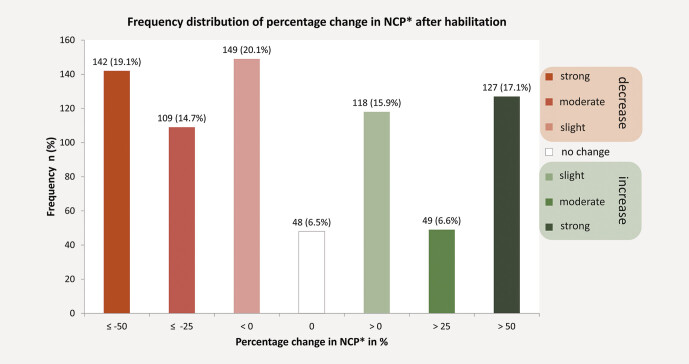 Fig. 1
| University/city |
| % |
| Aachen | 30 | 4 |
| Bochum | 12 | 1.6 |
| Bonn | 32 | 4.3 |
| Berlin Charite | 38 | 5.1 |
| Dresden | 22 | 3 |
| Düsseldorf | 19 | 2.6 |
| Erlangen | 32 | 4.3 |
| Essen | 27 | 3.6 |
| Frankfurt am Main | 12 | 1.6 |
| Freiburg | 34 | 4.6 |
| Gießen | 12 | 1.6 |
| Göttingen | 16 | 2.2 |
| Greifswald | 2 | 0.3 |
| Halle-Wittenberg | 4 | 0.5 |
| Hamburg | 42 | 5.7 |
| Hanover | 37 | 5 |
| Heidelberg | 3 | 0.4 |
| Homburg | 11 | 1.5 |
| Jena | 14 | 1.9 |
| Cologne | 23 | 3.1 |
| Leipzig | 20 | 2.7 |
| Magdeburg | 7 | 0.9 |
| Mainz | 12 | 1.6 |
| Mannheim | 21 | 2.8 |
| Marburg | 12 | 1.6 |
| Technical University of Munich | 39 | 5.3 |
| Ludwig Maximilian University of Munich | 47 | 6.3 |
| Münster | 30 | 4 |
| Regensburg | 32 | 4.3 |
| Rostock | 4 | 0.5 |
| Kiel | 13 | 1.8 |
| Lübeck | 13 | 1.8 |
| Tübingen | 32 | 4.3 |
| Ulm | 21 | 2.8 |
| Witten/Herdecke | 4 | 0.5 |
| Würzburg | 13 | 1.8 |
| Change in NCP 1 | NCP median (IQR) | ||||||
|
Decrease,
|
Increase,
| 2016 | 2017 | 2020 | 2021 | ||
| 1
Percentage change in NCP was calculated as categorial variable for chi-squared test,
2
differences in pooled NCPs between 2016 and 2017 versus 2020 and 2021; bold
| |||||||
|
| |||||||
| Male, 116 (81.1) | 62 (53.4) | 54 (46.6) | 44 (35) | 46 (35) | 46 (36) | 40 (45) | 0.2 |
| Female, 27 (18.9) | 14 (51.9) | 13 (48.1) | 59 (46) | 48 (42) | 50 (28) | 45 (67) | 0.4 |
|
| |||||||
| Male, 403 (67.3) | 215 (53.3) | 188 (46.7) | 54 (44) | 49 (41) | 50 (52) | 47 (58) |
|
| Female, 196 (32.7) | 109 (55.6) | 87 (44.4) | 54 (53) | 59 (46) | 49 (66) | 47 (66) |
|
| Publications, mean (±SD) | Citations, mean (±SD) | Self-citations, mean (±SD) | h-index, mean (±SD) | NCP median (IQR) | |||||
| 2016 | 2017 | 2020 | 2021 | ||||||
|
NCP: Normalized citation percentile, n.m.: not measured,
1
mean difference of subgroups,
2
differences in pooled NCPs between 2016 and 2017 versus 2020 and 2021, bold
| |||||||||
|
| |||||||||
| Total, 742 (100) | 35.1 (33.7) | 411.3 (660) | 6.5 (9.5) | 10 (6.2) | 52 (44) | 50 (42) | 48 (53) | 46 (57) |
|
| Surgical, 143 (19.3) | 26.6 (18.5) | 252.3 (235.8) | 4.2 (4.6) | 8.14 (4.1) | 46 (37) | 47 (36) | 47 (35) | 40 (51) | 0.1 |
| Non-surgical, 599 (80.7) | 37.1 (36.1) | 449.2 (720.4) | 7.1 (10.3) | 10.5 (6.1) | 54 (45) | 51 (43) | 50 (56) | 47 (58) |
|
|
|
|
|
| 0.1 | 0.052 | 0.1 | 0.1 | ||
|
| |||||||||
| Prehab (2016–2018) | 14.6 (13.4) | 58.2 (104.9) | 3 (4.2) | n.m. | |||||
| Posthab (2020–2022) | 15.9 (18.4) | 92.4 (241.2) | 3.6 (6.7) | n.m. | |||||
| 0.23 |
| 0.16 | |||||||
| Publications, mean (±SD) | Citations, mean (±SD) | Self-citations, mean (±SD) | h-index, mean (±SD) | NCP median (IQR) | |||||
| 2016 | 2017 | 2020 | 2021 | ||||||
|
NCP: Normalized citation percentile, n.m.: not measured,
1
mean difference of subgroups,
2
differences in pooled NCPs between 2016 and 2017 versus 2020 and 2021, bold
| |||||||||
|
| |||||||||
| Male 519 (70) | 37 (35.8) | 407.5 (623.9) | 6.8 (10.1) | 10.1 (6.3) | |||||
| Female 223 (30) | 30.6 (27.8) | 420.0 (738.4) | 5.9 (8) | 9.9 (6.2) | |||||
|
| 0.7 | 0.3 | 0.8 | ||||||
|
| |||||||||
| Prehab (2016–2018) | |||||||||
Male | 15.5 (14.1) | 58.61 (108) | 3.11 (4.4) | n.m. | 52 (42) | 49 (40) | |||
Female | 12.5 (11.3) | 57.15 (97.6) | 2.68 (3.5) | n.m. | 54 (45) | 56 (45) | |||
|
| 0.4 | 0.4 | 0.4 |
| |||||
| Posthab (2020–2022) | |||||||||
Male | 16.59 (19.6) | 93.63 (269.7) | 3.7 (7) | n.m. | 48 (48) | 46 (55) |
| ||
Female | 14.12 (15) | 89.47 (156.6) | 3.2 (6) | n.m. | 49 (63) | 46 (67) |
| ||
|
|
|
|
|
| |||||
| Publications, mean (±SD) | Citations, mean (±SD) | Self-citations, mean (±SD) | h-index, mean (±SD) | NCP median (IQR) | |||||
| 2016 | 2017 | 2020 | 2021 | ||||||
|
NCP: Normalized citation percentile, n.m.: not measured, n.a.: not applicable,
1
mean difference of subgroups,
2
differences in pooled NCPs between 2016 and 2017 versus 2020 and 2021, bold
| |||||||||
|
| |||||||||
| 44 (100) | 30.5 (17.4) | 269.8 (157.8) | 4.9 (4.5) | 8.9 (3.1) | 48 (27) | 45 (35) | 49 (29) | 42.5 (39) | 0.8 |
|
| |||||||||
| Male, 42 (95.5) | 31 (17.6) | 269.9 (158.5) | 5 (4.5) | 8.9 (3.1) | |||||
| Female, 2 (4.5) | 20 (8.5) | 269 (202.2) | 3.5 (2.12) | 10 (2.8) | |||||
| 0.4 | 0.9 | 0.8 | 0.5 | ||||||
|
| |||||||||
| Prehab (2016–2018) | |||||||||
Male | 13.8 (7.9) | 31.5 (22.5) | 2.8 (2.5) | n.m. | 48 (26) | 45 (38) | |||
Female | 12 (5.7) | 42.5 (46) | 3 (2.8) | n.m. | 60.5 (n.a.) | 41.5 (n.a.) | |||
|
|
|
|
|
|
| ||||
| Posthab (2020–2022) | |||||||||
Male | 13.9 (10.2) | 38.8 (31.8) | 2.2 (3) | n.m. | 48.5 (26) | 41.5 (37) | 1 | ||
Female | 7 (2.8) | 37 (26.9) | 0.5 (0.7) | n.m. | 74.5 (n.a.) | 61.5 (n.a.) | 0.4 | ||
| 0.4 | 0.9 | 0.4 | 0.1 | 0.2 | |||||
Peer Reviews
No public reviews on file for this paper yet. If you reviewed it on a platform where reviews are public (OpenReview, ICLR, NeurIPS, ICML), you can paste yours below so the community can read it here.
Videos
No videos yet. Explain this paper in a talk, walkthrough, or lecture? Add one.
Taxonomy
TopicsInnovations in Medical Education · Health and Medical Research Impacts · Diversity and Career in Medicine
Introduction
Habilitation is a procedure by which one of the highest university degrees “PD” or “Priv.-Doz.” (Privatdozent) is achieved in the field of medicine in Germany 1 2 3 . This degree is an additional qualification at a higher level than the German doctoral degree, and it is usually a criterion for a full professorship within the German university system 1 2 3 4 . Therefore, habilitation represents a milestone in an academic career. A habilitation candidate must fulfill a university’s set criteria of excellence in research, teaching, and education over a long period 1 2 3 4 . Habilitation is awarded following a public lecture that the candidate delivers after the habilitation thesis has been accepted. Habilitation effectively includes the venia legendi (Latin: “permission to lecture”). The term habilitation is derived from the Latin term “habilis” (having sufficient ability to do or to conduct, being skillful) 5 . Consequently, it could be assumed that academic performance would increase or at least remain at the same high level once this higher qualification has been obtained if science is understood as an endogenous progress in which new, more meaningful findings are based on previous accumulated knowledge 6 . Recent evidence shows declining research productivity worldwide 6 . The volume of research papers published has skyrocketed over the past few decades, but the papers have become less novel compared to prior work 6 . The reasons for this phenomenon are unclear 6 7 .
We hypothesize that habilitation is a career milestone within the German university system, representing an incentive for scientific productivity that falls off once the scientist has achieved the object of this incentive.
This study aims to compare scientific performance among scientists of German universities using bibliometrics before and after completing their academic habilitation milestone.
This study has been authorized by the local ethical committee and was carried out in accordance with the Ethical standards of the 1964 Declaration of Helsinki as updated in 2004.
Scientific performance of all habilitation candidates of German universities in the field of human medicine from 2018 was compared before and after they completed their habilitation. The candidates were researched from announcements of a publicly accessible German university news portal and the biggest national medical journal 8 9 . All candidates from the field of human medicine who had been announced as having completed their habilitation between January 2018 and December 2018 were included.
A three-year period between January 2016 and December 2018 was defined as the period before habilitation (prehab phase). The period after the habilitation (posthab phase) was defined as one year after the year of habilitation (2018) between January 2020 and December 2022. A one-year gap (2019) up to the habilitation year was deliberately chosen. This year was not evaluated to prevent lingering achievements during the prehab phase from distorting results from the posthab phase.
Scientific performance was calculated using established bibliometric parameters from author records in the Web of Science (WoS) 10 . Access took place between November 2023 and December 2023. The primary performance indicator was defined as the normalized citation percentile (NCP). NCPs are part of author impact beamplots 11 . An NCP indicates how a publication has performed relative to its peers, and how performance has changed over time, and therefore serves a normalized performance indicator 12 . NCP values are determined by comparing citations for a single publication to citation counts for all publications in the same year, subject category, and article type, and calculating the percentage of papers at each level of citation. Higher NCP values indicate better performance 12 . For example, a publication with a percentile of value of 99 is in the top 1% of most cited publications in the same article type, year, and subject category 12 . Changes in NCP values of 2016 and 2017 were compared against values of 2020 and 2021. The shortened period was selected because NCPs are not offered for the current and previous analysis year, and analysis was only possible up to 2021 at the time of the study design.
The number of publications, number of citations, and self-citations before and after habilitation were used as secondary performance indicators.
Sex of candidates was determined based on their first names. In addition to the affiliated university, the habilitation subject was categorized into surgical and non-surgical. The profile with the most entries was evaluated for each person with more than one author profile in the WoS. The number of publications, citations, and self-citations as well as h-index of the entire career period were also recorded.
Statistical analysis
Descriptive statistics were calculated. Interval and ordinal dependent variables were compared using the Mann-Whitney U test. NCP values from the two years in the prehab and posthab phases were pooled for group comparison. To calculate percentage change of NCP values, ordinal scaled NCPs in the two years of the prehab and posthab phases were first summed together. The NCP was raised from 0 to 1 for individuals without publications that year to avoid division by zero in the percentage calculation. Percentage change in NCP between the two phases was classified as follows: ≤−50%: strong; ≤−25%: moderate; < 0%: slight; 0%: no change; > 0%: slight; > 25%: moderate; > 50%: strong. Chi-squared test and Fisher’s exact test were used in analyzing the association between sex, subject area, and change in scientific performance. For this purpose, percentage change in NCP was calculated as categorial variable (decrease: < 0%; increase: ≥ 0%).
The confidence level (CI) was set at 95% ( p < 0.05). Data analysis was performed using SPSS 26.0 (IBM, Armonk, New York) and Microsoft Excel 2019 (Microsoft Corporation, Redmond, Washington).
Results
The analysis encompassed 742 habilitation candidates announced from 36 universities. Table 1 lists all the cities where the universities were located and the frequency distribution of scientists.
: Table 1 List of associated cities of included universities, and frequency distribution of scientists. Data are from Web of Science, provided by Clarivate. Web of Science and Clarivate are trademarks of their respective owners and used herein with permission.
Men were represented more often than women by a majority of over two thirds (70% [519]). In surgical disciplines, this distribution was much more divergent with a significant association between sex, and subject area ( p = 0.001; Table 2 ).
: Table 2 Association between sex, subject area, and change in scientific performance.
Scientific performance defined by NCP values decreased significantly after completing habilitation ( p < 0.001; Table 3 ). This applied to both men and women ( p = 0.015, p = 0.003; Table 4 ), but without any significant association between gender, subject area, and change in performance (χ² [1, n = 742] = 0.3, p = 1; Table 2 ).
: Table 3 Mean ± standard deviation (SD), median and interquartile range (IQR) of analyzed scientometric parameters.
However, women in surgical disciplines had lower rates of decline in performance than women in non-surgical subject areas (51.9% vs. 55.6%; Table 2 ).
Most scientists experienced a decline in performance (53.9% [400]). This decline was moderate to severe in a third of the total study population ( Fig. 1 ). Performance increased in 39.6% (294) of the cases and remained at the same level in 6.5% (48) of the cases. Fig. 1 shows frequency distribution of percentage change in NCP after completing habilitation.
Frequency distribution of percentage change in NCP after completing habilitation. Data are from Web of Science, provided by Clarivate. Web of Science and Clarivate are trademarks of their respective owners and used herein with permission.
Women published significantly less than men in the prehab phase and in total ( p = 0.004, p = 0.034; Table 4 ). Nevertheless, they had similar mean values regarding number of citations, self-citations, and h-index, and they tended to be superior in their performance to the men in the prehab phase considering NCP median values. Their performance was even significantly higher in 2017, immediately before habilitation ( p = 0.003). This advance diminished in the posthab phase, and their level of performance was comparable to that of men ( Table 4 ). Secondary performance indicators – number of publications, number of self-citations – did not change significantly, but the absolute number of citations increased significantly in the posthab phase ( p = 0.03; Table 4 ).
: Table 4 Mean ± standard deviation (SD), median and interquartile range (IQR) of analyzed scientometric parameters regarding gender differences.
Orthopedic surgeons and traumatologists (O&T)
NCPs of 44 scientists were examined and showed a statistically non-significant decrease in performance after habilitation ( Table 5 ). This decline was moderate to severe in 31.8% (14) of this subgroup.
: Table 5 Mean ± standard deviation (SD), median and interquartile range (IQR) of orthopedic surgeons, and traumatologists regarding differences by sex.
Women were strongly underrepresented in this male-dominated discipline (4.5%, 2). However, similar to the total cohort, women published less than men but demonstrated nearly equal mean values regarding number of citations, and h-index. In addition, they tended to be superior in their performance to the men in both phases regarding NCP median values. In contrast to men, their performance even tended to increase after habilitation ( Table 5 ).
Discussion
This is the first study to investigate scientific performance in the field of medicine among scientists of German universities with particular focus on their performance before and after finishing habilitation that functions as an academic milestone.
Our principal finding was that most scientists in Germany experienced a significant decline in scientific performance measured by an established bibliometric parameter after reaching that milestone. This decline in performance was moderate to severe in a third of the study population ( Fig. 1 ). The primary performance indicator measured by using the normalized citation percentile decreased significantly, whereas secondary performance indicators, such as the number of publications and absolute number of citations, remained almost the same or increased significantly.
If science is understood as a progress in which new, more meaningful findings are based on previous ones 6 7 , and completing the habilitation is understood as just one milestone on this path that proves the ability to conduct independent research, then this observation is surprising. One would expect that academic performance would at least remain the same or increase further after habilitation. However, the opposite effect as observed – an decrease – supports our assumption that habilitation might be a career milestone within the German university system representing an incentive for scientific productivity that declines once a scientist has achieved the object of this incentive. These individuals might have primarily been interested in obtaining an academic title and could have influenced the results by representing a “low hanging fruits” mentality 6 7 . However, other reasons are also conceivable. Personal circumstances could have been responsible for a temporary focus on other aspects of both private and professional life after reaching this career milestone. A temporary reduction in performance to recover intellectual creativity after the strenuous, time-consuming habilitation phase is conceivable.
Our finding that women tend to lose performance slightly more than men could underline this assumption. Women are known to be exposed to greater hurdles in their academic careers 13 14 15 16 , and the far lower number of habilitation candidates may reflect the additional burden of family planning in the following years 14 15 16 . Interestingly, we observed that women have published significantly less than men. Nevertheless, their mean values regarding number of citations and h-index were similar, and their performance measured by NCPs even tended to be superior to men in the prehab phase, which might confirm that a high quantity (number of publications) does not necessarily guarantee scientific quality.
Women’s performance in the year 2017, immediately before habilitation, was even significantly higher. This advantage flattened out after finishing habilitation, reaching a performance level comparable to that of men.
Women were strongly underrepresented (4.5%, 2) in the male-dominated O&T discipline, and tended to be superior to the men in both phases. In contrast to the men, their performance even tended to increase after reaching the academic milestone. Our observation that women surgical disciplines have a lower rate of performance loss than in non-surgical subjects, where the proportion of women is higher, suggests that this outsider role may be responsible for the result. However, our data subgroups are too different in sample size to allow a valid interpretation of these gender differences.
This study has several strengths. In addition to the large sample size, one of the strengths is the usage of NCPs as a performance indicator instead of the widely known h-index 11 12 17 . This index characterizes a researcher’s publication and citation counts to a single number that depends on career length and discipline as citation counts accumulate over time at rates that vary between research fields 12 17 18 . Therefore, it does not provide valid comparability between individuals and is mathematically inconsistent 12 18 .
Bornmann and Marx of the Max Planck Society introduced and developed usage of NCP containing impact beamplots for bibliometric data. The Institute for Scientific Information (ISI) has promoted NCP containing beamplots as an alternative to the h-index as they contextualize a researcher’s article to make them suitable for comparison; this reduces the risk of reliance on a single-point metric that lacks context and nuance, and performance changes can be evaluated over the course of a researcher’s career 12 19 20 .
However, this study also has several limitations to consider. Firstly, the results are only transferable to a single country with a specific university system and only one discipline. Secondly, the results are limited by selection bias, as only a sample of scientists from 2018 was examined. Only scientists whose names had been publicly announced on the two accessed platforms could be included. Thirdly, the study period was short. Performance was examined just one year after the habilitation. It remains unclear whether and for how this decline would be observed over a longer examination period.
Conclusion
Scientific performance seems to be incentive-dependent and significantly decreases after completing a career milestone in Germany, but without any significant association between gender, subject area, and change in performance. In O&T, this decline is not statistically significant; women, who are strongly underrepresented, even tend to increase their performance.
The reference list from the paper itself. Each links out to its DOI / PubMed record.
- 1Yildirim TM Auffarth GU Khoramnia R[How to: the path to habilitation]Ophthalmologie 202412192792910.1007/s 00347-024-02005-938438810 · doi ↗ · pubmed ↗
- 2Weineck SB Koelblinger D Kiesslich T[Medical habilitation in German-speaking countries: Quantitative assessment of content and elaboration of habilitation guidelines]Chirurg 20158635536510.1007/s 00104-014-2766-225047266 · doi ↗ · pubmed ↗
- 3Strauss M Ehlers J GerßJ[Status Quo – The requirements for medical habilitation in Germany]Dtsch Med Wochenschr 2020145 e 130e 13610.1055/a-1210-522133022742 PMC 7671823 · doi ↗ · pubmed ↗
- 4Research in Germany How to become a professor in Germanyhttps://www.research-in-germany.org/en/your-goal/postdoc/career-options-and-dual-careers/professorship.html
- 5DWDS – Digital Dictionary of the German Language Habilitation, diehttps://www.dwds.de/wb/Habilitation
- 6Park M Leahey E Funk RJ Papers and patents are becoming less disruptive over time Nature 202361313814410.1038/s 41586-022-05543-x 36600070 · doi ↗ · pubmed ↗
- 7Kozlov M‘Disruptive’ science has declined – and no one knows why Nature 202361322510.1038/d 41586-022-04577-536599999 · doi ↗ · pubmed ↗
- 8Deutsches Ärzteblatt https://www.aerzteblatt.de/int