PREVALENCE OF PALMARIS LONGUS TENDON AGENESIS IN A POPULATION OF MEDICAL STUDENTS
Paola Dias Tagliacozzo, Camila Cassillo, Julio Cesar Gali, Wallace Rodrigo Dantas, Leonardo Goya Machado, Edie Benedito Caetano

TL;DR
This study found that 16% of medical students lack the palmaris longus tendon, with a higher rate in females and on the left side.
Contribution
The study reports a 16% prevalence of palmaris longus tendon agenesis in medical students, highlighting gender and lateral differences.
Findings
Agenesis of the palmaris longus tendon was observed in 16% of 200 evaluated limbs.
Females had a higher rate of agenesis (21%) compared to males (11%).
Tendon absence was more frequent in the left upper limb regardless of gender.
Abstract
To assess the prevalence of palmaris longus (PL) tendon agenesis in a population of medical students. The presence of the palmaris longus tendon was evaluated using Schaeffer's test, applied bilaterally in 100 medical students, totaling 200 evaluated antimeres. The data were analyzed for unilateral or bilateral presence of the tendon, in relation to gender, laterality (right or left), and the occurrence of agenesis. Agenesis of the palmaris longus tendon was observed in 32 out of 200 evaluated antimeres (16%). Among female participants, agenesis was identified in 21 antimeres (21%), whereas in males it was observed in 11 antimeres (11%). Tendon absence was more frequent in the left upper limb, regardless of gender. The prevalence of palmaris longus tendon agenesis in the studied sample was 16%, with a higher frequency among females. Tendon absence was more common on the left side in…
Genes, proteins, chemicals, diseases, species, mutations and cell lines named across the full text — each resolved to its canonical identifier and authoritative record.
Click any figure to enlarge with its caption.
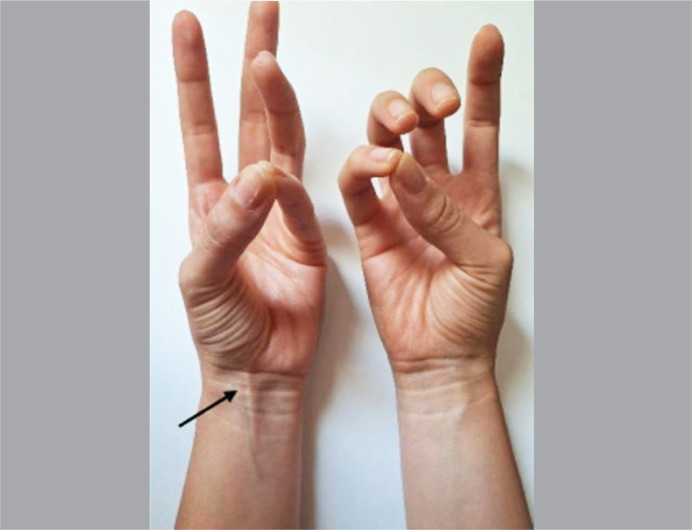 Figure 1
| Sex | Female | Male |
|---|---|---|
| Unilateral and bilateral agency | 21% | 11% |
| Unilateral agenesis to the right | 16% | 10% |
| Unilateral agenesis to the left | 26% | 12% |
| Bilateral agency | 6% | 6% |
| Total of individuals | 50 | 50 |
Peer Reviews
No public reviews on file for this paper yet. If you reviewed it on a platform where reviews are public (OpenReview, ICLR, NeurIPS, ICML), you can paste yours below so the community can read it here.
Videos
No videos yet. Explain this paper in a talk, walkthrough, or lecture? Add one.
Taxonomy
TopicsTendon Structure and Treatment · Orthopedic Surgery and Rehabilitation · Peripheral Nerve Disorders
INTRODUCTION
The palmaris longus (PL) is a superficial muscle covered by the anterior fascia of the forearm,^ 1–3 ^ being responsible for the flexion of the wrist and the tension of the palm aponeurosis.^ 2–5 ^ It originates from the medial epicondyle of the humerus, extending medially to the carpal's radial flexor muscle and laterally to the carpal's ulnar flexor, entering the palm aponeurosis.^ 2,3,6 ^ It is innervated predominantly by the median nerve and can, in some cases, receive innervation from the ulnar nerve, and is vascularized by recurrent ulnar arteries.^ 1,7 ^ This muscle is considered to be the most variable of the human body, and may present variations in duplication, agenesis, position and insertion.^ 8,9 ^ According to Yammine et al.^ 10 ^, the variations in the PL are associated with a dominant pattern of autosomal inheritance with incomplete penetration. There is evidence of its evolutionary role: in arboreal primates, the muscle is consistently present, assisting in climbing and grasping objects; whereas in bipedal or predominantly terrestrial primates, its presence becomes more variable, PL has become less necessary, which justifies its vestigial characteristic.^ 5,8,11,12 ^
The prevalence of PL tendon agenesis is approximately 15%.^ 2,5 ^ Epidemiological studies suggest that the regression of this muscle may be related to the migration of the Homo sapiens from the African continent, as Caucasian populations present higher rates of PL agenesis (26%) compared to descendants of Asian peoples (12%) and African peoples (6%).^ 7,13 ^ Some articles also indicate that the absence of PL occurs more frequently unilaterally, predominantly on the left side, and is more common in female sex.^ 2,12,14,15 ^
Although it is considered a vestigial muscle, the absence of which does not compromise the movements of the hand or wrist, the PL has clinical and surgical relevance.^ 9,16 ^ It is used in reconstructive procedures, such as replacement and repair of other tendons, repair of facial paralysis and reconstruction of labia defects, in addition to serving as an anatomical reference for the location of the median nerve.^ 3,15,17,18 ^ Changes in its anatomical insertion may also be associated with clinical manifestations of carpal tunnel syndrome.^ 11,12,19–23 ^
Knowledge of the prevalence of PL agenesis is essential to provide anatomical information to surgeons, allowing them to know its variations, which are useful in planning surgeries involving the use of palmar muscle as a graft or as an anatomical reference in surgical procedures. We found few studies addressing the prevalence of this tendon in the Brazilian population. Thus, the present study aimed to identify the frequency of PL muscle tendon agenesis in a population of 100 medical students.
MATERIALS AND METHODS
This research was approved by the Ethics Committee of our institution under the number 57590422.0.0000.5373. The sample was composed of 100 medical students, from the first to the sixth year of the course, aged between 18 and 30 years, of whom 50 were female and 50 were male. Only individuals without a history of trauma in the ventral area of the forearms or any history of diseases affecting the soft parts of this area were included. The selection of participants was random, depending on the availability of volunteers. Verification of the PL tendon was performed using Schaeffer's maneuver on both forearms. This test consists of asking the volunteer to keep the elbow folded at 90 degrees and perform the wrist flexion associated with the opposition of the thumb to the smallest finger (Figure 1). The presence of the tendon was considered positive when it became visible in the distal third of the wrist; if it was not possible to visualize it, its absence was recorded.
Anterior photographic view depicting bilateral performance of Schaeffer's maneuver. The PL tendon is present on the left side (arrow) and there is agenesis of this tendon on the right side.
The tests for each antimere were conducted independently by two authors (PDT and CC), and the results were later compared to verify inter-observer agreement. The gender of the student and the side (or bilaterality) of the long PL tendon agenesis were recorded.
RESULTS
Based on the data obtained, the prevalence of absence of the long PL tendon in the evaluated population was 16%. When stratified by sex, absent tendon was observed in 21% of women and 11% of men. In the female sample (n = 100 upper antimeres), the absence of the tendon was identified in 21 antimeres, with eight in the upper right limb and 13 in the left. Three volunteers presented bilateral agenesis. In the male sample (n = 100 upper antimeres), the absence was observed in 11 members, five to the right and six to the left, with the occurrence of bilateral agenesis in three individuals.
Considering the general prevalence of the absence of the PS tendon by antimeres, regardless of gender, a rate of 13% was observed in the right upper limb and 19% in the left upper limb. Stratified by sex, the data indicated that the absence on the right side was 16% in women and 10% in men; on the left side, the agenesis was 26% in women and 12% in men. The overall prevalence of bilateral PL tendon agenesis, considering both sexes, was 6% in both sexes. The results are grouped in Table 1.
DISCUSSION
The main finding of this study was the verification of the prevalence of PL tendon agenesis (PL) in 16% of the sample analyzed. This condition was more common among female individuals (21%), compared to male individuals (11%). Regarding laterality, the absence of tendon was more prevalent in the left upper limb (19%) than in the right (13%). Bilateral agenesis was observed in 6% of participants, with no difference between the sexes.
National studies conducted by Garcia et al.^ 1 ^ Bonsi,^ 24 ^ Pierucci et al.^ 25 ^ and Morais et al.^ 26 ^ report frequencies of agenesis of PL of 13.9%, 16.5%, 9.2% and 26.5%, in this order. The findings of this study approximate the data reported by Bonsi,^ 24 ^ whose prevalence was 16.5%, and are also comparable to the results of Garcia et al.^ 1 ^ (13.9%). On the other hand, the percentages observed by Pierucci et al.^ 25 ^ and Morais et al.^ 26 ^ showed more pronounced discrepancies. A methodological analysis of the studies of Garcia et al.^ 1 ^ and Bonsi^ 24 ^ revealed that both used the same procedure adopted in this research, i.e. Schaeffer's maneuver, and it is therefore not possible to attribute the observed divergence to the technique employed. However, Morais et al.^ 26 ^ applied four different maneuvers to confirm the absence of the PL tendon, which may justify, at least partially, the observed difference.
In comparing our results with international literature data, we found that Cohen et al.^ 13 ^ reported the absence of PL tendon in 28% of the Israeli population, while Al Risi et al.^ 19 ^ found the prevalence of agenesia in 7.5% of the Oman population. In the Pakistani population, Javaid27 observed a 12% prevalence of this tendon agenesis. On the other hand, Kapoor et al.^ 15 ^ observed the absence of tendon in 17.2% of the Indian population and Sadacharan et al.^ 12 ^ identified this absence in 12.8% of the African population. Cohen et al.^ 13 ^ suggested that PL prevalence is more strongly associated with geographical than ethnic factors, observing that individuals of different ethnicities, but residing in the same geographic region, presented similar rates of agenesis. This hypothesis may contribute to the understanding of the observed variations in relation to the data obtained in this study.
The results presented here corroborate the findings of Morais et al.^ 26 ^ Javaid,^ 27 ^ Ioannis et al.^ 2 ^ Raouf et al.^ 14 ^ and Kapoor et al.^ 1 ^ which also report greater prevalence of PL agenesis in female subjects and left antimere. These findings contrast with the data from Al Risi et al.^ 19 ^ that identified a higher prevalence of the absence of PL in males. Pierucci et al.^ 25 ^ in turn described a higher prevalence of unilateral agenesis in the left antimeric among men (15.2%) and in the right antimeric among women (18%).
Additionally, the data from this study indicate that bilateral PL agenesis occurs less frequently than unilateral agenesis, a pattern also reported by Garcia et al.^ 1 ^ Pierucci et al.^ 25 ^ Sadacharan et al.^ 12 ^ and Morais et al.^ 26 ^ No records were identified in the literature indicating a higher prevalence of bilateral agenesis of the PL tendon compared to the unilateral form.
As a limitation of our study we can cite that we did not investigate whether there was a correlation between the side of the agenesis of the PL tendon and the dominant limb and, as a clinical relevance, we can highlight that the agenesis of this tendon is present in a small portion of the population and that the bilateral absence is even smaller, which makes the PL tendon a viable option for use as a tendon graft in lesions of the finger flexors, for example, since the removal of this anatomical structure practically does not interfere with the flexion of the wrist, since other tendons, such as the ulnar flex of the carp and the radial flexor of the carp perform this function more efficiently.
CONCLUSION
In the analyzed population, PL tendon agenesis was observed in 16% of subjects, being more common in females and left antimeres. Bilateral agenesis was identified in 6% of individuals of both sexes.
The reference list from the paper itself. Each links out to its DOI / PubMed record.
- 1Garcia LB Marques CN dos Santos CM Bertolini SMMG Estudo da prevalência do músculo palmar longo em humanos Iniciação Científica Cesumar 2007711924
- 2Ioannis D Anastasios K Konstantinos N Lazaros K Georgios N Palmaris Longus Muscle's Prevalence in Different Nations and Interesting Anatomical Variations: Review of the Literature J Clin Med Res 201571182583010.14740/jocmr 2243 w 26491493 PMC 4596262 · doi ↗ · pubmed ↗
- 3Chandan CB Nitisha, Kumar P Akhtar MJ Kumar A Study of morphometric and anatomical variations of palmaris longus and plantaris tendons Eur J Mol Clin Med 20229410751082
- 4Fowlie C Fuller C Pratten MK Assessment of the presence/absence of the palmaris longus muscle in different sports, and elite and non-elite sport populations Physiotherapy 201298213814210.1016/j.physio.2011.02.00622507364 · doi ↗ · pubmed ↗
- 5Georgiev GP Iliev AA Dimitrova IN Kotov GN Malinova LG Landzhov BV Palmaris Longus Muscle Variations: Clinical Significance and Proposal of New Classifications Folia Med (Plovdiv)201759328929710.1515/folmed-2017-003528976893 · doi ↗ · pubmed ↗
- 6Angelini LCJúnior Angelini FB Oliveira BC Soares SA Angelini LC Cabral RH SE OF THE TENDON OF THE PALMARIS LONGUS MUSCLE IN SURGICAL PROCEDURES: STUDY ON CADAVERS Acta Ortop Bras 201220422622910.1590/S 1413-7852201200040000724453608 PMC 3718403 · doi ↗ · pubmed ↗
- 7Andring N Kennedy SA Iannuzzi NP Anomalous Forearm Muscles and Their Clinical Relevance J Hand Surg Am 201843545546310.1016/j.jhsa.2018.02.02829602650 · doi ↗ · pubmed ↗
- 8Aversi-Ferreira RA Bretas RV Maior RS Davaasuren M Paraguassú-Chaves CA Nishijo H Morphometric and statistical analysis of the palmaris longus muscle in human and non-human primates Biomed Res Int 2014201417890617890610.1155/2014/17890624860810 PMC 4016873 · doi ↗ · pubmed ↗