Clinical Presentation and Molecular Characteristics of Kabuki Syndrome With Congenital Hyperinsulinism: A Retrospective Study
Mélanie Gaudillière, Thibaud Armand, Valérie Senée, Carine Villanueva, Marc Nicolino, Kevin Perge

TL;DR
This study explores the high rate of congenital hyperinsulinism in Kabuki syndrome patients and its genetic basis.
Contribution
The study identifies a strong correlation between specific KMT2D gene variants and hypoglycaemia in Kabuki syndrome.
Findings
33% of Kabuki syndrome patients presented neonatal hypoglycaemia, with 28% having congenital hyperinsulinism.
All hypoglycaemic patients had truncating variants in the C-terminal part of the KMT2D gene.
Diazoxide monotherapy was effective in managing hyperinsulinism in most cases.
Abstract
Introduction: Kabuki syndrome (KS) is a rare disease predisposing to congenital hyperinsulinism (CHI). The incidence of CHI in KS may be higher than considered in practice, and appropriate management of hypoglycemia would reduce long-term neurologic morbidity in these patients. Thus, the aims of our study were to estimate the occurrence rate of CHI-related hypoglycaemia in KS, to describe its evolution, and to identify potential genotype-phenotype correlations. Methods: We conducted a single-centre retrospective study in patients with KS from 1999 to 2024. Results: Among the 18 patients identified with KS included in the study, six (33%) presented neonatal hypoglycaemia, of whom five (28%) demonstrated CHI. Of these five, three had persistent CHI. Only the three patients with this condition required anti-hypoglycaemic drugs. They all responded well to diazoxide monotherapy, and one…
Genes, proteins, chemicals, diseases, species, mutations and cell lines named across the full text — each resolved to its canonical identifier and authoritative record.
Click any figure to enlarge with its caption.
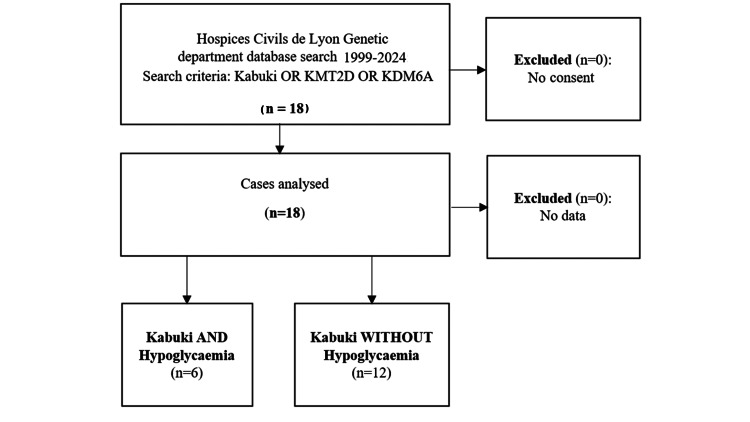 Figure 1
| Parameters | Total cohort (n=18), n (%) | Patients with hypoglycaemia (n=6), n (%) | Patients without hypoglycaemia (n=12), n (%) |
| Sex male | 11 (61%) | 3 (50%) | 8 (67%) |
| Sex female | 7 (39%) | 3 (50%) | 4 (33%) |
| IUGR | 0 (0%) | 0 (0%) | 0 (0%) |
| Median birth weight (grams), median (IQR) | 2910 (2687-3385) | 2910 (2595-3710) | 3005 (2687-3305) |
| Age at delivery (weeks+day of gestation) | 39 (38-39+5) | 38 (36+6-40) | 39 (38-39+5) |
| Caucasian ethnicity | 13 (72%) | 5 (83%) | 8 (67%) |
| CHI confirmed | 5 (28%) | 5 (83%) | 0 (0%) |
| Case ID | Age at last investigation (years) | Sex | Ethnicity | Age at delivery (weeks of gestation) | Birth weight (grams) | Presentation of hypoglycaemia/Level of PG (mg/dL) | Insulinemia (mUI/L) | Treatment of hypoglycaemia | Evolution | Variants |
| 1 | 18 | M | Maghreb | 39 | 3200 | 0 | - | 0 | 0 | Gene |
| 2 | 14 | M | Caucasian | 40 | 3260 | 0 | - | 0 | 0 | Gene |
| 3 | 8 | F | Caucasian | 39 | 2770 | Hypo D1 PG: 32mg/dL | NA | CEF +IV (7,5mg/kg/min) then IEF +DM by NG TUBE stop D12 | 0 | Gene |
| 4 | 16 | F | Caucasian | 38 | 2790 | 0 | - | 0 | 0 | Gene |
| 5 | 11 | M | Caucasian | 37+6 | 3420 | Hypo D1 PG :21mg/dL | 4 | CEF+IV (8mg/kg/min) then IEF +DM by NG TUBE stop D10 | 0 | Gene |
| 6 | 10 | M | African/ Caucasian | 38 | 2920 | Hypo D1 PG :35mg/dL | 6 | CEF +IV (12mg/kg/min) +Diazoxide 8mg/kg/d from D14, then IEF DM by NG TUBE, then IEF by gastrostomy from 6 months | Stop Diazoxide at 6 years old | Gene |
| 7 | 11 | F | Caucasian | 39+2 | 3680 | 0 | - | 0 | 0 | Gene |
| 8 | 4 | F | Caucasian | 41 | 4000 | Hypo D1 PG: 28mg/dL | 5 | CEF +IV (9.5mg/kg/min) then IEF +DM by NG TUBE stop D21 | Stop NG TUBE at 6 months old | Gene |
| 9 | 19 | M | Caucasian | 40 | 3520 | 0 | - | 0 | 0 | Gene |
| 10 | 11 | M | Caucasian | 35 | 2420 | 0 | - | 0 | 0 | Gene |
| 11 | 19 | F | Maghreb | 38 | 2700 | 0 | - | 0 | 0 | Gene |
| 12 | 22 | F | Caucasian | 39 | 3350 | 0 | - | 0 | 0 | Gene |
| 13 | 7 months | F | Caucasian | 37+5 | 2900 | Hypo D1 PG :34mg/dL | 12 | CEF +IV(10mg/kg/min) + Diazoxide 7mg/kg/d from D21, then IEF +DM by NG TUBE, then IEF by gastrostomy from 5 months old | IEF with 11mg/kg/d + Diazoxide 9mg/kg/d | Gene |
| 14 | 21 months | M | Maghreb/ Turkish | 40 | 3160 | 0 | - | 0 | 0 | Gene |
| 15 | 17 | M | Caucasian | 36 | 2420 | Hypo D1 PG :23mg/dL | 8 | CEF +IV (11mg/kg/min)+ glucagon +diazoxide 10mg/kg/d from D14+ octreotide by pump from 3 months old, then IEF by gastrostomy from 6 months old | Stop diazoxide at 4 years Stop octreotide at 10 years | Gene |
| 16 | 14 | M | Turkish | 39+2 | 2850 | 0 | - | 0 | 0 | Gene |
| 17 | 12 | M | Caucasian | 37 | 2600 | 0 | - | 0 | 0 | Gene |
| 18 | 15 | M | Caucasian | 38+2 | 2625 | 0 | - | 0 | 0 | Gene |
| Case ID | Presentation of hypoglycaemia/Level of PG (mg/dL) | Insulinemia (mUI/L) | Treatment of hypoglycaemia | Evolution |
| 3 | Hypo D1 PG: 32mg/dL | NA | CEF +IV (7,5mg/kg/min) then IEF +DM by NG TUBE | Stop at D12 |
| 5 | Hypo D1 PG: 21mg/dL | 4 | CEF+IV (8mg/kg/min) then IEF +DM by NG TUBE | Stop at D10 |
| 6 | Hypo D1 PG: 35mg/dL | 6 | CEF +IV (12mg/kg/min) + Diazoxide 8mg/kg/d from D14, then IEF+ DM by NG TUBE, then IEF by gastrostomy from 6 months old | Stop Diazoxide at 6 years old |
| 8 | Hypo D1 PG: 28mg/dL | 5 | CEF +IV (9.5mg/kg/min) then IEF +DM by NG TUBE | Stop at D21 |
| 13 | Hypo D1 D1 :34mg/dL | 12 | CEF +IV (10mg/kg/min) + Diazoxide 7mg/kg/d from D21, then IEF +DM by NG TUBE, then IEF by gastrostomy from 5 months old | IEF with 11mg/kg/d + Diazoxide 9mg/kg/d |
| 15 | Hypo D1 D1: 23mg/dL | 8 | CEF +IV (11mg/kg/min)+ +Diazoxide 10mg/kg/d from D14+ octreotide by pump from 3 months old, then IEF by gastrostomy from 6 months old | Stop Diazoxide at 4 years old Stop octreotide at 10 years old |
| Case | Exon | Nucleotide change | Amino acid change | Type |
| 1 | 31 | c.7216G>A | p.Asp2406Asn | MS |
| 2 | 39 | c.13040_13041del | p.Gln4347Argfs*23 | FS |
| 3 | 3 | c.269_272del | p.Asp90Glyfs*39 | FS |
| 4 | 51 | c.16273G>A | p.Glu5425Lys | MS |
| 5 | 48 | c.14946dup |
| FS |
| 6 | 39 | c.11515dup | p.Gln3839Profs*173 | FS |
| 7 | 48 | c.15640C>G | p.Arg5214Gly | MS |
| 8 | 47 | c.14568G>A | p.Trp4856* | NS |
| 9 | 39 | c.11791C>T | p.Leu3931Phe | MS |
| 10 | 48 | c.15461G>A | p.Arg5154Gln | MS |
| 11 | 53 | c.16501C>T | p.Arg5501* | NS |
| 12 | 28 | c.5993A>G | p.Tyr1998Cys | MS |
| 13 | 39 | c.11944C>T | p.Arg3982* | NS |
| 14 | All | Microdeletion 1.6Mb | Del | |
| 15 | 31 | c.6987_6988insT | p.Pro2330Serfs*47 | FS |
| 16 | - | c.14516-1G>C | p.Gly4840Glufs*30 | I |
| 17 | 31 | c.6751del |
| FS |
| 18 | 31 | c.7670C>T | p.Pro2557Leu | MS |
Peer Reviews
No public reviews on file for this paper yet. If you reviewed it on a platform where reviews are public (OpenReview, ICLR, NeurIPS, ICML), you can paste yours below so the community can read it here.
Videos
No videos yet. Explain this paper in a talk, walkthrough, or lecture? Add one.
Taxonomy
TopicsGenomics and Rare Diseases · Immunodeficiency and Autoimmune Disorders · Hyperglycemia and glycemic control in critically ill and hospitalized patients
Introduction
Described for the first time in 1981 by Kuroki et al. [1] and Niikawa et al. [2], Kabuki syndrome (KS) is an uncommon and variable congenital condition, occurring in roughly one out of 32,000 births in Japan and about one out of 86,000 in other regions of the world [3,4]. Genetically, KS demonstrates an autosomal dominant pattern of inheritance and two genes have been identified: KMT2D discovered in 2010 [5], located on chromosome 12q13, which variants are found in 70-75% of cases [6], and KDM6A, first described in 2012 [7], located on Xp11.23, which variants are found in 1-9% of cases [6].
Clinically, this syndrome presents five principal traits: a facial dysmorphy (prominent ears, arched eyebrows with the lateral one third dispersed, depressed nasal tip, and neversion of the lower lateral eyelid), various skeletal anomalies such as brachydactyly and scoliosis, distinctive dermatoglyphic patterns including persistent fingertip pads and an increased number of loop fingerprints, mild to moderate cognitive impairment, and postnatal growth delay despite normal weight and length at birth [3,4,8]. Other commonly reported clinical features include neonatal hypotonia, recurrent otitis media, feeding problems, cleft palate, oligodontia, congenital heart defect, gastrointestinal and renal anomalies, immune deficiency, and congenital hypothyroidism [4].
Hypoglycaemia is an uncommon endocrine manifestation [9,10], and when it occurs, it is often linked to growth hormone deficiency, adrenal or adrenocorticotropic hormone (ACTH) insufficiency, or to congenital hyperinsulinism (CHI) [11,12]. CHI can be transient or permanent and is often described as a rare manifestation, characterized by a good response to diazoxide. Because recent studies have shown that the incidence of CHI would be more important than considered in practice [11] and because an appropriate management of hypoglycaemias would reduce long-term neurologic morbidity in these patients [12], we conducted a retrospective study in patients affected with KS in our department of paediatric endocrinology in order to: (i) estimate the occurrence rate of CHI-related hypoglycaemia in KS, (ii) to describe its evolution, and (iii) to identify potential genotype-phenotype correlations.
Materials and methods
This was a retrospective study of all children with genetically proven KS followed between 1999 and 2024 in the Department of Paediatric Endocrinology, Hôpital Femme Mère Enfant under Hospices Civils de Lyon, Lyon, France. The study protocol received approval from the Scientific and Ethical Committee of Hospices Civils de Lyon and was carried out in accordance with the principles of the Declaration of Helsinki. In line with current French regulations, parents were informed about the study.
Molecular genetics analyses
Genomic DNA was extracted from ethylenediaminetetraacetic acid (EDTA)-treated peripheral blood samples using the Maxwell® 16 LEV Blood DNA Kit (Promega, Madison, Wisconsin, United States). The exons and exon-intron junctions of the KMT2D gene were first examined using Sanger sequencing or targeted next-generation sequencing (MiSeq; Illumina, Inc., San Diego, California, United States).
Data collection
Information on genotypes (variant type, molecular nature, and predicted protein impact), demographic characteristics (sex, ethnicity, and age at last evaluation), and clinical and biochemical phenotypes was collected for each case. Children were considered cured of CHI from the time they no longer required hyperglycaemic medication and had normal carbohydrate intakes for their age.
Definitions
Hypoglycaemia was defined as a plasma glucose value < 50 mg/dL, and CHI diagnosis was established as an excessive and inappropriate level of insulin during episodes of hypoglycaemia (insulin level >1 mUI/L). If CHI lasted more than six months, it was considered persistent.
Statistical analysis
Phenotypic and genotypic characteristics were examined using descriptive statistical methods. Continuous quantitative variables were summarized by their median and interquartile range (IQR), while categorical variables were described using frequency distributions.
Results
Patient characteristics
A total of 18 patients with KS followed up between 1999 and 2024 were included in our study (Figure 1). Table 1 and Table 2 summarize the clinical characteristics of these patients. Among the 18 patients (11 boys (61%) and seven girls (39%)) with KS studied, 33% (n=6) presented with neonatal hypoglycaemia, of which 28% (n=5) demonstrated CHI. In all the cases, hypoglycaemia was diagnosed on day 1, with the diagnosis of KS evoked in all patients, particularly in the presence of the facial phenotype. There were no children with intrauterine growth retardation and no mothers with gestational diabetes. Three of the KS patients (17%) had persistent CHI; only these three patients required anti-hypoglycaemic drugs, and they all responded well to diazoxide monotherapy, and one then needed the addition of octreotide. In the overall cohort, the median birth weight was 2910 g (range, 2687-3385 g) and the median age at delivery was 39 weeks of gestation (range, 38 weeks-39 weeks+5 days). The children were mostly of Caucasian origin (72%). No clinical differences were obvious at birth between those who develop hypoglycaemia and those who do not.
Flowchart of study participants
KS cases with CHI
Case 3
Patient 3 was a girl born to healthy, unrelated parents. She was born at term and eutrophic (39 AW, 2770 g). She presented hypoglycaemia on the first day of life without a determined aetiology (plasma glucose at 32 mg/dl, insulin level not available). She was able to achieve normoglycaemia through continuous glucose intake via nasogastric tube and intravenous infusion (intakes around 7,5mg/kg/min), then by discontinuous intakes that were enriched with maltose dextrin administered with nasogastric tube. She recovered from hypoglycaemia without any pharmacological treatment on day 12. Genetic samples revealed a heterozygous de novo variant in *the KMT2D gene (c.269_272del) leading to a truncated protein (p.Asp90Glyfs39).
Case 5
Patient 5 was a boy born to healthy, unrelated parents. He was born at term and eutrophic (37+6 AW, 3420 g). He presented hypoglycaemia on the first day of life (insulin level at 4 mUI/L for plasma glucose at 21 mg/dl). He was able to achieve normoglycaemia through continuous glucose intake via nasogastric tube and intravenous infusion (intakes around 8 mg/kg/minute), then by discontinuous intakes that were enriched with maltose dextrin administered with a nasogastric tube. He recovered from hypoglycaemia without any pharmacological treatment on day 10. Genetic samples revealed a heterozygous de novo variant* KMT2D* gene (c.14946dupG), leading to a truncated protein (p.Lys4983Glufs*24).
Case 6
Patient 6 was a boy born to healthy, unrelated parents. He was born at term and eutrophic (38 AW, 2920 g). He presented hypoglycaemia on the first day of life (insulin level at 6 mUI/L for plasma glucose at 35 mg/dl). He was able to achieve normoglycaemia through continuous glucose intake via nasogastric tube and intravenous infusion (intakes around 12 mg/kg/minute), then by diazoxide therapy from day 14 at 8 mg/kg/day. Then, he had discontinuous intakes that were enriched with maltose dextrin administered with a nasogastric tube, then with a gastrostomy. He recovered from hypoglycaemia at the age of six months. Genetic samples revealed a heterozygous de novo variant KMT2D gene (c.11515dup), leading to a truncated protein (p.Gln3839Profs*173).
Case 8
Patient 8 was a girl born to healthy, unrelated parents. She was born at term and eutrophic (41 AW, 4000 g). She presented hypoglycaemia on the first day of life (insulin level at 5 mUI/L for plasma glucose at 28 mg/dl). She was able to achieve normoglycaemia through continuous glucose intake via nasogastric tube and intravenous infusion (intakes around 9,5 mg/kg/minute), then by discontinuous intakes that were enriched with maltose dextrin administered with nasogastric tube. She recovered from hypoglycaemia without any pharmacological treatment on day 21. Genetic samples revealed a heterozygous de novo variant KMT2D gene (c.14568G>A), leading to a truncated protein (p.Trp4856*).
Case 13
Patient 13 was a girl born to healthy, unrelated parents. She was born at term and eutrophic (37+5 AW, 2900 g). She presented hypoglycaemia on the first day of life (insulin level at 12 mUI/L for plasma glucose at 34 mg/dl). She was able to achieve normoglycaemia through continuous glucose intake via a nasogastric tube and intravenous infusion (intakes around 10 mg/kg/minute), then by diazoxide therapy from day 21 at 7 mg/kg/day. Then, she had discontinuous intakes that were enriched with maltose dextrin administered by nasogastric tube, then by gastrostomy. She was still being treated with diazoxide at a dose of 9 mg/kg/day and glucose intakes were around 11 mg/kg/minute. Genetic samples revealed a heterozygous de novo variant KMT2D gene (c.11944C>7), leading to a truncated protein (p.Arg3982*).
Case 15
Patient 15 was a boy born to healthy, unrelated parents. He was born at term and eutrophic (36 AW, 2420 g). He presented hypoglycaemia on the first day of life (insulin level at 8 mUI/L for plasma glucose at 23 mg/dl). He was able to achieve normoglycaemia through continuous glucose intake via nasogastric tube and intravenous infusion (intakes around 11 mg/kg/minute), then by diazoxide therapy from day 14 at 10 mg/kg/day, and finally by using octreotide infused subcutaneously by pump from the age of three months. Then, he had discontinuous intakes that were enriched with maltose dextrin administered by nasogastric tube, then by gastrostomy. He recovered from hypoglycaemia at 10 years old. Diazoxide was stopped at four years of age, and octreotide at 10 years old. Genetic samples revealed a de novo variant KMT2D gene (c.6987_6988insT; p.Pro2330Serfs*47).
Genotype/phenotype correlations
KS is inherited in an autosomal dominant manner. For all the cases, each specific mutation was not found in any of the parents’ DNA and therefore considered to be a de novo mutation. They had all heterozygous variants of the KMT2D gene except one, who had a heterozygous microdeletion of the same gene (Table 4). Among these 17 variants, the majority were truncating variants (10/17, 59%) (three nonsense variants (3/17, 18%), six frameshift variants (6/17, 35%), and one splicing variant (1/17, 6%). Seven variants (41%) were missense variants. Among the six patients with hypoglycaemia, all had nonsense or frameshift variants in the C-terminal part of the KMT2D protein. In other words, 55% (6/11) of patients with heterozygous truncating variants or deletion in KMT2D presented hypoglycaemia compared to 0% (0/7) in patients with missense variants.
Discussion
Neurologic outcomes can be compromised in neonates with hyperinsulinemic hypoglycaemia. Thus, early recognition and appropriate treatment are vital to minimize neurocognitive impairment in particular [13]. In KS, hypoglycaemia is often described as a rare manifestation, occurring in around 6.5-10% of cases according to different studies [14-16]. In our cohort, interestingly, the rate of hypoglycaemia was between three and four times higher, while there was no history of gestational diabetes observed in mothers or IUGR, both situations being also at risk for neonatal hypoglycaemia. CHI is not reported as a major feature of KS in the literature, even if KS is described as the second most common syndromic form of CHI [10,11]. In our study, CHI was found in a quarter of KS cases and was associated with hypoglycaemias except in one of the cases where hypoglycaemia remained without aetiology. Moreover, we had three patients who presented with persistent CHI, representing half of the patients with CHI and 17% of the global KS cohort, whereas this persistent form is described as occurring rarely in KS patients [14].
Concerning the genetic variants found in* the KMT2D* gene for the hypoglycaemic patients, just over half were nonsense and frameshift variants. This result was in favour of the causal role of the altered structure of the KMT2D protein as suggested in a previous study [17]. Indeed, the* KMT2D* gene has 54 coding exons and encodes a large protein, which is a histone- lysine-N-methyltransferase of 5537 amino acids that belongs to the Trithorax group of proteins [18]. KMT2D functions as a transcriptional activator by modifying histones to stimulate the expression of its target genes, and itseems to participate in regulating cytoskeleton- and adhesion-associated processes that can influence cellular growth and survival [19]. However, the mechanism through which KMT2D pathogenic variants would result in CHI remains to be determined by further research. [20].
In terms of genotype-phenotype correlations, our study found that only the patients with heterozygous truncating variants in KMT2D may present hypoglycaemia compared to patients with missense variants. Moreover, most of the variants responsible for CHI were localized on the C-terminus part of the protein, which must play an important role in the functionality of the protein, as had already been noted in the study of Makrythanansis et al. [16]. On the other hand, there is no clear genotype-phenotype correlation with regard to the transient versus persistent character of CHI. In our cohort, all patients demonstrated a pathogenic variant in the KMT2D gene. This finding aligns with published data, as most individuals with KS carry variants of this type, whereas only 2-8% of cases are reported to harbour pathogenic variants in the KDM6A gene [6]. It is important to note that all our patients with CHI had pathogenic variants in the KMT2D gene, whereas CHI is more commonly associated with KDM6A variants [4,6,21,22]. The mechanism by which haploinsufficiency of the KDM6A gene causes CHI in KS is not fully understood, but it appears to involve disruption of epigenetic changes during pancreatic differentiation [23]. Pathogenic variants in the KDM6A gene could cause pancreatic beta cell dysfunction, via possible mechanisms including altered KATP channel function or altered adenosine triphosphate (ATP)/adenosine diphosphate (ADP) ratio.
In general, reports of hypoglycaemia in children indicate that, without appropriate management, affected patients may develop severe neurological complications such as seizures, developmental delay, or even cerebral palsy. Diazoxide remains the first-line pharmacological treatment for CHI and is effective in controlling hypoglycaemia, particularly in patients with the persistent form of the disease [17]. In our study, only the three patients with this condition required anti-hypoglycaemic drugs. They all responded well to diazoxide monotherapy, and one then needed the addition of octreotide, as similarly described in other previous publications [10,24].
The main limitations of the study are its retrospective nature and the absence of a systematic investigation of hypoglycemia and etiological assessment.
Conclusions
Our study highlights that hypoglycaemia, most often related to CHI, is a more common feature of KS. Importantly, persistent forms of CHI, although typically considered rare in KS, accounted for half of CHI cases in our series. These findings underline the need for systematic glucose monitoring in all neonates with early clinical suspicion or confirmed diagnosis of KS, regardless of birth weight or maternal history. From a molecular perspective, our data point toward a possible genotype-phenotype correlation, with hypoglycaemia occurring exclusively in patients carrying truncating variants of KMT2D, mostly located in the C-terminal region of the protein. These findings reinforce the essential functional role of this domain in pancreatic physiology and may contribute to improving risk stratification in KS. Nonetheless, larger multicentre studies are needed to confirm this association and to clarify the mechanisms by which KMT2D dysfunction leads to impaired insulin secretion.
Overall, our work emphasizes the importance of raising awareness among neonatologists, endocrinologists, and clinical geneticists that Kabuki syndrome represents a significant cause of syndromic CHI. Conversely, infants presenting with unexplained hyperinsulinaemic hypoglycaemia should prompt consideration of KS and appropriate genetic testing. Improving early detection of this association is key to optimizing neurodevelopmental outcomes and guiding genetic counselling for affected families.
The reference list from the paper itself. Each links out to its DOI / PubMed record.
- 1A new malformation syndrome of long palpebral fissures, large ears, depressed nasal tip, and skeletal anomalies associated with postnatal dwarfism and mental retardation J Pediatr Kuroki Y Suzuki Y Chyo H Hata A Matsui I 570573991981727709710.1016/s 0022-3476(81)80256-9 · doi ↗ · pubmed ↗
- 2Kabuki make-up syndrome: a syndrome of mental retardation, unusual facies, large and protruding ears, and postnatal growth deficiency J Pediatr Niikawa N Matsuura N Fukushima Y Ohsawa T Kajii T 565569991981727709610.1016/s 0022-3476(81)80255-7 · doi ↗ · pubmed ↗
- 3Exome sequencing identifies MLL 2 mutations as a cause of Kabuki syndrome Nat Genet Ng SB Bigham AW Buckingham KJ 7907934220102071117510.1038/ng.646PMC 2930028 · doi ↗ · pubmed ↗
- 4How genetically heterogeneous is Kabuki syndrome?: MLL 2 testing in 116 patients, review and analyses of mutation and phenotypic spectrum Eur J Hum Genet Banka S Veeramachaneni R Reardon W 3813882020122212675010.1038/ejhg.2011.220PMC 3306863 · doi ↗ · pubmed ↗
- 5A mutation screen in patients with Kabuki syndrome Hum Genet Li Y Bögershausen N Alanay Y 71572413020112160774810.1007/s 00439-011-1004-y · doi ↗ · pubmed ↗
- 6Mutation update for Kabuki syndrome genes KMT 2D and KDM 6A and further delineation of X-linked Kabuki syndrome subtype 2Hum Mutat Bögershausen N Gatinois V Riehmer V 8478643720162730255510.1002/humu.23026 · doi ↗ · pubmed ↗
- 7Deletion of KDM 6A, a histone demethylase interacting with MLL 2, in three patients with Kabuki syndrome Am J Hum Genet Lederer D Grisart B Digilio MC 1191249020122219748610.1016/j.ajhg.2011.11.021PMC 3257878 · doi ↗ · pubmed ↗
- 8Kabuki syndrome: international consensus diagnostic criteria J Med Genet Adam MP Banka S Bjornsson HT 89955620193051473810.1136/jmedgenet-2018-105625 · doi ↗ · pubmed ↗