Stamping Lithography on Arbitrary Surfaces based on Self‐Assembly of Colloidal Particles
Guoxu Yu, Heyang Zhang, Yiming Li, Lele Song, Jinglin Jia, Lei Chen, Ding Weng, Yuan Ma, Jiadao Wang

TL;DR
A new method called Stamping Lithography is introduced to create 3D circuits on curved surfaces using self-assembled particles, offering a practical alternative to traditional planar techniques.
Contribution
The novel Stamping Lithography method enables efficient fabrication of 3D circuits on arbitrary surfaces using self-assembly and etching.
Findings
Stamping Lithography allows circuit fabrication on non-developable surfaces like hemispheres.
The method uses self-assembled colloidal particles instead of photoresist and exposure processes.
It offers a scalable and material-flexible approach for 3D electronics.
Abstract
Three‐dimensional (3D) circuits on curved surfaces have been widely used in conformal antennas, intelligent skins, metasurfaces, and bionic electronics. Traditional planar circuit technologies represented by photolithography are confronted with the problem of being difficult to apply to curved surfaces. To solve this problem, transfer printing technology uses planar stamps to transfer devices onto curved surfaces fabricated by photolithography, but faces the problem of over‐stretching when adapting to non‐developable surfaces. Meanwhile, in‐situ additive manufacturing technologies on curved surfaces, such as inkjet printing and laser direct writing, have low manufacturing efficiency, and the available materials are minimal. Herein, this paper proposes a new method called Stamping Lithography, which comprises a resist mask stamping process based on self‐assembly of colloidal particles…
Genes, proteins, chemicals, diseases, species, mutations and cell lines named across the full text — each resolved to its canonical identifier and authoritative record.
Click any figure to enlarge with its caption.
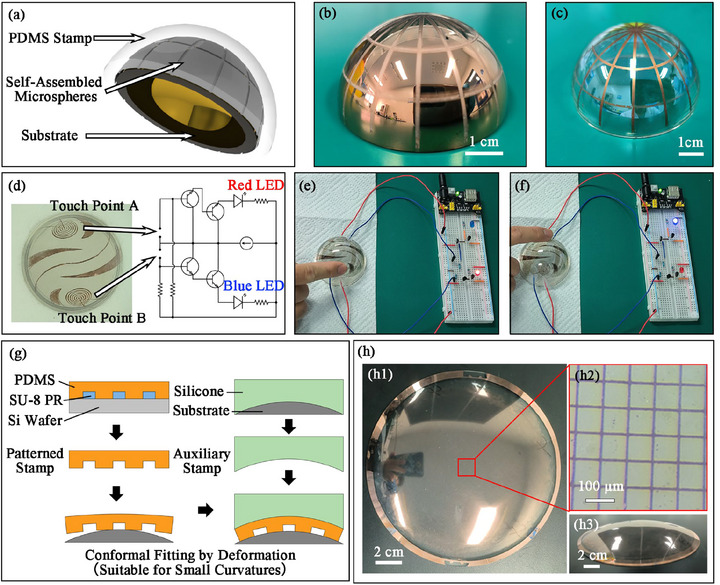 Figure 1
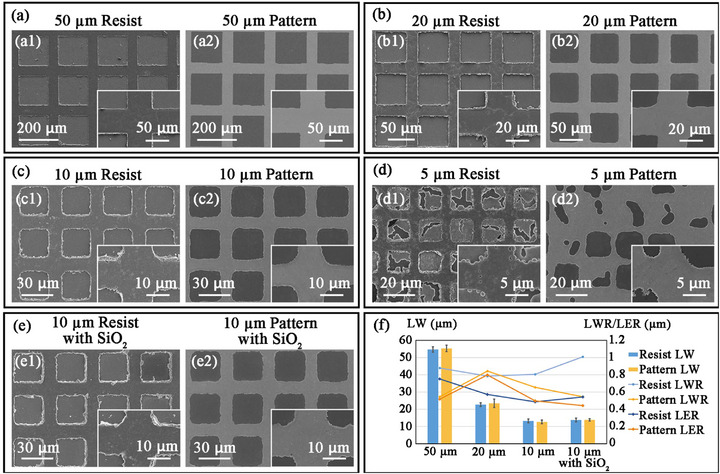 Figure 2
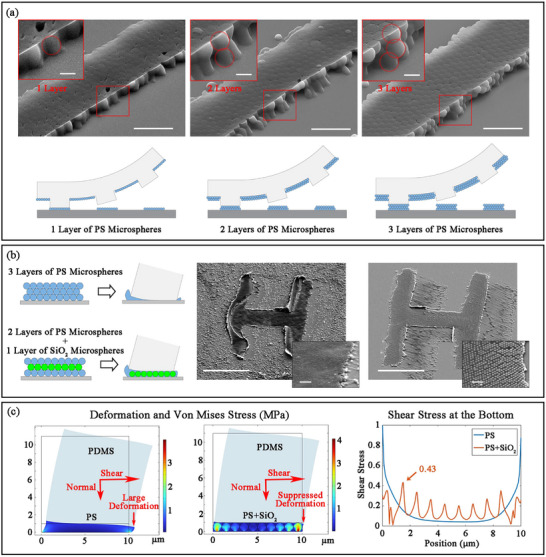 Figure 3
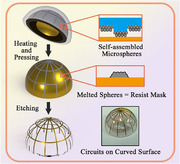 Figure 4
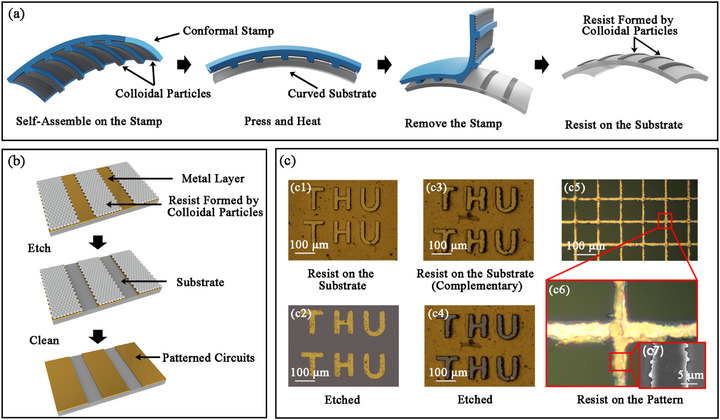 Figure 5
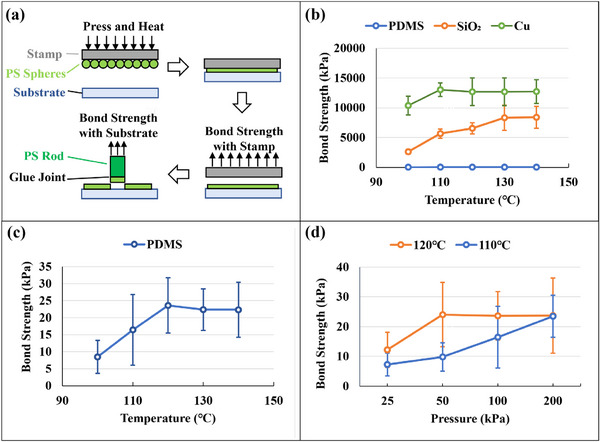 Figure 6
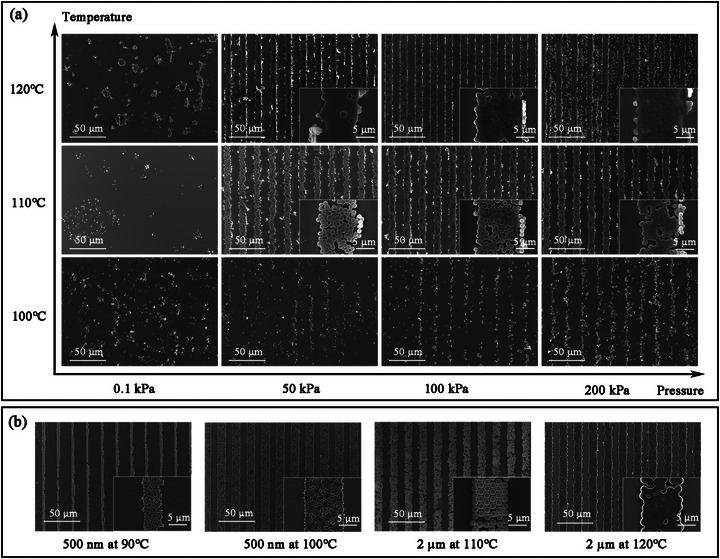 Figure 7
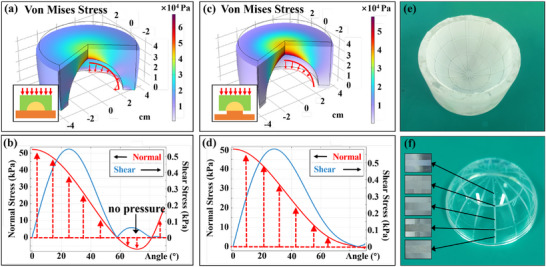 Figure 8
Peer Reviews
No public reviews on file for this paper yet. If you reviewed it on a platform where reviews are public (OpenReview, ICLR, NeurIPS, ICML), you can paste yours below so the community can read it here.
Videos
No videos yet. Explain this paper in a talk, walkthrough, or lecture? Add one.
Taxonomy
TopicsNanomaterials and Printing Technologies · Nanofabrication and Lithography Techniques · Advanced Materials and Mechanics