Interlocked Rotaxane Enables TADF with Distinct Excited-State Structural Relaxation
Chuan-Jing Lin, Kai-Hsin Chang, Chun-Yen Lin, Kuan-Hsuan Su, Chieh-Ming Hung, Yi-Hung Liu, Orion Shih, Ken-Tsung Wong, Pi-Tai Chou

TL;DR
This paper introduces a new type of TADF exciplex based on an interlocked rotaxane structure, which improves the efficiency and stability of OLEDs.
Contribution
The first rotaxane-based TADF exciplex with distinct excited-state structural relaxation is demonstrated.
Findings
The CT-Rotaxane exhibits a small singlet–triplet energy gap and fast reverse intersystem crossing.
The rotaxane TADF exciplex shows structural relaxation in both solution and solid state.
Rotaxane-type OLEDs achieved a peak external quantum efficiency of 7.23% with improved operational stability.
Abstract
We present the first demonstration of a rotaxane-based thermally activated delayed fluorescence (TADF) exciplex, its unique excited-state structural relaxation and application in organic light-emitting diodes (OLEDs). The design employs a triazene cage (Trz-cage) as the host electron acceptor, threaded by a carbazole derivative with ethylene glycol ether chains serving as the guest donor, and capped at both ends with bulky triphenylmethane stoppers, thus forming the rotaxane exciplex, namely the charge-transfer CT-Rotaxane. The TADF nature of CT-Rotaxane is evidenced by microsecond-scale delayed fluorescence subject quenched by oxygen, a small singlet–triplet energy gap (ΔE ST = 0.084 eV), and a fast reverse intersystem crossing rate of 9.8 × 10⁵ s–1 in toluene. Notably, the rotaxane TADF exciplex undergoes pronounced structural relaxation in both solution (τ ≈ 264 ps) and solid state…
Genes, proteins, chemicals, diseases, species, mutations and cell lines named across the full text — each resolved to its canonical identifier and authoritative record.
Click any figure to enlarge with its caption.
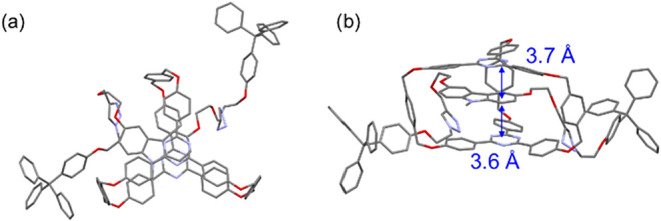 Figure 1
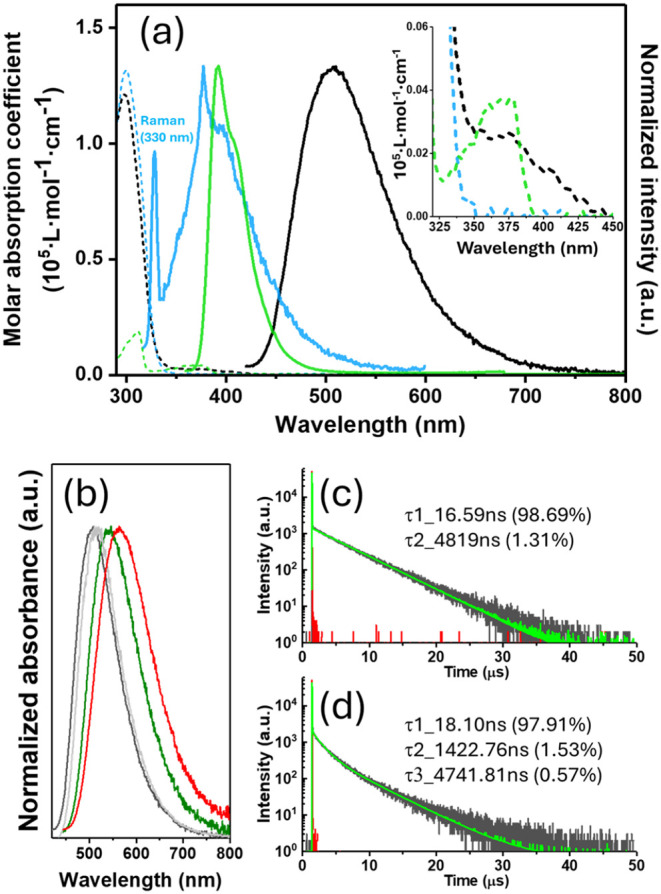 Figure 2
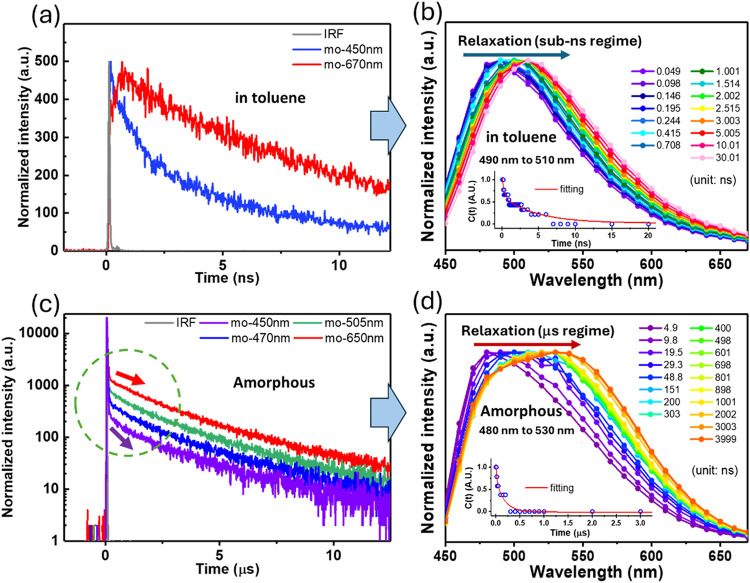 Figure 3
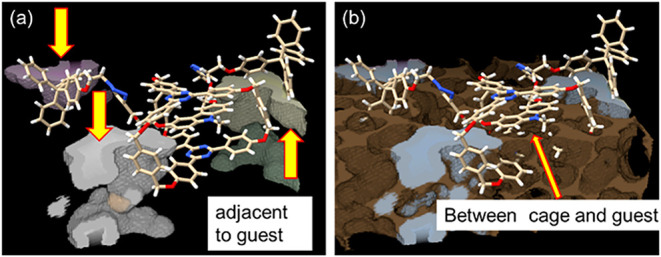 Figure 4
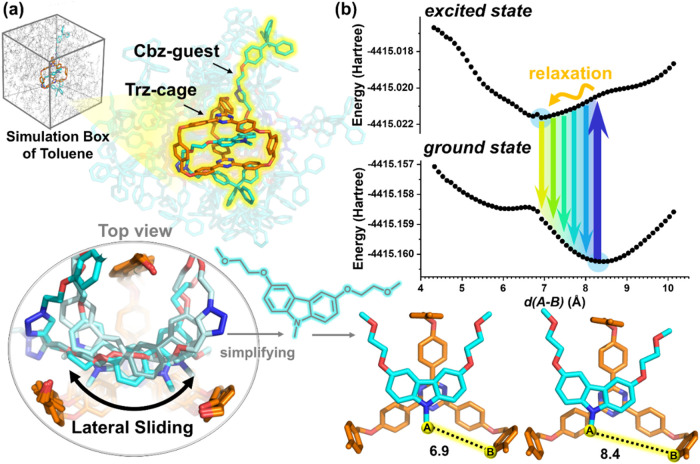 Figure 5
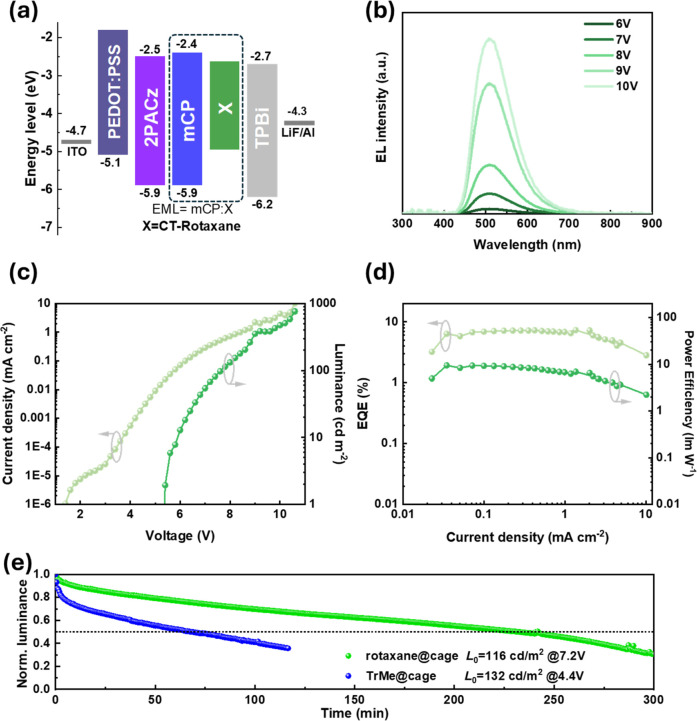 Figure 6
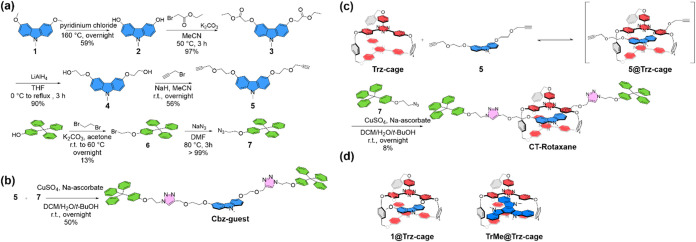 Figure 7
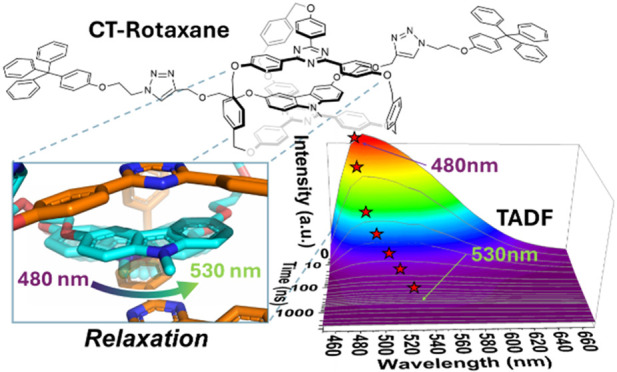 Figure 8
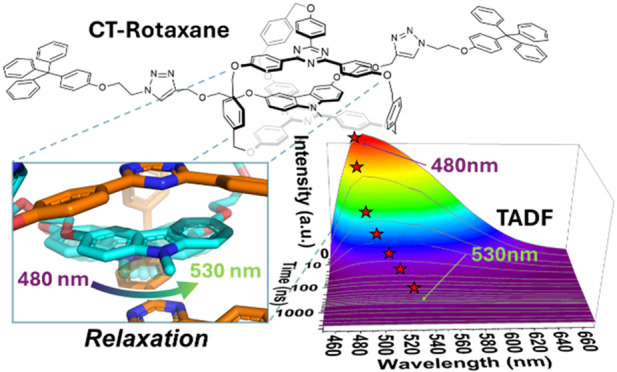 Figure 9
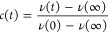 Figure 10
Peer Reviews
No public reviews on file for this paper yet. If you reviewed it on a platform where reviews are public (OpenReview, ICLR, NeurIPS, ICML), you can paste yours below so the community can read it here.
Videos
No videos yet. Explain this paper in a talk, walkthrough, or lecture? Add one.
Taxonomy
TopicsOrganic Light-Emitting Diodes Research · Supramolecular Chemistry and Complexes · Luminescence and Fluorescent Materials