Observation of Transition from Rate Law to Butler–Volmer Controlled Water Oxidation Kinetics on Hematite Photoanodes
Tianhao He, Daniele Benetti, Cindy Tseng, Benjamin Moss, Detre Teschner, Travis E. Jones, Andreas Kafizas, Michael Grätzel, Simone Piccinin, James R. Durrant

TL;DR
This study shows how water oxidation on hematite photoanodes changes from being controlled by reaction rates to being governed by potential as hole density increases.
Contribution
The paper unifies population-based and Butler–Volmer models by observing a mechanistic transition in water oxidation on hematite.
Findings
At low hole densities, water oxidation follows a rate law mechanism.
At high hole densities, the reaction shifts to a Butler–Volmer-like, potential-driven regime.
The transition is triggered by band edge unpinning after surface M–OH species are fully oxidized.
Abstract
Despite its central role in photoelectrochemical (PEC) water splitting, the mechanistic pathway of water oxidation on metal oxides remains unresolved, with population-based and Butler–Volmer (BV) models offering distinct views on how surface valence band holes drive the reaction. Here, we bring together these two perspectives by combining operando photoinduced absorption (PIA) spectroscopy with photocurrent analyses on α-Fe2O3 (hematite) photoanodes as a function of light intensity. We find a crossover from population-controlled, rate law water oxidation at low hole densities to a BV-like, potential driven regime at high densities, triggered by band edge unpinning once surface M–OH species are fully oxidized, and excess holes accumulate without compensation. This mechanistic transition unifies competing models of interfacial charge transfer and reveals design principles for optimizing…
Genes, proteins, chemicals, diseases, species, mutations and cell lines named across the full text — each resolved to its canonical identifier and authoritative record.
Click any figure to enlarge with its caption.
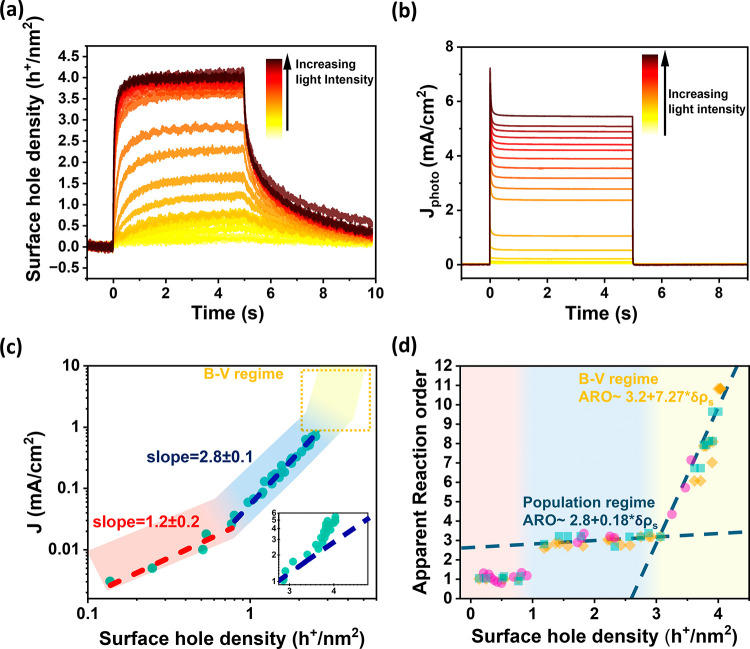 Figure 1
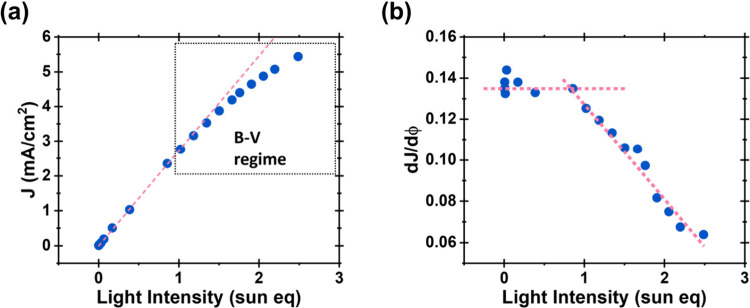 Figure 2
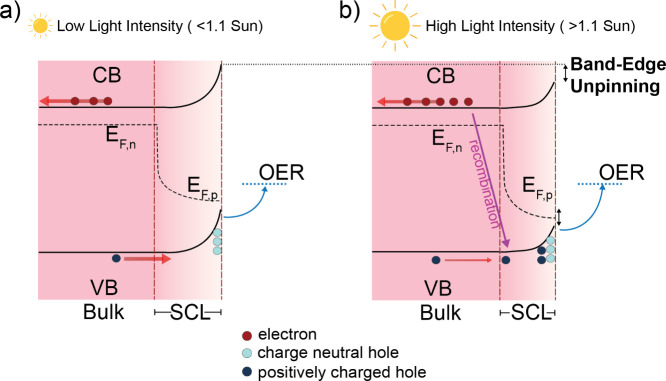 Figure 3
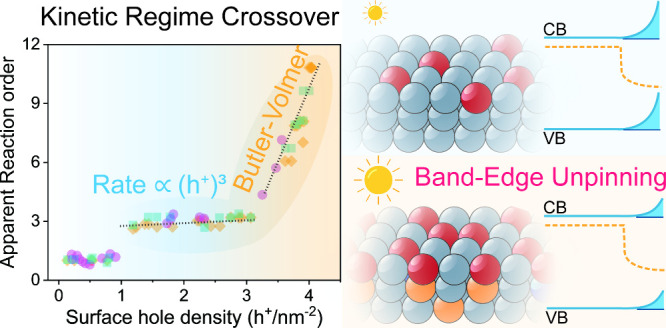 Figure 4
 Figure 5
 Figure 6
Peer Reviews
No public reviews on file for this paper yet. If you reviewed it on a platform where reviews are public (OpenReview, ICLR, NeurIPS, ICML), you can paste yours below so the community can read it here.
Videos
No videos yet. Explain this paper in a talk, walkthrough, or lecture? Add one.
Taxonomy
TopicsIron oxide chemistry and applications · Microbial Fuel Cells and Bioremediation · TiO2 Photocatalysis and Solar Cells