Entropic Control of the Helicity Inversion Rates of Twisted Metallomacrocycles by Reversible and Regioselective Deprotonation
Tomoki Nakajima, Shohei Tashiro, Masahiro Ehara, Mitsuhiko Shionoya

TL;DR
This paper shows how the rate of helicity inversion in a twisted metal complex can be controlled through changes in activation entropy.
Contribution
The study introduces a novel method of entropic control over helicity inversion rates via regioselective deprotonation.
Findings
Partial deprotonation reduced the helicity inversion rate to 1/20 of its original rate.
Activation entropy dominates the rate change after deprotonation.
Proton relay via water molecules reduces activation entropy during inversion.
Abstract
The rate of molecular motion has been enthalpically controlled by external stimuli such as acids and bases, electrons, and light. However, controlling the rate of molecular motion through activation entropy remains a challenging task. Here, we report entropic control of the helicity inversion rate of a trinuclear PdII macrocycle with right- and left-handed twisted structures. Three of the six NH protons in this metallo-macrocycle were regioselectively deprotonated by a moderately strong base, inducing intramolecular proton transfer from the NH to N– moieties in the helicity inversion. After the partial deprotonation, the helicity inversion rate of the twisted macrocycle decreased to 1/20 of that before deprotonation due to the dominant influence of the activation entropy term. The kinetic isotope effects on the inversion rate suggest that an orderly proton relay occurs between the NH…
Genes, proteins, chemicals, diseases, species, mutations and cell lines named across the full text — each resolved to its canonical identifier and authoritative record.
Click any figure to enlarge with its caption.
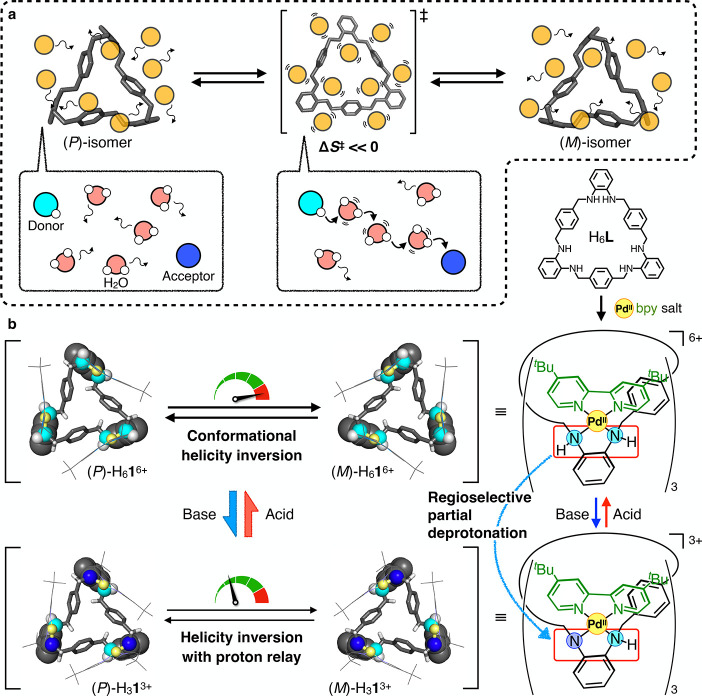 Figure 1
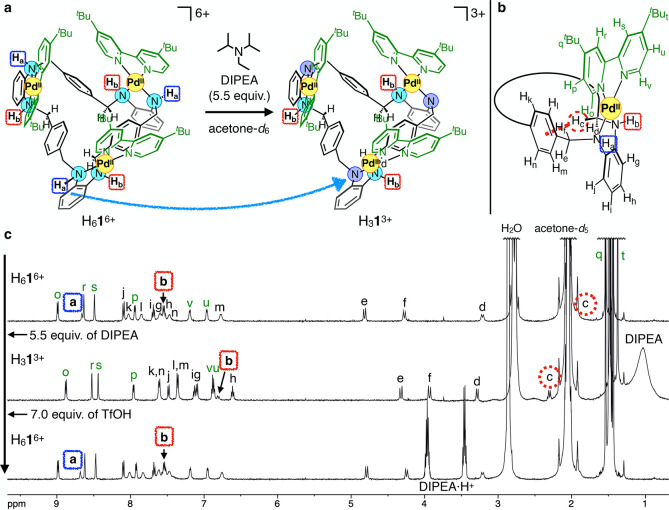 Figure 2
 Figure 3
 Figure 4
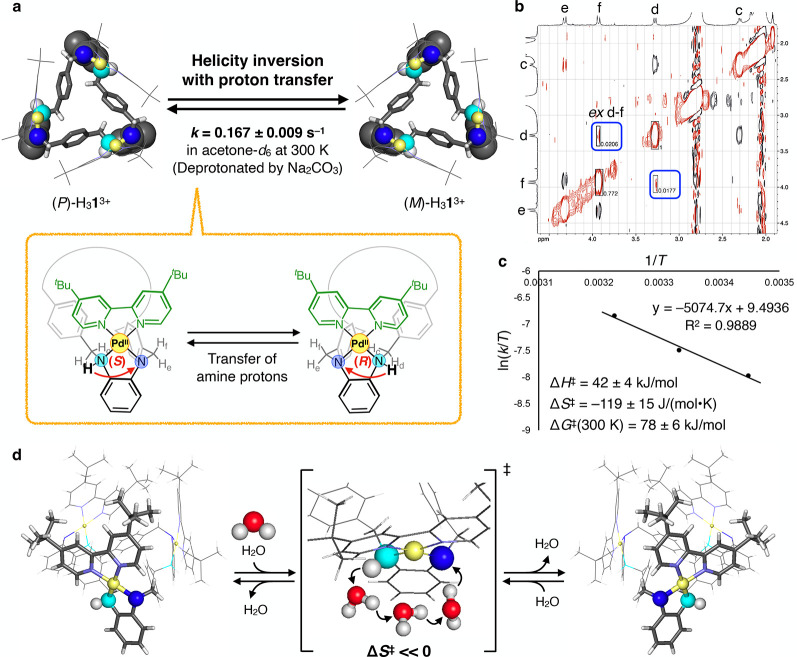 Figure 5
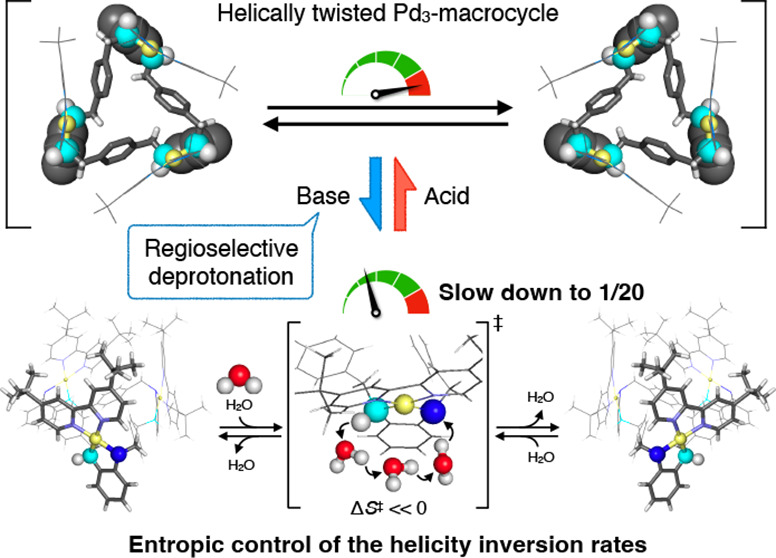 Figure 6
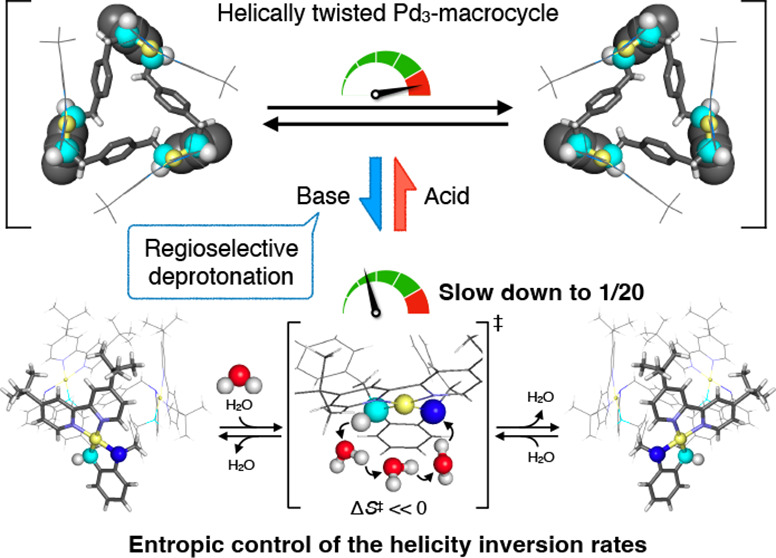 Figure 7
Peer Reviews
No public reviews on file for this paper yet. If you reviewed it on a platform where reviews are public (OpenReview, ICLR, NeurIPS, ICML), you can paste yours below so the community can read it here.
Videos
No videos yet. Explain this paper in a talk, walkthrough, or lecture? Add one.
Taxonomy
TopicsSupramolecular Chemistry and Complexes · Supramolecular Self-Assembly in Materials · Molecular Sensors and Ion Detection