Weathering the storm: Effect of climate change on acute stroke care and stroke rehabilitation
Erica M. Jones, Aardhra M. Venkatachalam, Nneka L. Ifejika

TL;DR
Climate change affects stroke recovery and care, and healthcare providers must address these challenges at multiple levels.
Contribution
The paper highlights the role of physiatrists in leading climate change mitigation efforts for stroke survivors.
Findings
Climate change impacts stroke recovery and disproportionately affects high-risk populations.
Healthcare practitioners can mitigate these effects through patient, community, and policy-level strategies.
Abstract
Climate change has deleterious effects on stroke recovery, disproportionately affecting populations with increased stroke incidence. These effects start prior to the acute care hospitalization, precipitated by environmental etiologies and are sustained throughout the life course of stroke survivors. Health care practitioners play a critical role in identifying these concerns and mitigating their impact through effective strategies at the patient level, interventions at the community level, and advocacy at the state and federal level. As the experts on improvement in function, quality of life, and the mitigation of disability, physiatrists have the opportunity to lead efforts in this space for stroke survivors and their caregivers.
Genes, proteins, chemicals, diseases, species, mutations and cell lines named across the full text — each resolved to its canonical identifier and authoritative record.
Click any figure to enlarge with its caption.
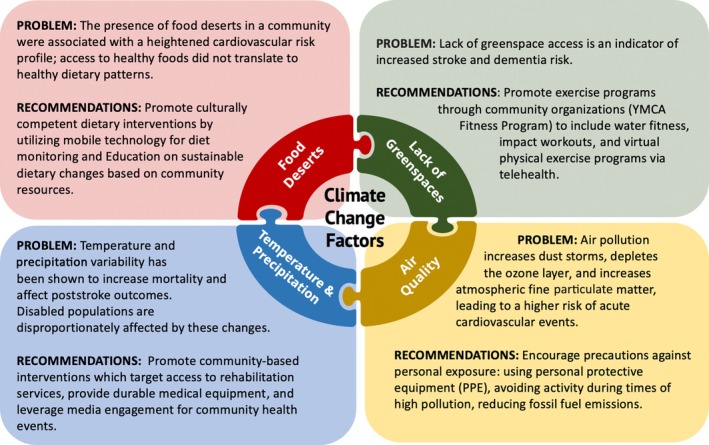 Figure 1
Peer Reviews
No public reviews on file for this paper yet. If you reviewed it on a platform where reviews are public (OpenReview, ICLR, NeurIPS, ICML), you can paste yours below so the community can read it here.
Videos
No videos yet. Explain this paper in a talk, walkthrough, or lecture? Add one.
Taxonomy
TopicsClimate Change and Health Impacts · Air Quality and Health Impacts · Health disparities and outcomes