“Poverty is a social issue, not a mathematical problem”: examining the lessons for beneficiary identification from implementation of the UHC indigent program in Kenya
Beryl Maritim, Rahab Mbau, Anita Musiega, Anne Musuva, Beatrice Amboko, Benjamin Tsofa, Caitlin Mazzilli, Ileana Vilcu, Ethan Wong, Felix Murira, Jacinta Nzinga, Matt Boxshall, Peter Mugo, Rose Nabi Deborah Karimi Muthuri, Wangari Ng’ang’a, Nirmala Ravishankar, Edwine Barasa

TL;DR
This paper examines how Kenya's UHC indigent program faced challenges in identifying poor households, highlighting the need for better alignment with local realities and stronger community involvement.
Contribution
The study provides novel insights into the implementation challenges of Kenya's UHC indigent program and offers lessons for improving future subsidy programs.
Findings
Program implementation deviated from its centralized design due to data gaps and political constraints.
Proxy means testing risks exclusion and fails to capture local poverty definitions.
Community validation and communication are critical for improving equity and accountability.
Abstract
Kenya rolled out a UHC indigent program aimed to expand financial protection and health service access for poor households through subsidized health insurance under the national insurer, National Health Insurance Fund (NHIF). As Kenya transitions to a new social health insurance framework under the Social Health Authority (SHA), understanding the implementation experience of the UHC indigent program is critical for informing the roll out of SHA’s indigent program. We conducted a qualitative process evaluation of the UHC indigent program using document reviews, semi-structured interviews with 23 key informants from national and county health authorities, development partners, and implementing actors, complemented by a validation workshop with 57 stakeholders. Our analysis was guided by Moore et al.‘s process evaluation framework and Wu et al.‘s policy capacity lens, examining…
Genes, proteins, chemicals, diseases, species, mutations and cell lines named across the full text — each resolved to its canonical identifier and authoritative record.
Click any figure to enlarge with its caption.
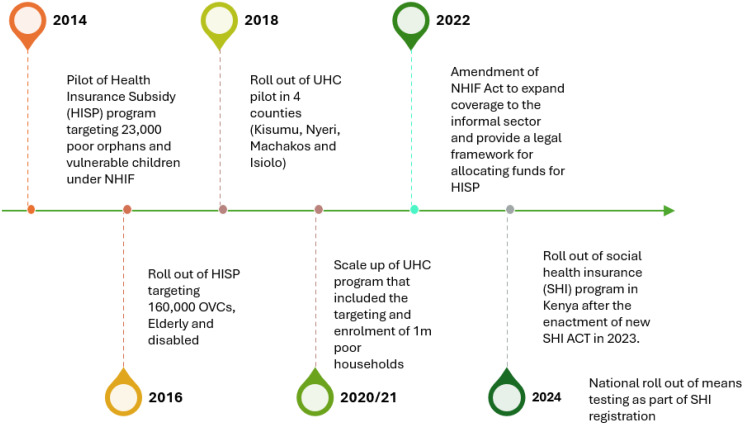 Figure 1
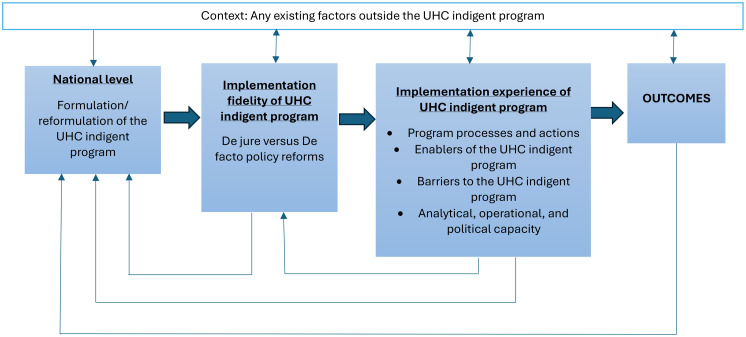 Figure 2
Peer Reviews
No public reviews on file for this paper yet. If you reviewed it on a platform where reviews are public (OpenReview, ICLR, NeurIPS, ICML), you can paste yours below so the community can read it here.
Videos
No videos yet. Explain this paper in a talk, walkthrough, or lecture? Add one.
Taxonomy
TopicsPoverty, Education, and Child Welfare · Human Rights and Development · International Development and Aid