Risk factors for adverse events associated with trimethoprim-sulfamethoxazole treatment for Pneumocystis pneumonia in non-human immunodeficiency virus-infected patients: a multicenter, retrospective, observational cohort study
Reina Idemitsu, Tatsuya Nagai, Hiroki Matsui, Haruka Fujioka, Yuya Homma, Ayumu Otsuki, Hiroyuki Ito, Shinichiro Ohmura, Toshiaki Miyamoto, Daisuke Shichi, Tomohisa Watari, Yoshihito Otsuka, Kei Nakashima

TL;DR
This study identifies risk factors for severe side effects of a common treatment for a type of pneumonia in non-HIV patients.
Contribution
The study identifies pretreatment serum sodium, potassium levels, and initial drug dose as novel risk factors for adverse events in non-HIV PCP patients treated with SXT.
Findings
Serum sodium, potassium levels, and initial trimethoprim dose per weight are independent risk factors for severe adverse events.
Skin rashes, hyponatremia, and hyperkalemia were the most frequent adverse events in treatment failure cases.
Baseline characteristics like electrolyte levels and drug dosing significantly differ between patients with and without adverse events.
Abstract
Pneumocystis jirovecii pneumonia (PCP) is a severe opportunistic infection. Trimethoprim-sulfamethoxazole (SXT) is the first-choice treatment for PCP in human immunodeficiency virus (HIV)-infected and non-HIV-infected patients. However, the high incidence of adverse events makes treatment with SXT difficult. The risk factors for these adverse events in patients with non-HIV PCP remain unclear. In this multicenter, retrospective, observational cohort study, we investigated these risk factors by analyzing data from patients with non-HIV PCP treated with SXT between June 2006 and March 2021 across three institutions. Patients were divided into two groups based on the presence of grade 3 or higher adverse events according to Common Terminology Criteria for Adverse Events (CTCAE) version 5.0: the adverse event (n = 74) and no adverse event (n = 62) groups. Patient characteristics were…
Genes, proteins, chemicals, diseases, species, mutations and cell lines named across the full text — each resolved to its canonical identifier and authoritative record.
Click any figure to enlarge with its caption.
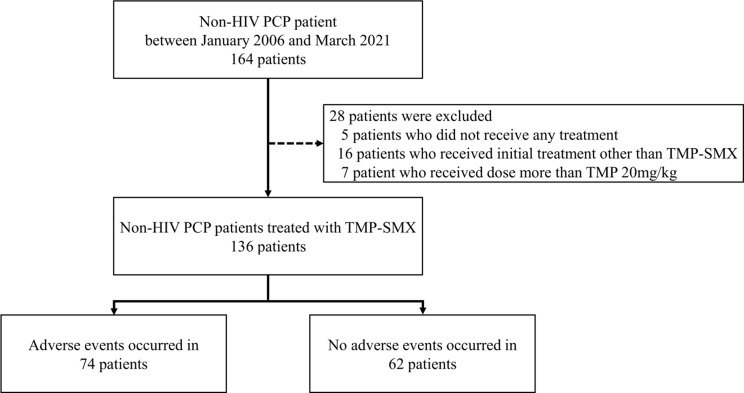 Figure 1
Peer Reviews
No public reviews on file for this paper yet. If you reviewed it on a platform where reviews are public (OpenReview, ICLR, NeurIPS, ICML), you can paste yours below so the community can read it here.
Videos
No videos yet. Explain this paper in a talk, walkthrough, or lecture? Add one.
Taxonomy
TopicsPneumocystis jirovecii pneumonia detection and treatment · HIV/AIDS drug development and treatment · Pneumonia and Respiratory Infections