Integration of clinical and proteomic risk factors enhances prognostic modelling of incident vascular complications in type 2 diabetes
Yue Huang, Mauro Tutino, Archit Singh, Nigel William Rayner, Andrei Barysenka, Ozvan Bocher, Eleftheria Zeggini

TL;DR
Adding blood protein data to standard clinical factors improves prediction of vascular complications in type 2 diabetes, especially for macrovascular outcomes.
Contribution
This study identifies plasma protein signatures that enhance vascular complication prediction in type 2 diabetes beyond traditional clinical markers.
Findings
Proteomics-integrated models improved prediction of macrovascular complications (C-index 0.72 vs. 0.60 with clinical data alone).
Selected proteins like LRRC37A2 and NT-proBNP showed strong predictive value for macrovascular outcomes.
Predictive gains were stable over 10 years for macrovascular outcomes but less consistent for microvascular complications.
Abstract
Type 2 diabetes complications manifest across various organs, but are fundamentally rooted in vascular dysfunction. This study aims to identify plasma protein signatures that improve prediction of macrovascular and microvascular complications in type 2 diabetes over classical clinical factors, assess the stability of their prognostic performance over time, and explore the cross-ancestry generalizability of the developed models. We analysed 2,923 plasma proteins in 917 European-ancestry UK Biobank participants with prevalent type 2 diabetes but no prior vascular disease at baseline. The primary outcomes were time to first macrovascular or microvascular complication, identified through ICD-10 codes during a mean follow-up of 10.41 years. Protein selection was performed using clinical-variables-prioritized LASSO Cox regression across 100 resamples to identify proteins offering predictive…
Genes, proteins, chemicals, diseases, species, mutations and cell lines named across the full text — each resolved to its canonical identifier and authoritative record.
Click any figure to enlarge with its caption.
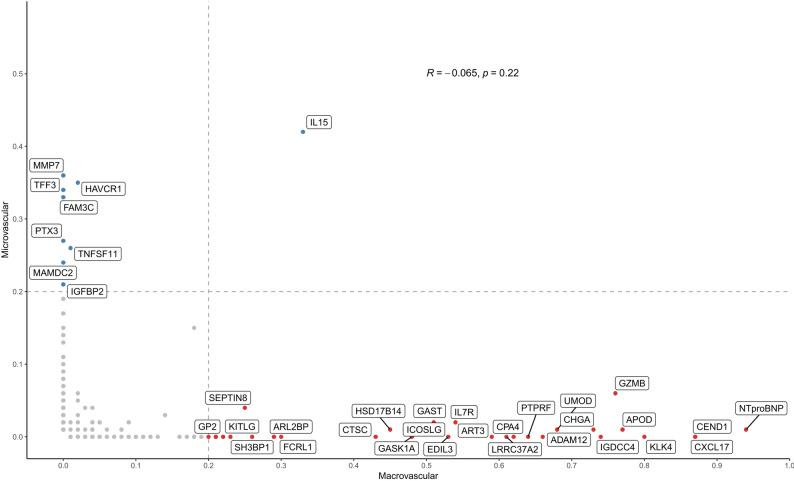 Figure 1
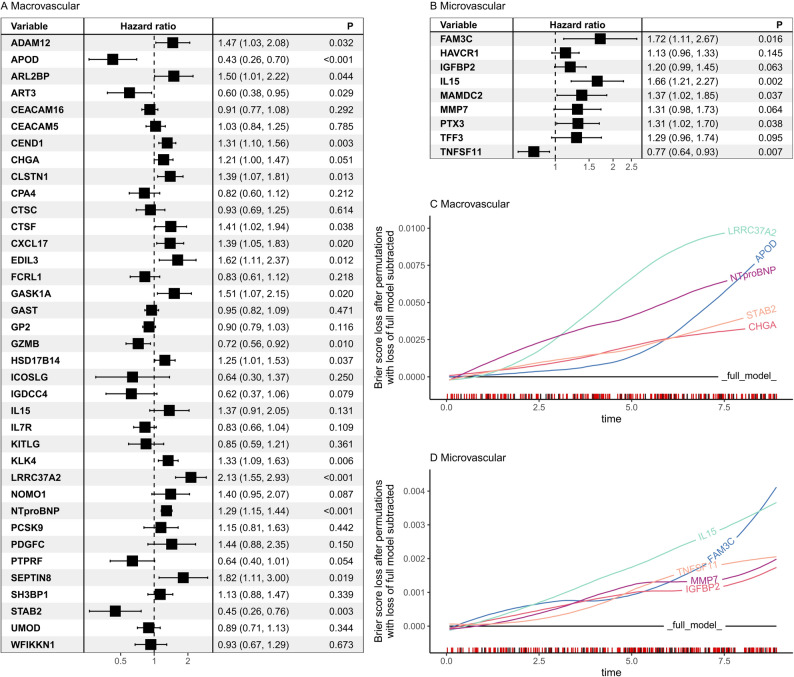 Figure 2
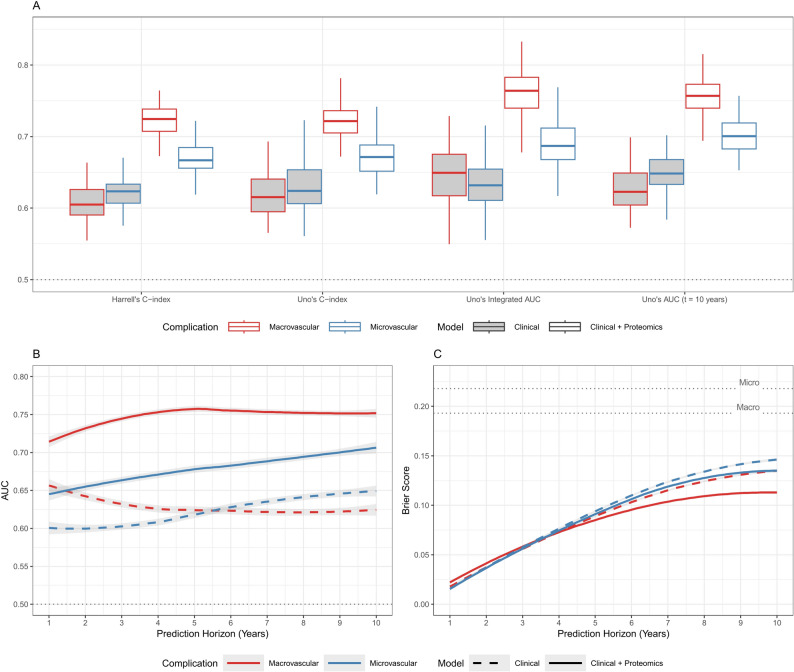 Figure 3
 Figure 4
Peer Reviews
No public reviews on file for this paper yet. If you reviewed it on a platform where reviews are public (OpenReview, ICLR, NeurIPS, ICML), you can paste yours below so the community can read it here.
Videos
No videos yet. Explain this paper in a talk, walkthrough, or lecture? Add one.
Taxonomy
TopicsGenetic Associations and Epidemiology · Adipokines, Inflammation, and Metabolic Diseases · Genomics and Rare Diseases