Predicting Properties from Near-Infrared Spectra with Machine Learning for Improved Polyolefin Differentiation
Shuaijun Li, Robert J. S. Ivancic, Bradley P. Sutliff, Derek Huang, Enrique Blázquez-Blázquez, Tyler B. Martin, Kalman B. Migler, Debra J. Audus, Sara V. Orski

TL;DR
This paper uses machine learning with near-infrared spectra to better differentiate polyolefins for improved plastic recycling.
Contribution
A novel ML approach that predicts polyolefin properties from NIR spectra, enhancing sorting accuracy and interpretability.
Findings
Partial least squares regression provides high accuracy for predicting polyolefin properties from NIR spectra.
Important wavenumbers for property prediction are linked to known CH3 vibrational absorption bands in polyolefins.
The method confirms the relationship between polymer chain structure and properties using ML models.
Abstract
As the scale and variety of plastics produced continue to grow, plastics recycling will require innovative solutions. The industrial state-of-the-art sorting technology, near-infrared (NIR) spectroscopy, as currently used, cannot effectively differentiate polyolefins, the single largest class of polymers by volume. Chemical similarity combined with architectural diversity in polyolefins stymies subclass delineation, such as differentiating low-density polyethylene from high-density polyethylene, due to their spectral similarity and chemical overlap. To address this challenge, we use machine learning (ML) to directly predict density, crystallinity, and short-chain branching from NIR spectra, enabling property-based sorting for more effective recycling. After testing a variety of ML models, we find that partial least squares regression provides high prediction accuracy with model…
Genes, proteins, chemicals, diseases, species, mutations and cell lines named across the full text — each resolved to its canonical identifier and authoritative record.
Click any figure to enlarge with its caption.
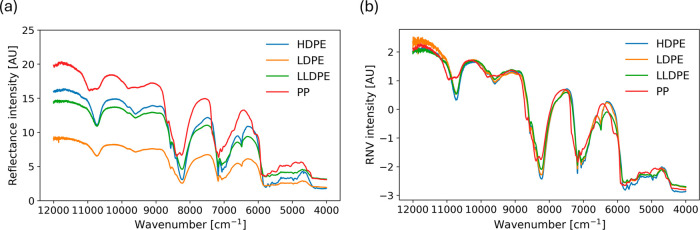 Figure 1
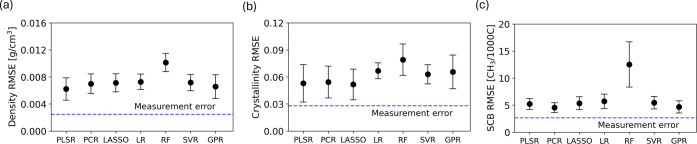 Figure 2
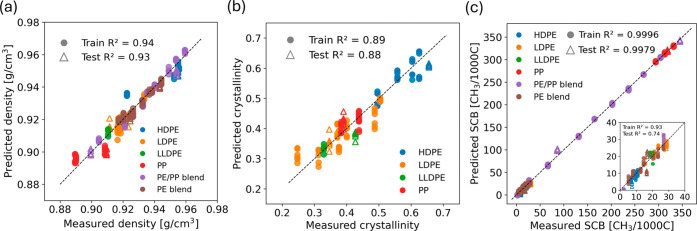 Figure 3
 Figure 4
 Figure 5
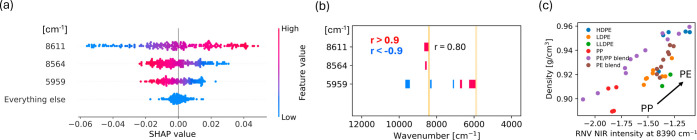 Figure 6
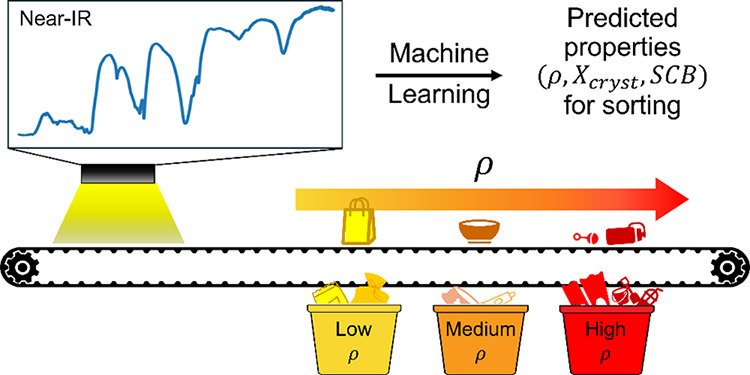 Figure 7
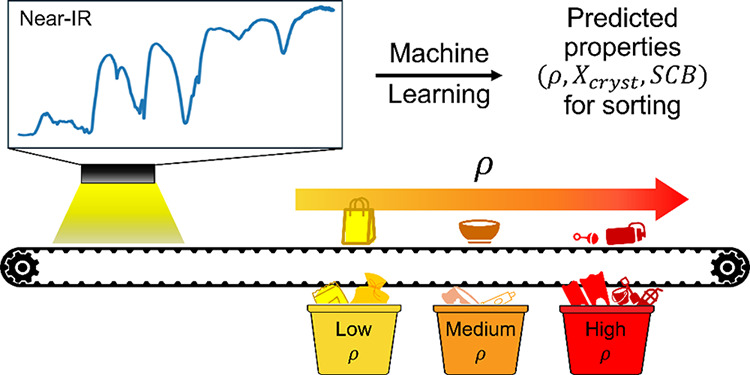 Figure 8
Peer Reviews
No public reviews on file for this paper yet. If you reviewed it on a platform where reviews are public (OpenReview, ICLR, NeurIPS, ICML), you can paste yours below so the community can read it here.
Videos
No videos yet. Explain this paper in a talk, walkthrough, or lecture? Add one.
Taxonomy
TopicsMicroplastics and Plastic Pollution · Spectroscopy and Chemometric Analyses · Polymer crystallization and properties