Thermo- and pH-Responsive Antimicrobial Hydrogels from Poly(2-(dimethylamino)ethyl methacrylate) and Cationic-Modified Chitosan for Sustained Papain Release
Carolina Cruz Ferreira, Guilherme Frey Schutz, Iago Aguiar Dias Carmo, Lucas Novaes Teixeira, Elizabeth Ferreira Martinez, Lúcia Helena Innocentini Mei, Roniérik Pioli Vieira

TL;DR
Researchers created a hydrogel that can release papain over time and has antimicrobial properties, which could be useful for wound dressings.
Contribution
A novel semi-IPN hydrogel combining PDMAEMA and HTCC for sustained papain release and antimicrobial activity is developed.
Findings
The 25% HTCC formulation showed nearly complete inhibition of Staphylococcus aureus.
Papain release was diffusion-controlled, with slower release in denser networks.
The hydrogel maintained fibroblast viability above 70%, indicating biocompatibility.
Abstract
Semi-interpenetrating polymer networks (semi-IPNs) composed of poly(2-(dimethylamino)ethyl methacrylate) (PDMAEMA) and various concentrations of N-(2-hydroxypropyl)-3-trimethylammonium chitosan chloride (HTCC) (5, 10, and 25% w/w) were synthesized and evaluated as matrices for papain loading and sustained delivery. The incorporation of HTCC significantly influenced the structural, swelling, and release properties of the networks. Monomer conversion and gel fraction decreased with increasing HTCC content, reaching 91.26 and 81.36%, respectively, at 25% HTCC. Swelling studies revealed a nonlinear behavior, with the 5% HTCC sample exhibiting the highest swelling degree (458.33%), while pure PDMAEMA and the 25% HTCC formulation reached 219.78 and 168.23%, respectively. Papain release profiles, fitted to the Peppas–Sahlin model, showed diffusion-controlled kinetics, with k 1 values…
Genes, proteins, chemicals, diseases, species, mutations and cell lines named across the full text — each resolved to its canonical identifier and authoritative record.
Click any figure to enlarge with its caption.
 Figure 1
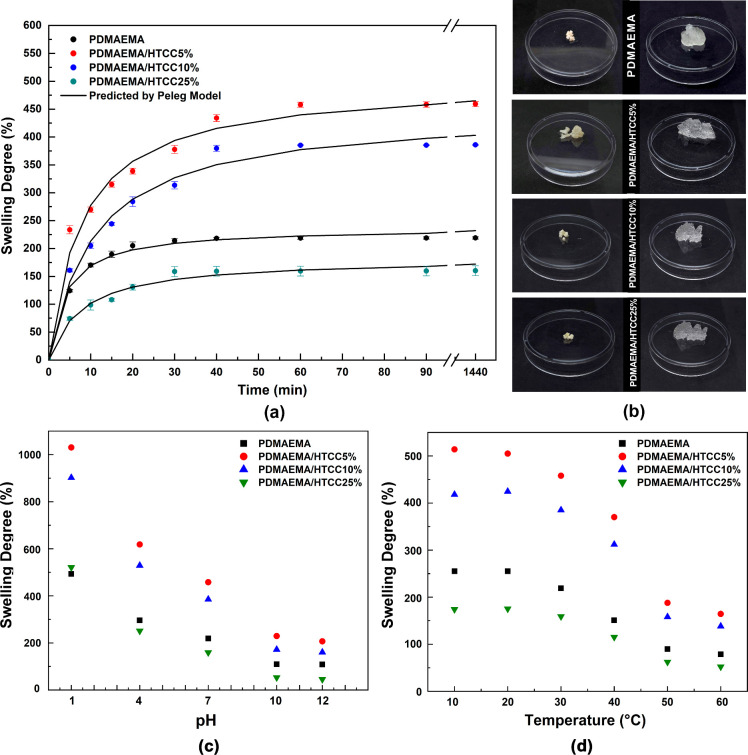 Figure 2
 Figure 3
 Figure 4
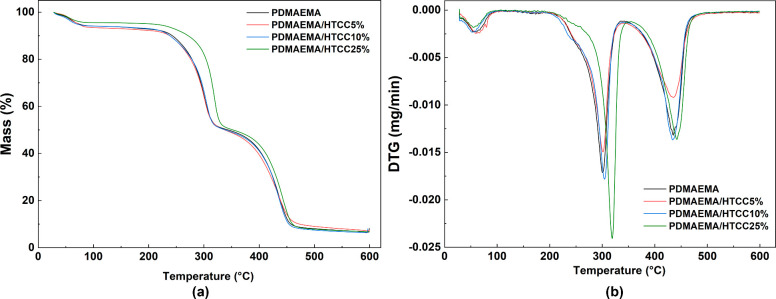 Figure 5
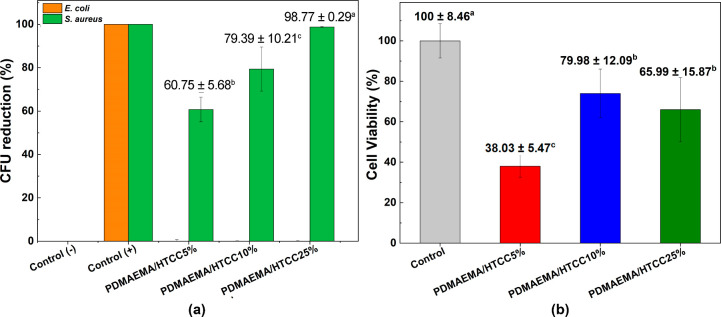 Figure 6
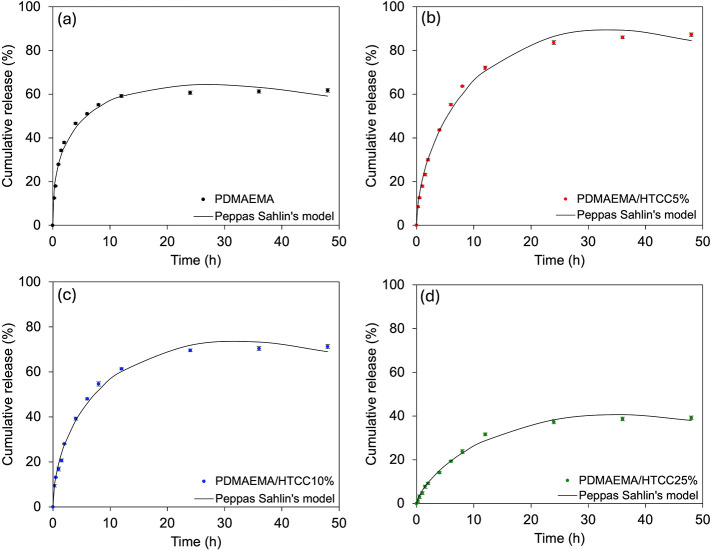 Figure 7
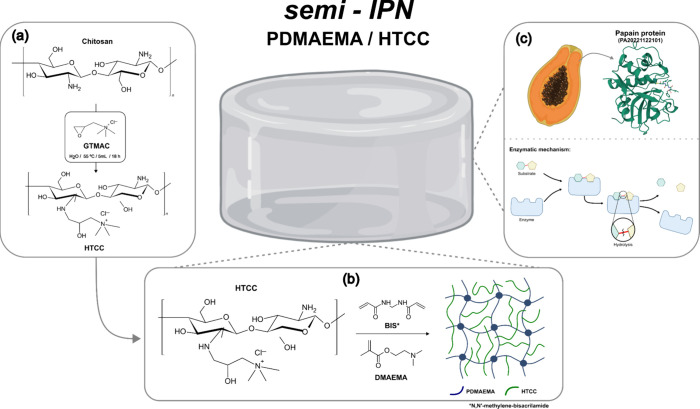 Figure 8
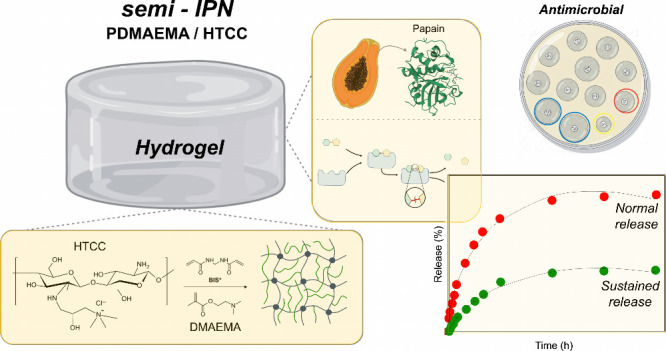 Figure 9
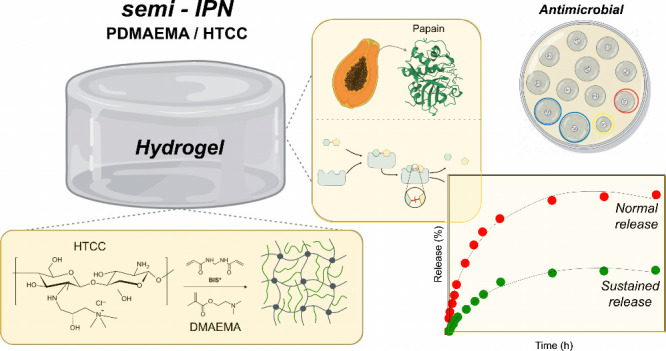 Figure 10
 Figure 11
 Figure 12
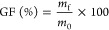 Figure 13
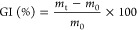 Figure 14
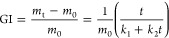 Figure 15
 Figure 16
 Figure 17
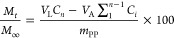 Figure 18
 Figure 19
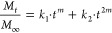 Figure 20
Peer Reviews
No public reviews on file for this paper yet. If you reviewed it on a platform where reviews are public (OpenReview, ICLR, NeurIPS, ICML), you can paste yours below so the community can read it here.
Videos
No videos yet. Explain this paper in a talk, walkthrough, or lecture? Add one.
Taxonomy
TopicsHydrogels: synthesis, properties, applications · Nanocomposite Films for Food Packaging · Antimicrobial agents and applications