Older adults can outperform younger adults in creative problem solving
Barbara Ozkalp-Poincloux, Mathieu Cassotti, Émilie Salvia, Gaelle E. Doucet, Anaëlle Camarda

TL;DR
Older adults may be better at creative problem solving than younger people due to their broader knowledge and associative thinking.
Contribution
The study shows that older adults produce more original ideas early in tasks by leveraging distant associations, challenging stereotypes about aging and creativity.
Findings
Older adults generated more original and expansive responses than younger and middle-aged adults, especially early in the task.
The advantage of older adults in creativity is linked to distant associations rather than executive control.
The initial creativity advantage of older adults diminished as the task progressed.
Abstract
This study investigated the impact of aging on creative problem solving, focusing on the ability to resist fixation and generate original ideas. Previous research has suggested that creativity peaks in middle adulthood, followed by a decline that is linked to reduced executive functions. However, emerging evidence challenges this view, highlighting that older adults may utilize broader associative networks and prior knowledge to maintain their creativity. Young adults, middle-aged adults, and older adults completed a creative task requiring them to generate solutions to a problem while resisting fixation. The participants also rated the creativity of their ideas, and their executive functioning was assessed. The results revealed that older adults generated more original and expansive responses than younger and middle-aged adults did, particularly during initial responses. This…
Genes, proteins, chemicals, diseases, species, mutations and cell lines named across the full text — each resolved to its canonical identifier and authoritative record.
Click any figure to enlarge with its caption.
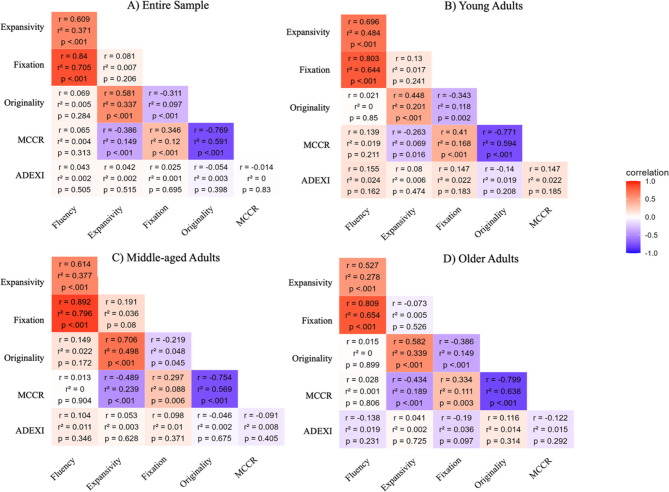 Figure 1
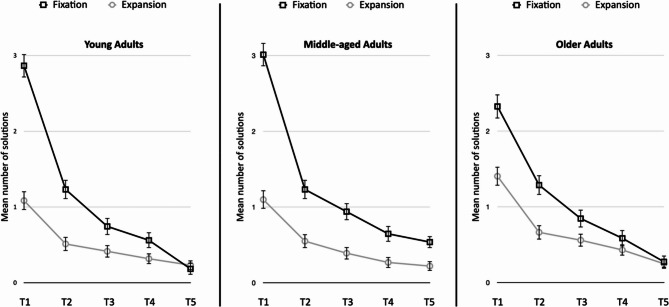 Figure 2
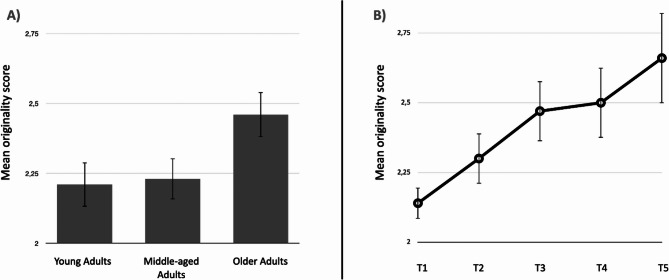 Figure 3
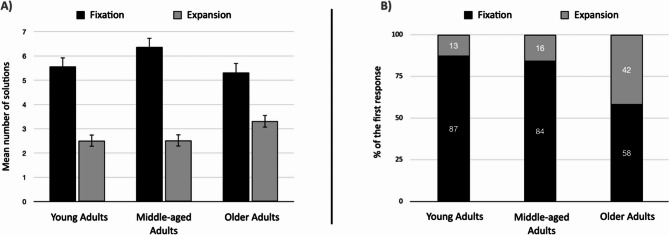 Figure 4
Peer Reviews
No public reviews on file for this paper yet. If you reviewed it on a platform where reviews are public (OpenReview, ICLR, NeurIPS, ICML), you can paste yours below so the community can read it here.
Videos
No videos yet. Explain this paper in a talk, walkthrough, or lecture? Add one.
Taxonomy
TopicsCreativity in Education and Neuroscience · Identity, Memory, and Therapy · Aging and Gerontology Research