Novel color vision assessment tool: AIM color detection and discrimination
Jingyi He, Jan Skerswetat, Peter J. Bex

TL;DR
A new computer-based tool called AIM is developed to quickly and accurately assess color vision, potentially replacing traditional methods.
Contribution
AIM introduces a self-administered, adaptive color vision test that improves on existing tools' speed and accuracy.
Findings
AIM demonstrated classification accuracies comparable to the anomaloscope.
AIM is rapid and has high test-retest repeatability.
HRR and FM100 were found to be less accurate than AIM and the anomaloscope.
Abstract
Color vision assessment is essential in clinical practice, yet different tests exhibit distinct strengths and limitations. Here we apply a psychophysical paradigm, Angular Indication Measurement (AIM) for color detection and discrimination. AIM is designed to address some of the shortcomings of existing tests, such as prolonged testing time, limited accuracy and sensitivity, and the necessity for clinician oversight. AIM presents adaptively generated charts, each a N×M (here 4 × 4) grid of stimuli, and participants are instructed to indicate either the orientation of the gap in a cone-isolating Landolt C optotype or the orientation of the edge between two colors in an equiluminant color space. The contrasts or color differences of the stimuli are adaptively selected for each chart based on performance of prior AIM charts. In a group of 23 color-normal and 15 people with color vision…
Genes, proteins, chemicals, diseases, species, mutations and cell lines named across the full text — each resolved to its canonical identifier and authoritative record.
Click any figure to enlarge with its caption.
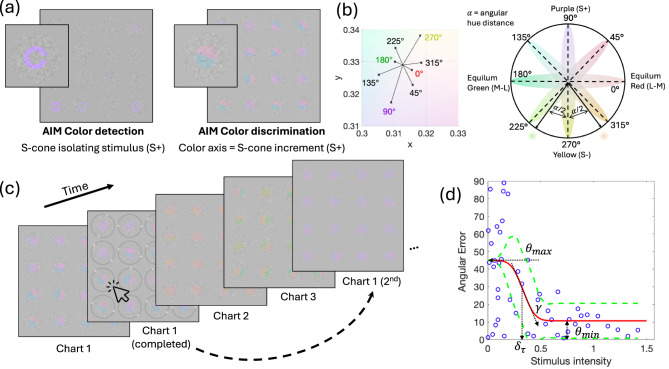 Figure 1
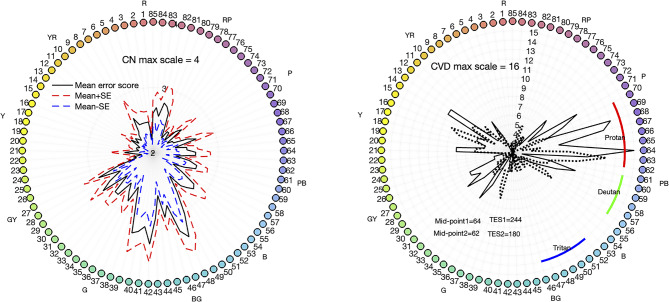 Figure 2
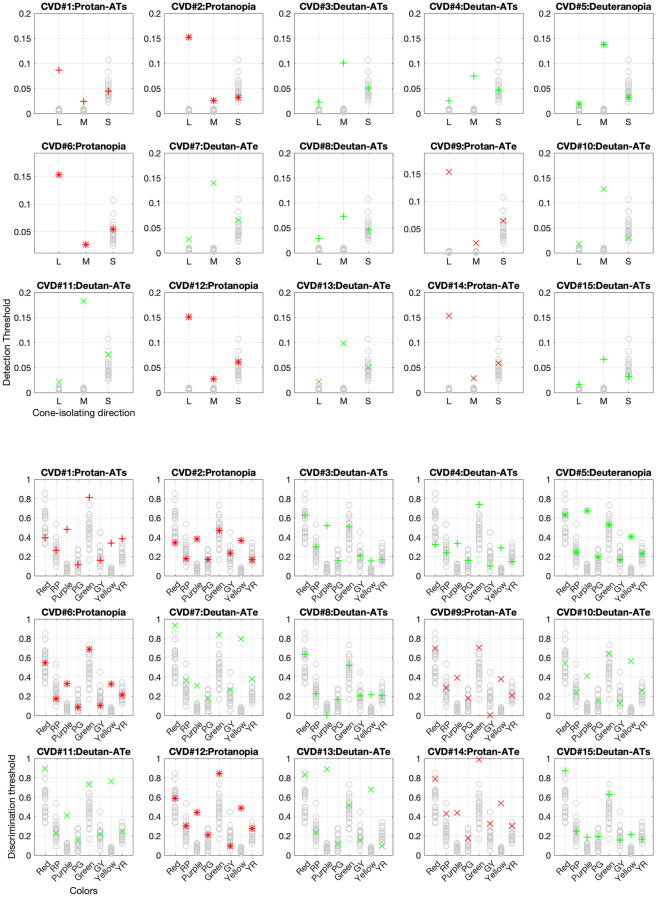 Figure 3
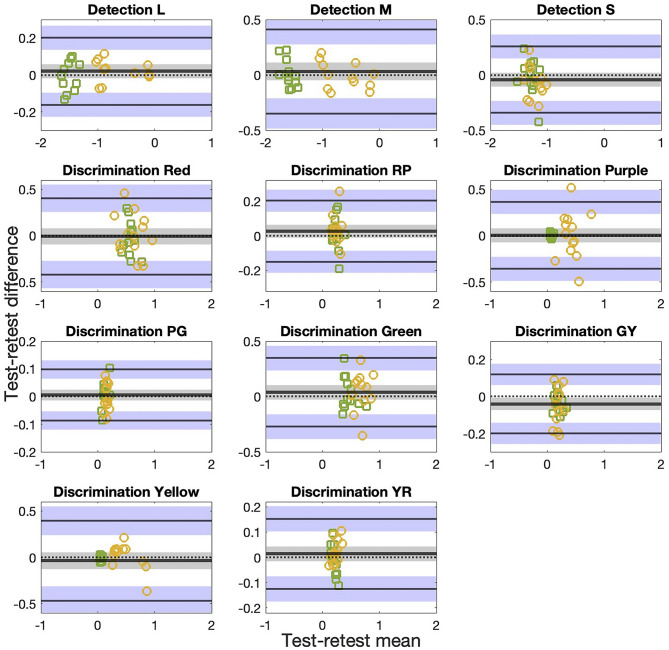 Figure 4
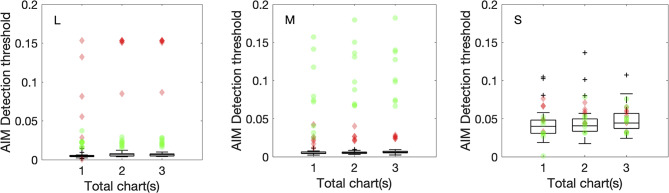 Figure 5
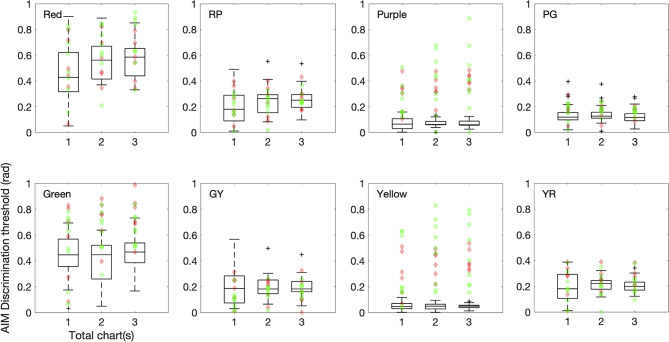 Figure 6
Peer Reviews
No public reviews on file for this paper yet. If you reviewed it on a platform where reviews are public (OpenReview, ICLR, NeurIPS, ICML), you can paste yours below so the community can read it here.
Videos
No videos yet. Explain this paper in a talk, walkthrough, or lecture? Add one.
Taxonomy
TopicsVisual perception and processing mechanisms · Categorization, perception, and language · Face Recognition and Perception