Development and Application of a Hybrid Support of Laccase from Trametes versicolor with Zinc Oxide Nanoparticles for Textile Dye Degradation
Sabrina Grando Cordeiro, Ani Caroline Weber, Guilherme Schwingel Henn, Jéssica Samara Herek dos Santos, Ana Laura da Rocha, Caroline Schmitz, Elziane Pereira Ferro, Daniel Kuhn, Valeriano Antônio Corbellini, Odorico Konrad, Eduardo Miranda Ethur, Lucélia Hoehne

TL;DR
Researchers created a hybrid support using laccase and zinc oxide nanoparticles to efficiently degrade textile dyes, showing improved stability and performance.
Contribution
A novel hybrid support combining laccase with green-synthesized ZnO nanoparticles for enhanced dye degradation.
Findings
The hybrid support with ZnO nanoparticles showed 153% initial enzyme activity after 35 days, compared to 68% without ZnO.
The immobilized biocatalyst achieved 86% degradation of Reactive Blue 198 under optimized conditions.
Cu2+ provided the highest immobilization efficiency (52%) with reduced enzyme leakage.
Abstract
A hybrid support based on sodium alginate and green-synthesized ZnO nanoparticles was developed for the immobilization of laccase (Trametes versicolor) and applied to textile dye degradation. ZnO nanoparticles were biosynthesized using pecan shell (Carya illinoinensis) extract in combination with a zing precursor salt (Zn(NO3)2·6H2O) and characterized by ultraviolet–visible (UV–Vis) absorption spectroscopy, Fourier transform infrared spectroscopy with attenuated total reflectance (FTIR–AR), scanning electron microscopy (SEM), and energy-dispersive X-ray spectroscopy (EDS), confirming their structural and morphological features. Laccase was entrapped in sodium alginate beads and cross-linked with divalent cations (0.2 M CaCl2, BaCl2 or CuSO4) supplemented with glutaraldehyde (100 μL of 50% v/v) during bead formation; beads were kept in the cross-linking solution for 60 min, washed and…
Genes, proteins, chemicals, diseases, species, mutations and cell lines named across the full text — each resolved to its canonical identifier and authoritative record.
Click any figure to enlarge with its caption.
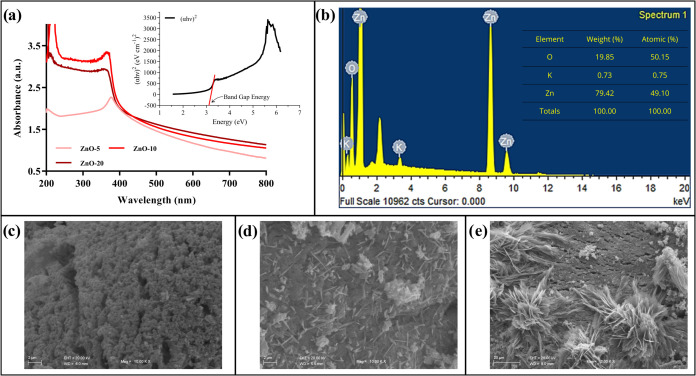 Figure 1
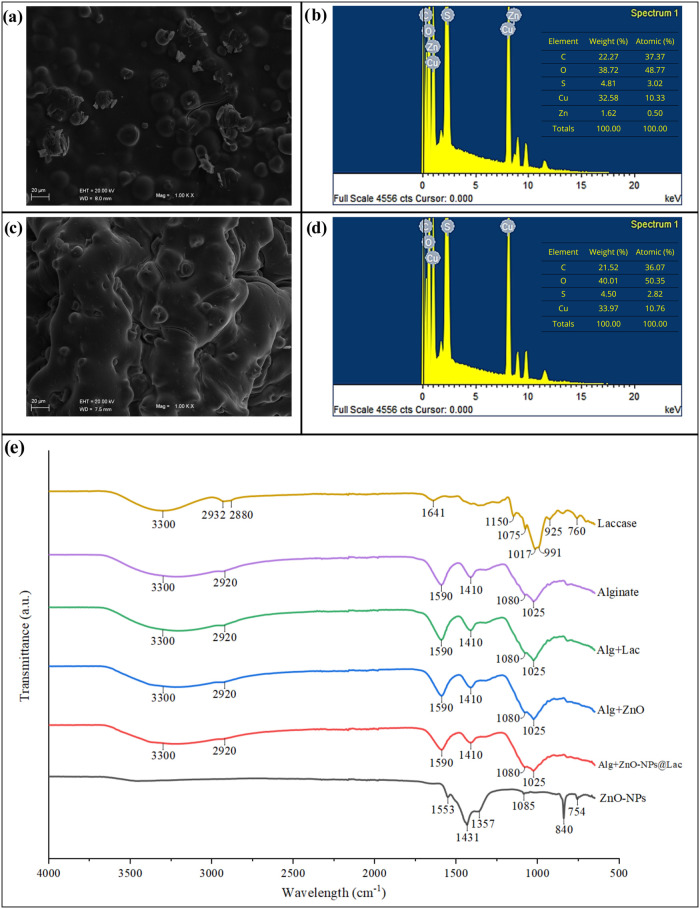 Figure 2
 Figure 3
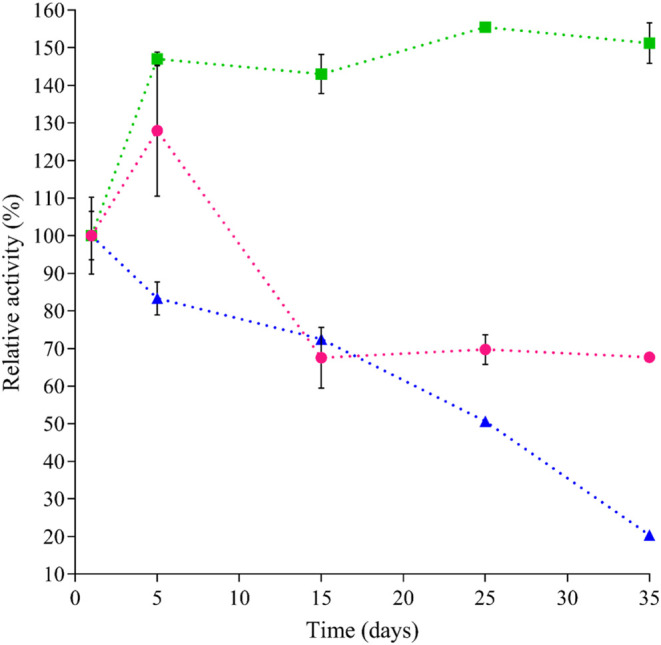 Figure 4
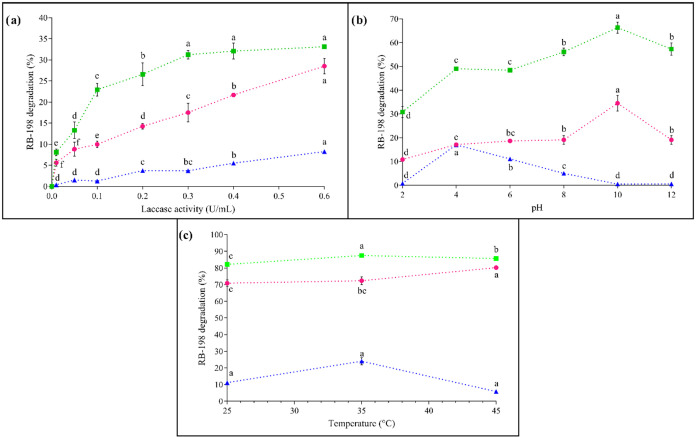 Figure 5
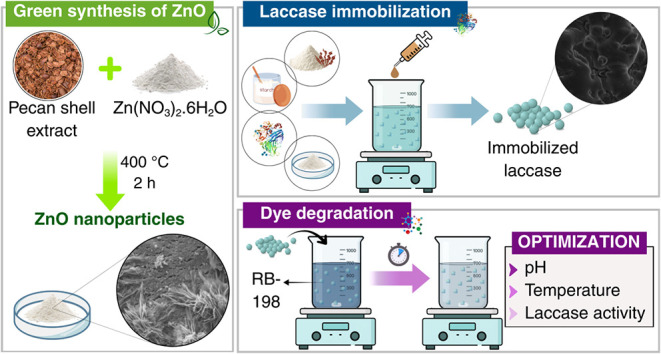 Figure 6
 Figure 7
 Figure 8
Peer Reviews
No public reviews on file for this paper yet. If you reviewed it on a platform where reviews are public (OpenReview, ICLR, NeurIPS, ICML), you can paste yours below so the community can read it here.
Videos
No videos yet. Explain this paper in a talk, walkthrough, or lecture? Add one.
Taxonomy
TopicsEnzyme-mediated dye degradation · Adsorption and biosorption for pollutant removal · Advanced Nanomaterials in Catalysis