Enhancing both the Intensities and Resolution of 19F NMR Spectra of PFAS through Band-Selective Homonuclear Decoupling
Markus Rotzinger, Viktoria Müller, Armin Macher, Jörg Feldmann, Klaus Zangger

TL;DR
This paper introduces a new NMR method to improve the clarity and signal strength of fluorine spectra in PFAS compounds.
Contribution
The novel approach uses band-selective homonuclear decoupling to enhance both resolution and intensity in 19F NMR spectra of PFAS.
Findings
PFAS mixtures with overlapping signals are resolved into individual singlets.
The method enables accurate identification and quantification of perfluorinated compounds.
Signal intensities are significantly enhanced without relying on chemical properties.
Abstract
A method for acquiring fluorine nuclear magnetic resonance (19F NMR) spectra of perfluoroalkyl and polyfluoroalkyl substances (PFASs) is described. The experiment uses band-selective homonuclear decoupling of the CF3 spectral region (around −82.4 ppm) and results in spectra showing both enhanced resolution and enhanced signal intensities for perfluorinated compounds. PFAS mixtures, which show highly overlapped multiplet signals in conventional 19F NMR spectra, are reduced to individual separated singlets, enabling not only their identification but also quantification, which does not depend on the chemical nature of each compound.
Genes, proteins, chemicals, diseases, species, mutations and cell lines named across the full text — each resolved to its canonical identifier and authoritative record.
Click any figure to enlarge with its caption.
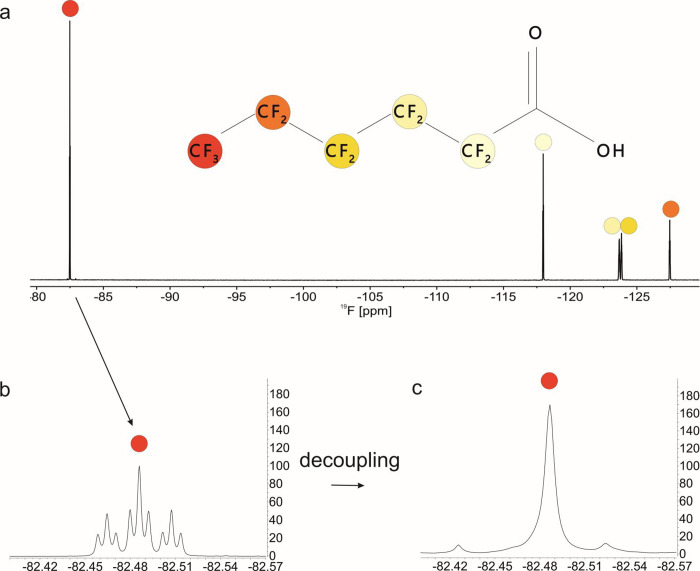 Figure 1
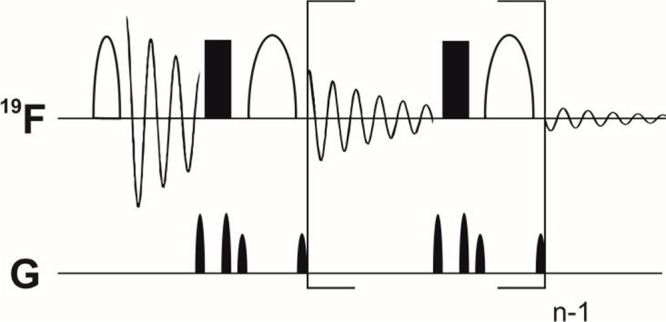 Figure 2
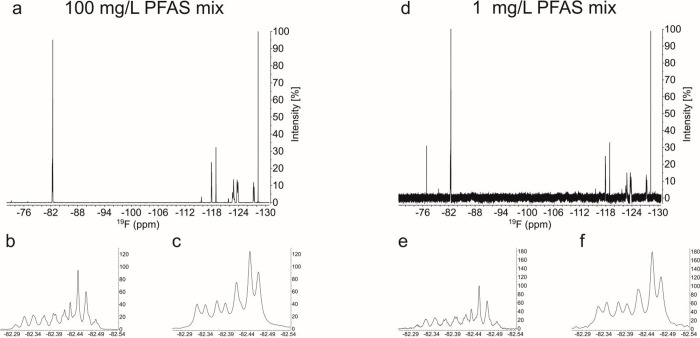 Figure 3
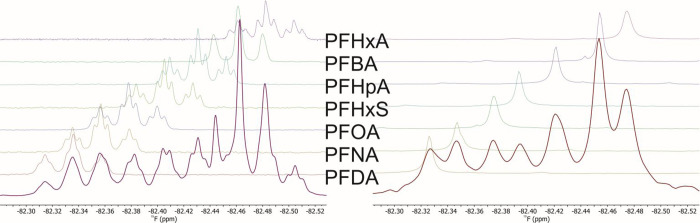 Figure 4
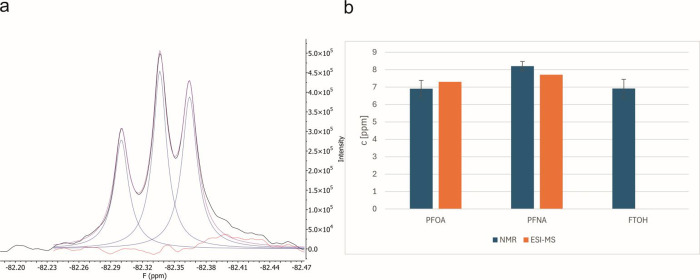 Figure 5
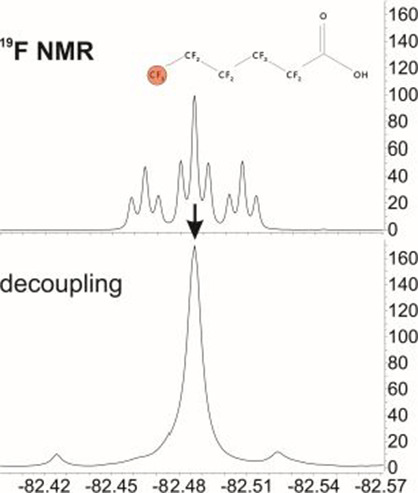 Figure 6
 Figure 7
Peer Reviews
No public reviews on file for this paper yet. If you reviewed it on a platform where reviews are public (OpenReview, ICLR, NeurIPS, ICML), you can paste yours below so the community can read it here.
Videos
No videos yet. Explain this paper in a talk, walkthrough, or lecture? Add one.
Taxonomy
TopicsPer- and polyfluoroalkyl substances research · Fluorine in Organic Chemistry · Molecular Sensors and Ion Detection