Convenient Benzylic Bromination of 2‑Hydroxy-5-methylisophthalaldehyde
Nikita Žoglo, Anton Mastitski, Vladislav Ivanistsev, Nadezda Kongi

TL;DR
A new method for brominating a specific aldehyde compound was developed, offering a practical way to modify similar chemical structures.
Contribution
A previously unreported, scalable bromination method for 2-hydroxy-5-methylisophthalaldehyde was developed.
Findings
Direct Wohl–Ziegler conditions failed for bromination.
Using methyl ether and geminal diacetate groups enabled clean photochemical bromination.
The three-step procedure yielded benzyl bromide at 39% after recrystallization.
Abstract
A convenient and scalable method for the selective benzylic bromination of 2-hydroxy-5-methylisophthalaldehyde was developed, previously unreported in the literature. Direct Wohl–Ziegler conditions failed, suggesting the investigation of various protection strategies. A combination of methyl ether and geminal diacetate protecting groups gave rise to clean photochemical bromination with N-bromosuccinimide in PhCl, affording the benzyl bromide in 39% yield after recrystallization, which can be further functionalized or deprotected. This robust three-step procedure provides a practical pathway for the functionalization of isophthalaldehyde derivatives.
Genes, proteins, chemicals, diseases, species, mutations and cell lines named across the full text — each resolved to its canonical identifier and authoritative record.
Click any figure to enlarge with its caption.
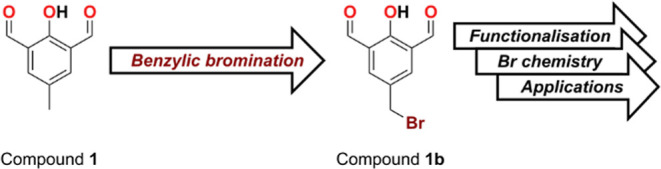 Figure 1
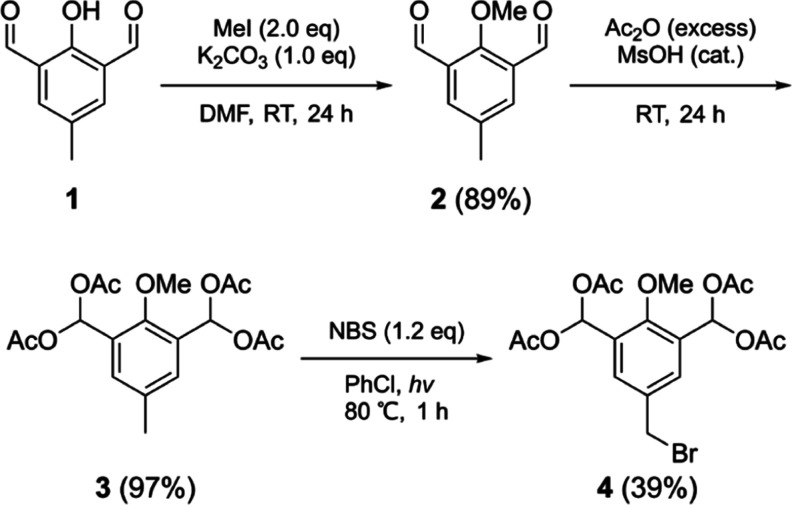 Figure 2
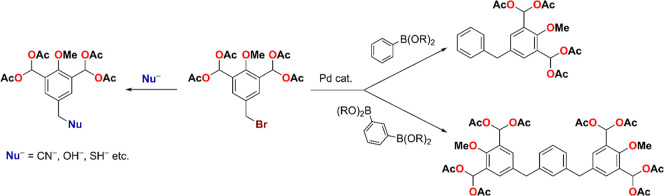 Figure 3
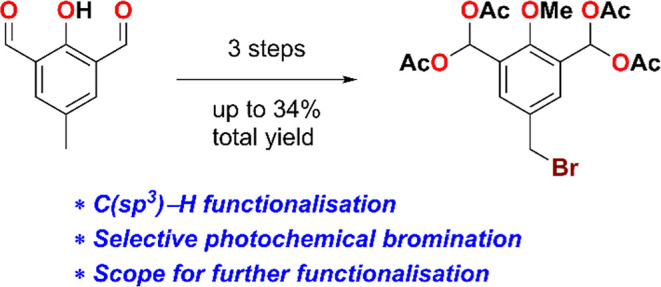 Figure 4
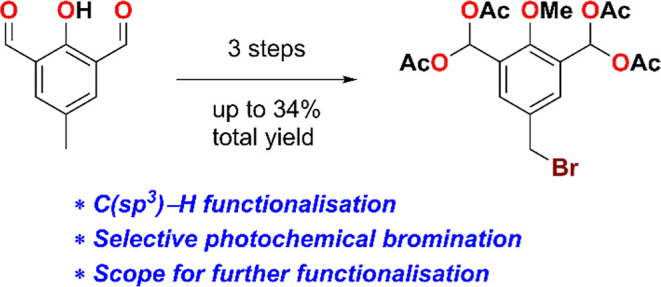 Figure 5
Peer Reviews
No public reviews on file for this paper yet. If you reviewed it on a platform where reviews are public (OpenReview, ICLR, NeurIPS, ICML), you can paste yours below so the community can read it here.
Videos
No videos yet. Explain this paper in a talk, walkthrough, or lecture? Add one.
Taxonomy
TopicsVanadium and Halogenation Chemistry · Coordination Chemistry and Organometallics · Oxidative Organic Chemistry Reactions