Detecting early memory changes in preclinical Alzheimer's disease using TabCAT favorites test: Data from the European Prevention of Alzheimer's Disease (EPAD) cohort
Anna Brugulat‐Serrat, Elena Tsoy, Gonzalo Sánchez‐Benavides, Marta Milà‐Alomà, Leslie S. Gaynor, Oriol Grau‐Rivera, Juan Domingo Gispert, Joel H Kramer, Katherine L Possin

TL;DR
The study shows that a computerized memory test can detect early Alzheimer's changes in people without symptoms.
Contribution
TabCAT Favorites is shown to be a sensitive tool for early detection of Alzheimer's pathology in asymptomatic individuals.
Findings
Poorer TabCAT Favorites performance was associated with increased likelihood of A+T+ status in asymptomatic individuals.
TabCAT Favorites is more sensitive than RBANS-MI for detecting early cognitive changes in Alzheimer's disease.
Low Favorites performance predicted progression to clinical dementia rating > 0 in individuals with A+T+ status.
Abstract
Sensitive memory paradigms may allow the detection of subtle memory changes associated with early Alzheimer's pathology in individuals without established clinical symptomatology. We explored the cross‐sectional association between performance on Tablet‐based Cognitive Assessment Tool (TabCAT) Favorites, a brief computerized memory test, with cerebrospinal fluid AT status (A for amyloid‐β and T for phosphorylated tau) and its discriminative validity in 727 clinically asymptomatic participants from the European Prevention of Alzheimer's Disease (EPAD) Longitudinal Cohort Study. Episodic memory was also evaluated with the Repeatable Battery for the Assessment of Neuropsychological Status Delayed Memory Index (RBANS‐MI). Compared to A‐T‐ individuals, poorer TabCAT Favorites Total Correct (Favorites‐TC) cross‐sectional performance was associated with an increased likelihood of A+T+…
Genes, proteins, chemicals, diseases, species, mutations and cell lines named across the full text — each resolved to its canonical identifier and authoritative record.
Click any figure to enlarge with its caption.
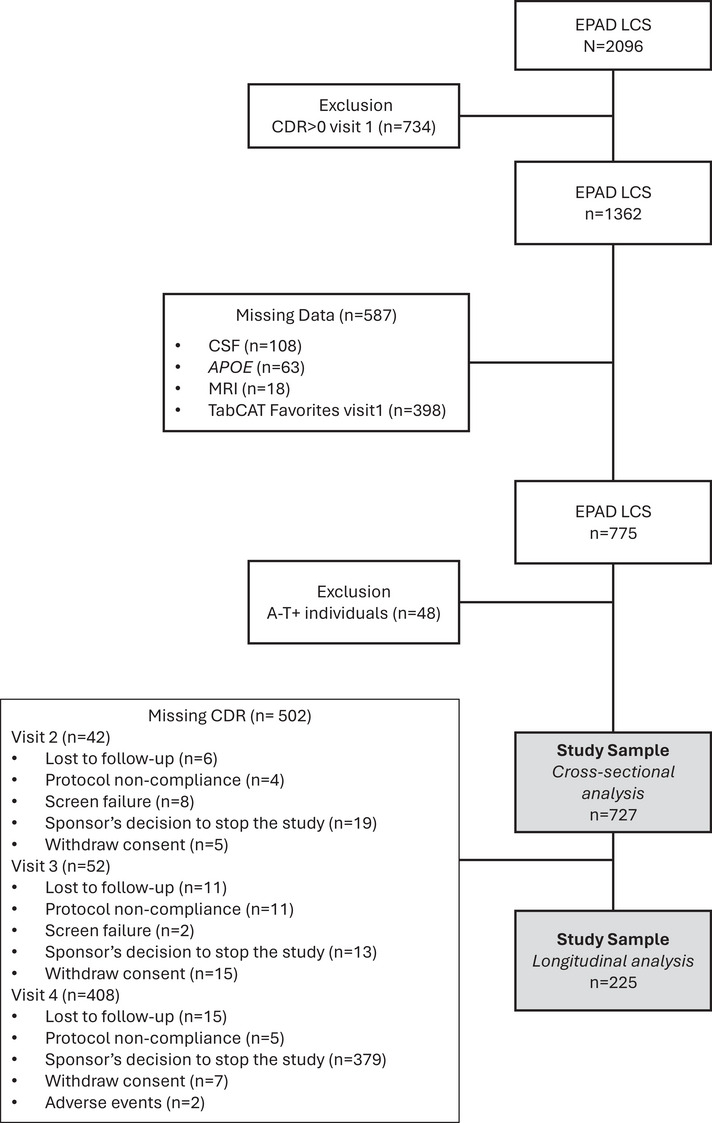 Figure 1
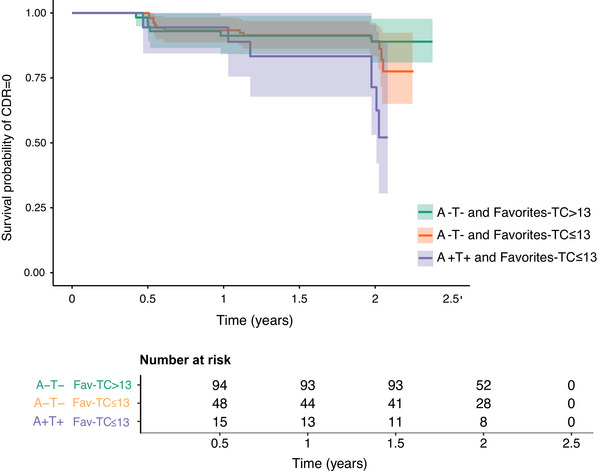 Figure 2
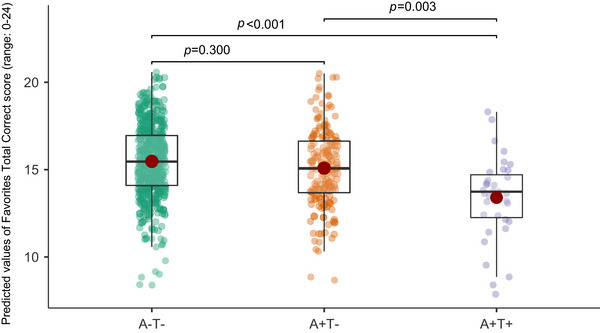 Figure 3
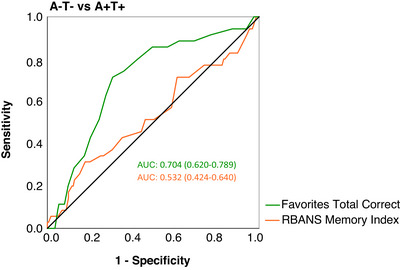 Figure 4
Peer Reviews
No public reviews on file for this paper yet. If you reviewed it on a platform where reviews are public (OpenReview, ICLR, NeurIPS, ICML), you can paste yours below so the community can read it here.
Videos
No videos yet. Explain this paper in a talk, walkthrough, or lecture? Add one.
Taxonomy
TopicsDementia and Cognitive Impairment Research · Alzheimer's disease research and treatments · Cancer-related cognitive impairment studies