Classification of tauopathies from human brain homogenates through salt‐modulated tau amplification
Alessia Santambrogio, Michael A. Metrick, Peifeng Xu, Nicholas C. T. Gallagher, Shunsuke Koga, Bernardino Ghetti, Dennis W. Dickson, Byron Caughey, Michele Vendruscolo

TL;DR
A new method using salt-modulated RT-QuIC classifies eight types of tau-related brain diseases by analyzing tau protein aggregation patterns.
Contribution
A heparin-free, salt-modulated RT-QuIC method that improves classification of tauopathies using fewer substrates and salt modulation.
Findings
The method successfully differentiated eight tauopathies, including Alzheimer's and Pick disease.
Salt modulation and ATR-FTIR confirmed strain-specific conformational differences in tau aggregates.
A decision-tree workflow using fluorescence metrics refined classification of complex 4R tauopathies.
Abstract
Tauopathies are a heterogeneous group of neurodegenerative disorders defined by abnormal aggregation of tau protein. Although cryogenic electron microscopy (cryo‐EM) has uncovered disease‐specific tau structures, translating these insights into diagnostic tools remains difficult. We developed a heparin‐free, salt‐modulated real‐time quaking‐induced conversion (RT‐QuIC) assay using K12 and K11 tau substrates, targeting aggregation‐prone regions. This current method improves on previous methodology by minimising the number of required substrates by modulating reaction salt content in order to differentiate yet‐undistinguished tauopathy strains. Thioflavin T fluorescence kinetics and attenuated total reflectance Fourier transform infrared spectroscopy (ATR‐FTIR) spectroscopy were used to classify tau aggregates from human brain homogenates. This method differentiated eight tauopathies,…
Genes, proteins, chemicals, diseases, species, mutations and cell lines named across the full text — each resolved to its canonical identifier and authoritative record.
Click any figure to enlarge with its caption.
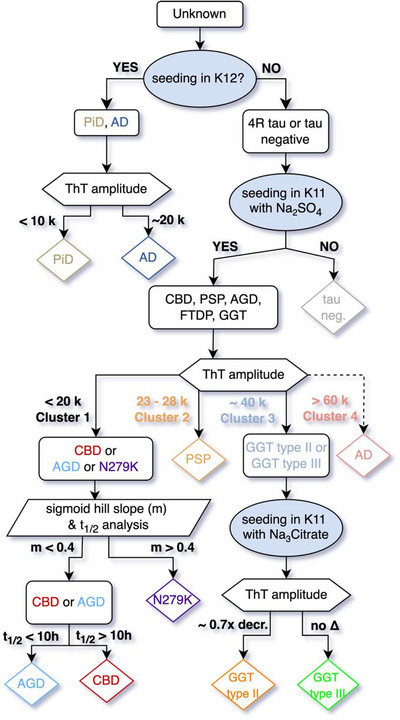 Figure 1
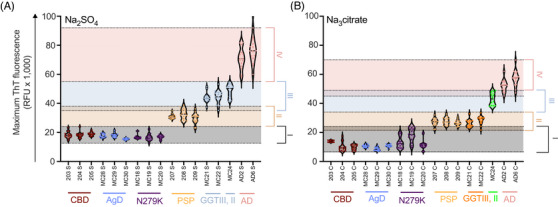 Figure 2
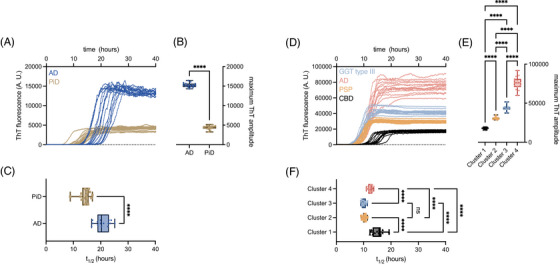 Figure 3
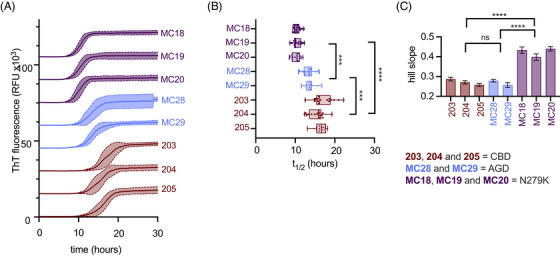 Figure 4
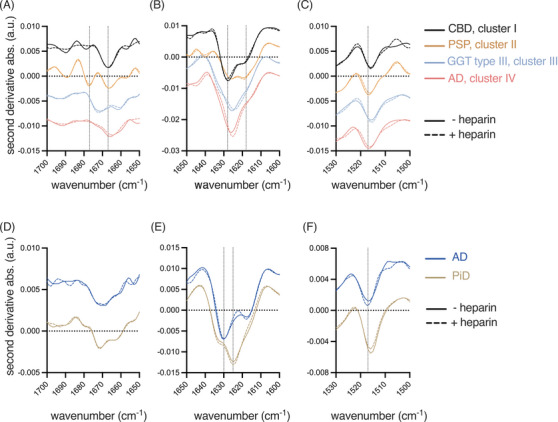 Figure 5
Peer Reviews
No public reviews on file for this paper yet. If you reviewed it on a platform where reviews are public (OpenReview, ICLR, NeurIPS, ICML), you can paste yours below so the community can read it here.
Videos
No videos yet. Explain this paper in a talk, walkthrough, or lecture? Add one.
Taxonomy
TopicsAlzheimer's disease research and treatments · Parkinson's Disease Mechanisms and Treatments · Dementia and Cognitive Impairment Research