Impact of pneumatic tube vs. bicycle courier transport on platelet aggregation: influence of sex and diabetes
Anna Hohneck, Elisabeth Kliemank, Simon Bach, Sebastian Brings, Lukas Seebauer, Mani Roshan, Zoltan Kender, Stefan Kopf, Norbert Frey, Markus Zorn, Stefan M. Woerner, Thomas Fleming, Julia Szendroedi

TL;DR
The study compares how pneumatic tube and bicycle courier transport affect platelet aggregation, finding that transport method and patient characteristics like sex and diabetes influence results.
Contribution
The study provides novel comparative data on platelet aggregation differences between pneumatic tube and bicycle courier transport, highlighting sex and diabetes as modifying factors.
Findings
Bicycle courier transport caused small but significant reductions in platelet aggregation for ADP, arachidonic acid, ristocetin, and collagen agonists compared to pneumatic tube transport.
Female patients and individuals with diabetes showed more pronounced reductions in collagen-induced aggregation, suggesting increased platelet mechanosensitivity in these groups.
Epinephrine-induced aggregation was unaffected by transport mode, and antiplatelet drugs inhibited aggregation for ADP, arachidonic acid, and epinephrine but not for collagen or ristocetin.
Abstract
Pneumatic tube (PT) transport can impact platelet function, often altering platelet aggregation. Consequently, manual transport is frequently recommended to mitigate preanalytical effects on platelet function tests. However, comparative data between PT and bicycle courier (BC) transport remain limited, and it is unclear whether different agonist pathways or specific patient characteristics, such as sex and diabetes, modify transport-related effects. In this study, two S-Monovette® 3.2% citrate syringes of whole blood were collected from 96 participants (43 female participants, 53 male participants; median age: 63 years). Samples were transported simultaneously by PT or BC to the Central Laboratory of University Hospital Heidelberg. Platelet function was assessed through light transmission aggregometry (LTA) using five diagnostically established agonists, including ADP, arachidonic…
Genes, proteins, chemicals, diseases, species, mutations and cell lines named across the full text — each resolved to its canonical identifier and authoritative record.
Click any figure to enlarge with its caption.
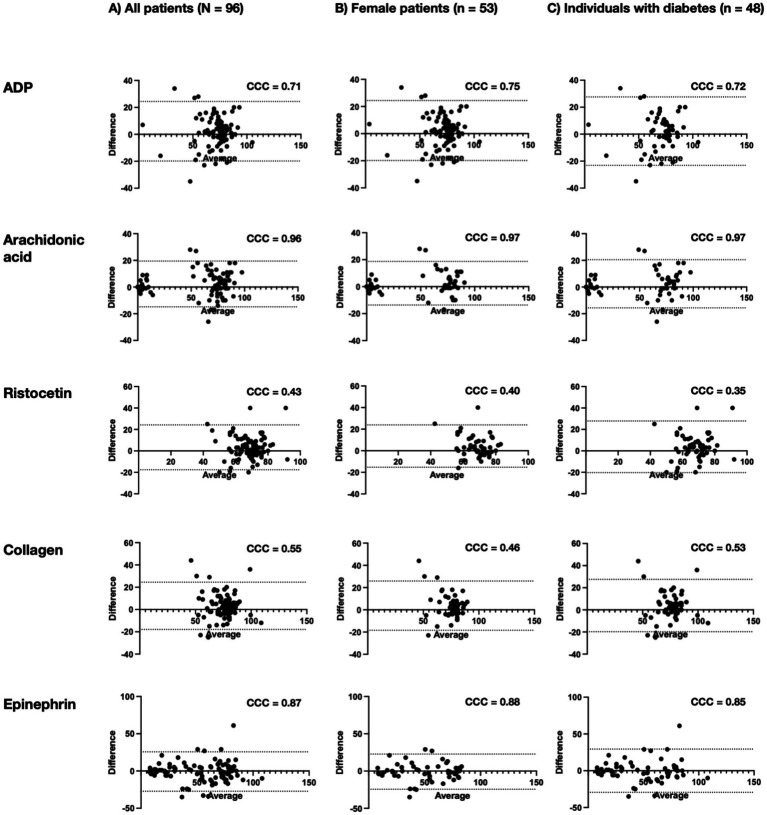 Figure 1
Peer Reviews
No public reviews on file for this paper yet. If you reviewed it on a platform where reviews are public (OpenReview, ICLR, NeurIPS, ICML), you can paste yours below so the community can read it here.
Videos
No videos yet. Explain this paper in a talk, walkthrough, or lecture? Add one.
Taxonomy
TopicsPlatelet Disorders and Treatments · Antiplatelet Therapy and Cardiovascular Diseases · Blood transfusion and management