Networks of exchange: East German kidney transplantation in European context, 1965–1990
Alexa Geisthövel

TL;DR
This paper explores how East Germany participated in international kidney transplant networks during the Cold War, highlighting collaboration across political blocs.
Contribution
It reveals the GDR's role in transnational organ exchange and knowledge sharing in kidney transplantation.
Findings
East Germany engaged in international kidney transplant networks through shared patient databases and cross-border collaborations.
The GDR's participation depended on both intra-bloc and trans-bloc exchanges for successful kidney transplants.
The study shows how socialist countries contributed to and benefited from global transplant practices during the Cold War.
Abstract
When kidney transplantation evolved from an experimental into a clinical treatment of end-stage renal disease (ESRD) in the 1960s, it was conceptualised as a collaborative therapy. Before specific immunosuppressants were introduced in the 1980s, the best chances for patient and graft survival were expected from finding ‘good’ matches between donor and recipient tissues. Therefore, the pioneers of clinical transplantation in Europe started to recombine their growing patient pools. They created trans-border organ exchange organisations such as Eurotransplant and Intertransplant, based on shared patient databases. The article traces international and transnational co-operation in kidney exchange using the example of state-socialist Germany. How did the German Democratic Republic (GDR) get involved with the interconnected networks of knowledge, data, and organ exchange in ESRD treatment?…
Genes, proteins, chemicals, diseases, species, mutations and cell lines named across the full text — each resolved to its canonical identifier and authoritative record.
Click any figure to enlarge with its caption.
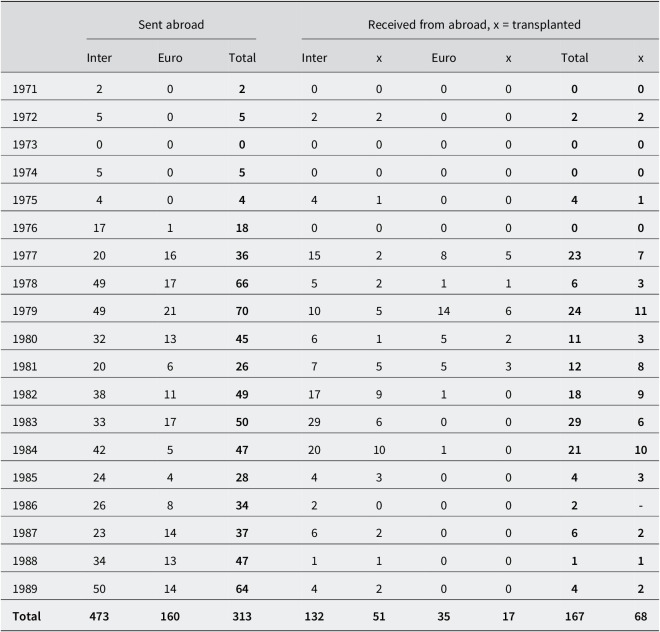 Figure 1
Peer Reviews
No public reviews on file for this paper yet. If you reviewed it on a platform where reviews are public (OpenReview, ICLR, NeurIPS, ICML), you can paste yours below so the community can read it here.
Videos
No videos yet. Explain this paper in a talk, walkthrough, or lecture? Add one.
Taxonomy
TopicsMedical History and Research · European history and politics · Historical Studies on Reproduction, Gender, Health, and Societal Changes